

| IN A NUTSHELL |
|
In the heart of Japan’s Kyushu Island lies the Aso Caldera, a geological marvel with a history as explosive as it is intriguing. This vast caldera, recognized as one of Earth’s nine supervolcanoes, spans 15 miles and is home to 17 active volcanoes. Its formation resulted from cataclysmic eruptions over 200,000 years, shaping both the landscape and the lives of the inhabitants. While it offers breathtaking views and fertile lands, the Aso Caldera remains a potential threat, as its volcanic activity is closely monitored by scientists worldwide. Understanding this supervolcano’s past and potential future is crucial for managing its risks.
The Geology of Aso Caldera: A Supervolcano in Japan’s Heart
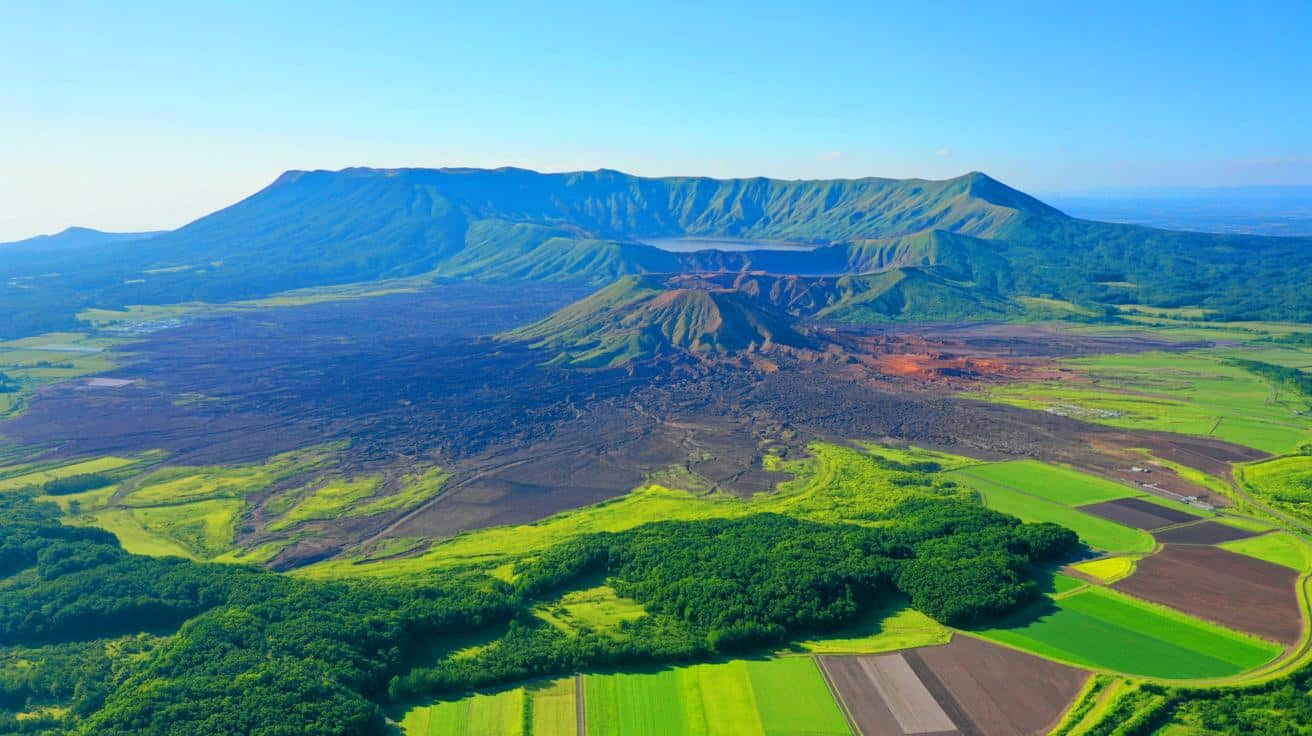
The Aso Caldera dominates the landscape of Kyushu Island, stretching 15 miles across. Its creation was marked by four significant pyroclastic eruptions between 300,000 and 90,000 years ago. These eruptions were so powerful that they reshaped the local geography and dispersed volcanic ash as far north as Hokkaido, nearly 900 miles away. The caldera’s vastness is accentuated by a surrounding ridge that reaches up to 4,000 feet, enclosing a unique ecological landscape.
Within the caldera’s boundaries, volcanic soil supports both urbanization and agriculture. The eruptions have left behind extensive volcanic rock deposits, enriching the soil and enabling diverse ecosystems to thrive. The Aso Caldera’s geological features make it a subject of intense study, as its history of eruptions places it among the most dangerous volcanic systems globally. The ongoing volcanic activity continues to shape the land and influence the lives of the local population.
Inside Aso Caldera: The Active Volcanoes and Their Eruptive Potential
At the heart of the Aso Caldera, 17 volcanoes stand as a testament to the region’s dynamic volcanic activity. The most prominent among them are the five peaks known as Aso Gogaku, including Takadake, Nekodake, Nakadake, Kishimadake, and Eboshidake. Nakadake, in particular, is noted for its frequent eruptions, with the last significant activity recorded in October 2021. This makes it one of Japan’s most active volcanoes and a focal point for geological monitoring.
The underlying magma chamber, located about 4 miles beneath the surface, fuels the volcanic activity at Nakadake and its neighboring peaks. While some cones like Kishimadake and Eboshidake have been dormant for millennia, their proximity to the central system means they could still pose a threat. Understanding the interactions within this complex network of volcanoes is vital for predicting future eruptions and safeguarding the surrounding communities.
Volcanic Explosivity and the Future of Aso Caldera
Aso’s eruptive history offers insights into the catastrophic potential of supervolcanoes. The largest known eruption, approximately 90,000 years ago, reached a level 8 on the Volcanic Explosivity Index, the highest on the scale. This event led to widespread ashfall across Japan, leaving deposits that influenced the region’s climate and ecosystems. While such eruptions are infrequent, their impact can be profound, affecting global weather patterns and local environments.
Currently, the likelihood of another supereruption at Aso is considered low. However, scientists remain vigilant, studying the deep magma chamber and the volcanic activity it fuels. Continuous research aims to improve understanding of the supervolcano’s behavior, enhancing predictive models and risk mitigation strategies. The possibility of future eruptions, while uncertain, underscores the importance of ongoing monitoring and scientific inquiry.
Aso Caldera’s Natural Beauty: Lakes, Hot Springs, and Agricultural Landscape
The interior of Aso Caldera is a testament to nature’s resilience and beauty. Once home to three ancient lakes, the caldera floor now supports a rich tapestry of agricultural fields, towns, and natural wonders. The fertile volcanic soil fosters diverse crops and sustains local communities, while the landscape offers a striking contrast between human habitation and natural splendor.
Beyond agriculture, the region is renowned for its hot springs, such as Jigoku, which means “hell” in Japanese. These geothermal features are a direct result of the volcanic activity below, drawing tourists who seek to experience the caldera’s unique geology. The balance between Aso’s idyllic appearance and its underlying volcanic power continues to captivate scientists and visitors alike, making it a significant site for both research and tourism.
The Aso Caldera is more than just a geological spectacle; it is a living laboratory for understanding supervolcanoes and their impact on our planet. Its complex interaction with tectonic plates and continuous volcanic activity provide valuable insights into Earth’s dynamic processes. As scientists strive to unravel the mysteries of Aso, they also seek to answer a critical question: How can we better predict and prepare for the potential risks posed by such powerful natural phenomena?



Wow, 17 active volcanoes in one place! Is it safe to live in the Aso Caldera? 🤔
Wow, a supervolcano right in Japan! Should we be worried? 😳
Thanks for the article! Fascinating and terrifying at the same time.
Great article! It’s fascinating to learn about the geological history of the Aso Caldera. Thank you!
Is it safe for tourists to visit the caldera with so many active volcanoes?
Great, just what we need – another thing to worry about! 😅
Are there any evacuation plans in place for the local communities in case of an eruption?
How often do scientists expect eruptions to occur in the Aso Caldera?
Why is it that Japan seems to have so many natural hazards?
I’m skeptical about these “supervolcano” scares. How likely is it that Aso will erupt in our lifetime?
Any idea how the locals feel about living near such a volatile area?
Is there any chance that the caldera could become even more active soon?
This is why I prefer staying far away from any volcanoes, thank you very much. 😬
What’s the history of evacuation plans for the area? Must be quite detailed!
Hope the hot springs don’t boil over if things get too heated! 😜
Are there any historical records of how past eruptions affected the local climate?
It’s amazing how fertile volcanic soil can be despite the danger it poses.
How does Aso compare to other supervolcanoes like Yellowstone?
With 17 active volcanoes, it sounds like a ticking time bomb! ⏰
Is it just me, or does the risk make the region even more intriguing to visit?
Thank you for the in-depth explanation. The geology of this area is truly remarkable.
I wonder how the local wildlife adapts to the volcanic environment. 🐦
Is Nakadake the only volcano actively erupting right now?
How do scientists predict volcanic eruptions in such a complex system?
Does the caldera have any unique species found nowhere else in the world?
Supervolcanoes are scary but also show us the power of nature. 🌍
What’s the worst-case scenario if the caldera were to erupt today?
Great article, but now I’m terrified to ever visit Japan! 😂
How does Aso’s volcanic activity impact global weather patterns?
Do the locals have traditional stories or myths about the volcanoes?
Can you feel the ground shake when you’re near the caldera?
I’d love to see the hot springs, but not if they’re about to start boiling! 😅
Does the caldera’s activity have any impact on the surrounding ocean?
Is there any evidence of past civilizations affected by eruptions here?
So, if Nakadake is the most active, what makes the other volcanoes in the caldera dangerous?
How does the caldera’s size compare to other supervolcanoes worldwide?
Does the volcanic soil affect the flavor of crops grown there?
Thanks for the info! It’s amazing how much we can learn from these geological formations.
Do the frequent eruptions impact air travel in the region?
Wow, 15 miles wide! That’s massive! 😮
Hope the monitoring systems are robust enough to give an early warning!
Can’t believe a supervolcano could potentially wipe out Japan! 😱
Can you imagine the size of the explosion if it goes off again? Mind-blowing! 💥