




| IN A NUTSHELL |
|
In the realm of geomagnetic phenomena, the South Atlantic Anomaly (SAA) has emerged as a focal point for scientific inquiry due to its significant impact on space technologies. Situated over South America and the South Atlantic Ocean, this vast region of weakened magnetic field has implications for satellites and other spacecraft. As NASA delves deeper into understanding this anomaly, researchers are increasingly concerned about its dynamic nature and potential risks. The SAA’s evolution not only challenges our technological safeguards but also offers insights into the complex mechanisms of Earth’s magnetic field.
Deep Origins and Complex Mechanisms
The South Atlantic Anomaly is a geomagnetic oddity that has captured the attention of scientists due to its peculiar characteristics. Defined by a stark reduction in magnetic intensity, the SAA allows high-energy solar particles to penetrate closer to Earth’s surface. This phenomenon is not merely a surface-level occurrence but is rooted deep within the planet. The geodynamo, a process within Earth’s outer core where molten iron and nickel move, generates the magnetic field. However, this generation is uneven, influenced by various factors.
One significant contributor to the SAA is the tilt of Earth’s magnetic axis relative to its rotational axis. Additionally, the African Large Low Shear Velocity Province, a dense structure 1,800 miles beneath Africa, disrupts magnetic field generation in this region. NASA geophysicists have linked the anomaly to a local polarity reversal, further weakening the dipole field intensity. Weijia Kuang from NASA describes this reversal as a “pothole” in Earth’s magnetic armor, adding to the anomaly’s complexity.
A Threat to Space Technology
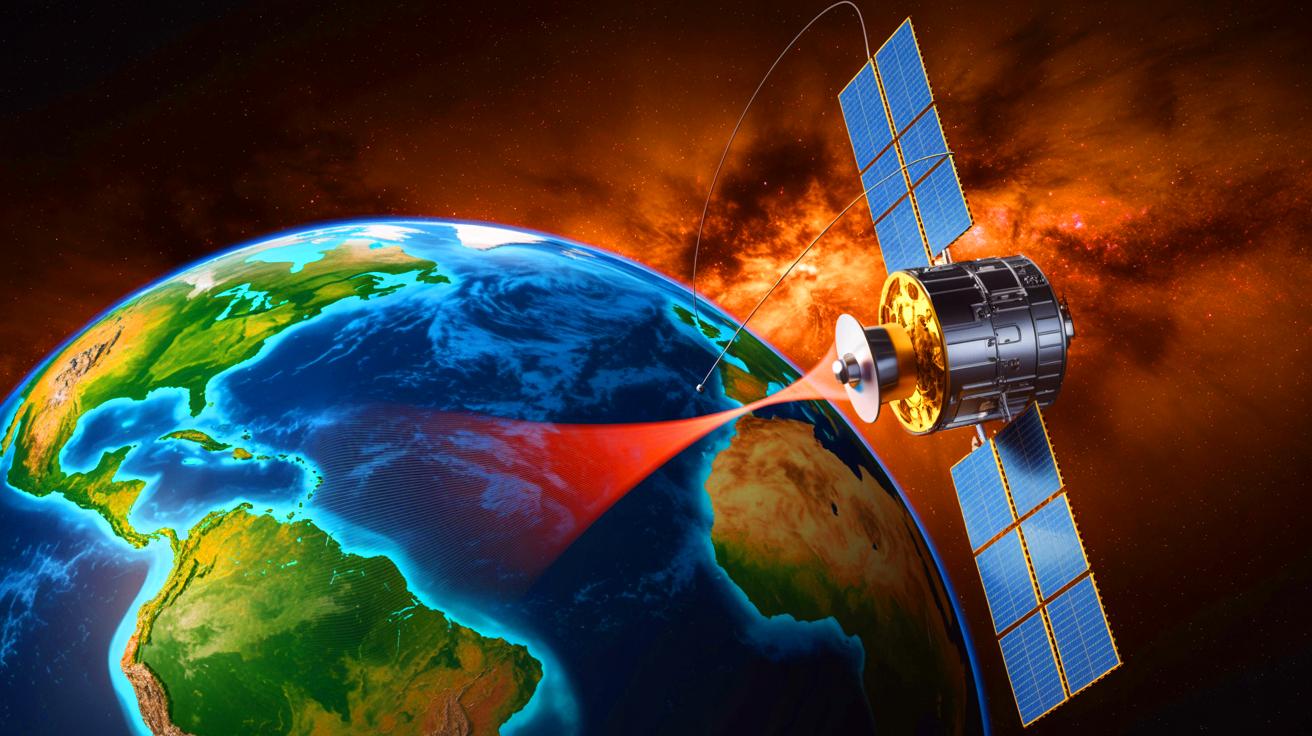
The implications of the South Atlantic Anomaly extend beyond theoretical discussions, posing tangible threats to space technology. Satellites traversing this region encounter high-energy protons that can induce single event upsets (SEUs). These SEUs can lead to temporary malfunctions, data corruption, or even permanent damage to critical systems. As a precaution, satellite operators often shut down non-essential systems when passing through the anomaly.
The International Space Station (ISS) regularly crosses the SAA, and while astronauts are shielded, external instruments face increased exposure. Bryan Blair, from the GEDI instrument team on the ISS, reports experiencing occasional “glitches” and resets, resulting in limited data loss each month. Other missions, such as the Ionospheric Connection Explorer (ICON), also monitor the SAA, adjusting operations as necessary. Recent data indicate the anomaly is drifting northwest, expanding, and splitting into two lobes, complicating predictive modeling and increasing spacecraft hazards.
Anticipating the Invisible
NASA’s approach to understanding the South Atlantic Anomaly involves a blend of satellite data and core simulations. These inputs fuel global models, like the International Geomagnetic Reference Field (IGRF), that track Earth’s magnetic field evolution. Such models are crucial for planning space missions and enhancing our understanding of Earth’s internal structure, akin to long-term weather forecasting.
While the current SAA evolution is unprecedented in the modern space era, historical records suggest that similar anomalies may have occurred millions of years ago. Importantly, scientists emphasize that the SAA is not a precursor to a magnetic pole reversal, a rare event occurring over extensive timescales. Continued study of the SAA is essential for protecting space technologies and understanding the forces shaping our planet.
The Future of Earth’s Magnetic Dynamics
As the South Atlantic Anomaly continues to evolve, the scientific community remains focused on understanding and mitigating its impact. The anomaly’s potential to disrupt satellite operations and its role in advancing our knowledge of Earth’s magnetic field present intriguing challenges. These challenges drive ongoing research and technological adaptations. The anomaly offers a unique opportunity to explore the interplay between Earth’s core dynamics and surface phenomena.
With the SAA’s ongoing evolution, questions abound about the future of Earth’s magnetic dynamics. Scientists are keen to determine how these changes will influence both technological innovation and scientific exploration in the coming years. How will the South Atlantic Anomaly shape our understanding of Earth’s magnetic field and its implications for space exploration?




Wow, this is like something out of a sci-fi movie! Should we be worried about our GPS going haywire? 🤔
Is this anomaly a sign of a future magnetic pole reversal? 🧲
Wow, this is like the Bermuda Triangle for satellites! 🚀
Thanks NASA for keeping an eye on these anomalies. The universe is full of surprises!
How does this affect GPS systems? 🤔
Does this mean we should expect more satellite failures in the future? 😬
Thanks for the detailed explanation. This article really opened my eyes! 😊
How long has NASA been studying the SAA?
Why is the South Atlantic Anomaly splitting into two zones? Is this a sign of something bigger?
Is there any danger to people living in these regions?
I wonder if this anomaly affects animals that rely on Earth’s magnetic field for navigation. 🐦
Seems like we have a cosmic pothole above us! 🌌
Great article! But what can be done to protect satellites? 🛰️
Great article! I didn’t even know about the South Atlantic Anomaly until now. Thanks for the info!
Is this why my phone’s GPS is always off when I’m in South America? 😂