



| IN A NUTSHELL |
|
Scientists have made a groundbreaking discovery beneath the western Pacific seafloor. A massive hydrogen-rich hydrothermal system, known as the Kunlun system, has been explored using the crewed submersible Fendouzhe. This discovery offers new insights into deep-sea serpentinization, a process where iron- and magnesium-rich rocks react with water to form serpentine minerals and release hydrogen. Researchers from the Institute of Oceanology of the Chinese Academy of Sciences (IOCAS) have revealed that this system is critical for understanding Earth’s internal processes and the conditions that may have fostered life’s origins.
Unveiling the Vast Kunlun Hydrothermal Field
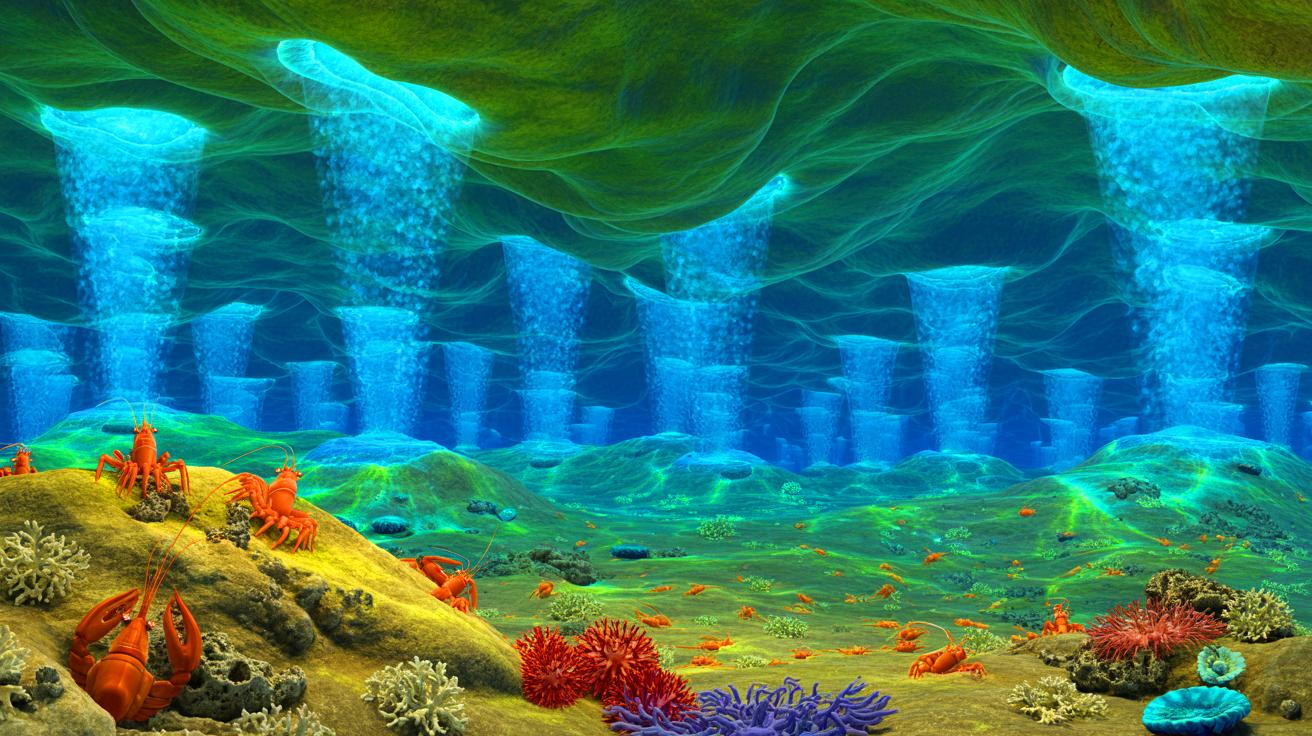
The Kunlun hydrothermal field is a tectonically active site located approximately 50 miles west of the Mussau Trench on the Caroline Plate. This site comprises 20 large seafloor depressions, some exceeding half a mile in diameter, clustered together like a pipe swarm. These are groups of vertical or steeply inclined cylindrical rock structures that funnel liquid or gas from the Earth’s interior.
Covering an area of 4.3 square miles, the Kunlun system is over a hundred times larger than the Lost City, a unique deep-sea hydrothermal field on the Atlantis Massif, part of the Mid-Atlantic Ridge. According to Prof. SUN Weidong, the study’s corresponding author, “The Kunlun system stands out for its exceptionally high hydrogen flux, scale, and unique geological setting.” This discovery challenges long-held assumptions about serpentinization-driven hydrogen generation, demonstrating that it can occur far from mid-ocean ridges.
Exploration of Larger Craters
The study, published in Science Advances, reveals that four of the larger craters were explored using the human-occupied vehicle Fendouzhe. These craters have steep walls similar to those of kimberlite pipes, reaching depths of up to 430 feet. Ecosystems have been observed in smaller pits at the bottom of these pipes. Using in situ Raman spectra, hydrogen concentrations of approximately 5.9 to 6.8 millimoles per kilogram in hydrothermal fluids have been measured.
Mapping the discharge area and analyzing flow velocity, researchers estimate the Kunlun field’s annual hydrogen flux at 4.8 × 10¹¹ moles per year, accounting for at least 5% of the global abiotic hydrogen output from all submarine sources. Geological features such as steep-walled craters, explosive breccia deposits, and layered carbonate structures suggest a staged evolution of the hydrothermal activity, beginning with gas-driven eruptions followed by prolonged hydrothermal circulation and mineral deposition.
Ecological Potential and Scientific Implications
“What’s particularly intriguing is its ecological potential,” Prof. SUN remarked. The team observed diverse deep-sea life thriving in the Kunlun system, including shrimp, squat lobsters, anemones, and tubeworms. These species may depend on hydrogen-fueled chemosynthesis, providing a natural laboratory for studying the links between hydrogen emissions and the emergence of primitive life.
Alkaline, hydrogen-rich fluids like those at Kunlun are thought to mirror the chemical environment of early Earth, offering scientists a unique opportunity to study conditions that may have been present during the origins of life. The discovery not only enhances our understanding of deep-sea hydrogen processes but also opens new avenues for identifying untapped submarine hydrogen resources.
Challenges and Future Prospects
Despite the promising insights gained from the Kunlun system, challenges remain. The vastness of the underwater landscape presents logistical hurdles for further exploration and study. Additionally, understanding the full scope of the ecological interactions and geological processes at play requires ongoing research and data collection.
The potential for harnessing hydrogen as an energy source adds another layer of complexity, blending scientific inquiry with the practical considerations of resource management. As scientists continue to explore this remarkable hydrothermal system, questions about its broader implications for energy production and environmental stewardship emerge. How will this discovery shape our approach to sustainable resource utilization in the future?
As the scientific community delves deeper into the mysteries of the Kunlun hydrothermal system, the possibilities seem endless. The discovery not only expands our knowledge of Earth’s geological and biological processes but also prompts us to consider the broader implications for energy, ecology, and the origins of life. What future breakthroughs might the depths of the ocean still hold?