




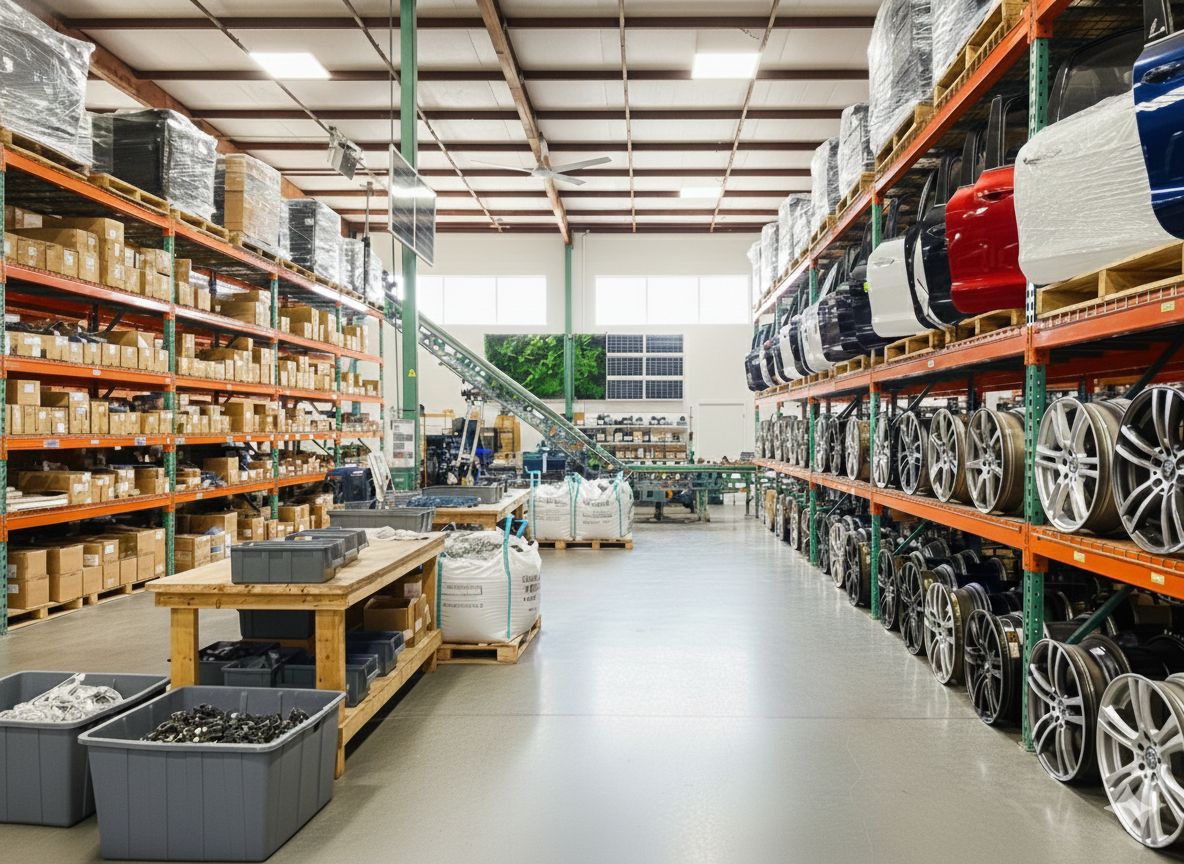
Cars used to end their lives in scrapyards, where they were crushed for metal. Nowadays, that picture is changing. With rising concerns about resource scarcity, climate change, and sustainability, the global automotive industry, which is responsible for approximately 10 % of global manufacturing emissions, is being forced to rethink what happens when a vehicle reaches the end of its life.
Increasingly, the end of one car’s life marks the beginning of a more circular economy. This global change has inspired a new generation of companies that treat sustainability as the foundation of their business. One company operates far from Detroit’s industrial skyline or Silicon Valley’s tech campuses. In the coastal city of Oceanside, California, Straight Six Auto Parts (SSAP)
Each year, over 25 million tons of material are recovered from end‑of‑life vehicles worldwide. However, massive inefficiencies persist. Millions of usable components are still being wasted due to poor management and inconsistent tracking systems. As regulations tighten in the EU and U.S., pressure mounts on dismantlers to improve traceability, driving record demand for sustainable, well‑organised vehicle recycling.
Simultaneously, culture is changing. The rise of online automotive influencers and enthusiasts has created a global market for authentic, pre‑owned parts. These communities, with online audiences in the millions, celebrate restoration and reuse rather than replacement. It’s a sign of changing values, craftsmanship over convenience, repair over disposability. In this growing landscape, companies like SSAP are rewriting the rules. It represents a new archetype, not a traditional junkyard, but a data-driven ecosystem that transforms what once was waste into a carefully managed stream of reusable assets. It prioritises compliance with local and international standards of environmental safety and consumer transparency.
A Business Built on Precision
SSAP launched in 2020 with just four employees and a single rented workspace. Within a few years, that small team expanded to 18 members working across three neighbouring warehouses, each a hub of movement, discipline, and analytics.
At the centre of this transformation is Operations Manager Sergei Drozhzhin, who combines the analytical mindset of a data scientist with the conscience of an environmentalist. He believes fair, stable employment strengthens sustainability by helping employees work accurately, decide wisely, and uphold the company’s reputation.
Nevertheless, beyond efficiency lies a subtler result: sustainability at scale. Through their rigorous tracking and analysis, SSAP has reduced excess inventory by roughly 25% and improved order processing efficiency by nearly 50%. These achievements don’t merely boost profit margins; they lessen energy consumption, minimise waste, and extend the usable life of each vehicle’s material legacy. Behind the statistics is a broader message: that efficiency, sustainability, and social responsibility can co-exist. In fact, they depend on each other. In the busy warehouses of Oceanside, that idea is not theory; it’s daily practice.
Sustainability at Work
For SSAP, sustainability isn’t a tagline; it’s the very logic of how the company works. Each day begins with the same set of questions: What materials can be recycled? How can energy use drop a little further today? Where can processes become cleaner, faster, and more efficient?
To address these, the company developed an operational model that directly supports the planet’s accuracy. Inside its facilities, every dismantled vehicle component follows a documented lifecycle. Fluids are safely extracted and recycled through certified partners; reusable metals and plastics are sorted with minimal contamination; and components that reach end‑of‑life are processed using eco‑friendly disposal methods. This technique achieves three outcomes.
First of all, reduce waste. From 1,500 dismantled vehicles, more than 100,000 parts have been reintroduced into circulation, significantly extending product lifespans. Secondly, optimised resource use.
Consequently, efficiency and responsibility are not separate pursuits; they’re the same objective, measured in different ways. By uniting economics with ethics, the company has turned integrity into a competitive strength. So, customers return not only for quality parts but for trust in its environmental conscience.
Scale, Reputation, and Market Leadership
At present, SSAP occupies a leading position in the U.S. premium auto‑recycling market. Its modern three‑warehouse complex functions as a regional benchmark for efficiency and compliance, supported by data systems that track every component from acquisition to sale.
The company’s client base spans continents, supplying authorized BMW, Mercedes, and Audi dealerships to YouTube creators like Throtl and TJ Hunt, as well as emerging innovator Revolt Systems. This mix reflects how the industry is evolving, where recycling, once seen as anti‑performance, now represents both cost‑efficiency and craftsmanship, proving that reused components can showcase technical expertise and environmental responsibility.
On customer review platforms, SSAP gained an extraordinary 99.9 % positive rating on eBay and other platforms. In a business often criticised for poor transparency, every part SSAP sells is documented, traced, and verified, so buyers know exactly where it came from and how well it performs. That level of clarity has turned importance into the company’s strongest form of currency.
In a social sense, SSAP’s consequence reaches beyond commerce. By providing stable, skilled jobs often seen as purely manual, it redefines modern manufacturing. Its employees combine craftsmanship with data-driven precision, proving that sustainability and skill can advance together. In this way, SSAP echoes a broader shift toward valuing repair, reuse, and the expertise that makes both feasible.
Purpose in Motion, Resilience by Design
SSAP’s deliberate growth reflects a clear principle: progress must also preserve resources. Its distributed‑warehouse network, modelled on global logistics systems, eliminates duplicate transport routes and minimises its carbon footprint without slowing delivery.
This sustainability‑first thinking was stress‑tested during the pandemic, when supply‑chain disruptions threatened the sector. Instead of cutting back, SSAP specialised further, developing stronger analytics, refining financial models, and deepening collaboration between departments. The result was twice the profitability per dismantled vehicle and a leaner, more resilient operation. In Sergei’s words, “Crises were moments to express gratitude later because they forced the abandonment of inefficiency.”
In Oceanside, the company has become a major contributor to the local clean-industry economy, creating well-paid technical jobs and continuous education programs that merge craftsmanship with environmental literacy.
The Quiet Green Revolution
Quantitatively, every repurposed car part carries an embodied environmental story. For example, manufacturing a new aluminium engine block requires around 1,500 kWh of energy, while restoring one uses less than a tenth. By returning over 100,000 premium components to circulation, SSAP has prevented thousands of tons of raw material extraction and associated emissions. This unglamorous, arithmetic form of sustainability rarely makes the headlines, but delivers cumulative monumental results, practical environmental stewardship achieved not by reinventing wheels, but by giving existing ones another spin.
Furthermore, there’s a cultural effect at play. The company’s practices subtly educate the consumer base. SSAP’s impact extends beyond business, shaping culture by educating consumers. Each reused mirror or salvaged transmission becomes a small vote for the circular economy. On this point, its impact reaches a global network of repairers and enthusiasts who see used as responsible, not inferior. SSAP proves sustainability need not be radical to transform; it thrives in the simple act of taking things apart carefully enough for them to live again.
In parallel, Sergei and his team are exploring artificial intelligence-based analytics to predict market cycles and optimise dismantling schedules without increasing waste. These systems will help the company adjust dynamically to both supply fluctuations and environmental regulations, sharpening its commitment to a greener future.
All in all, SSAP represents a tangible response to a broader global imperative: how to consume less, repair more, and waste nothing. The journey, from a modest warehouse to an example of ethical efficiency, illustrates how profitability and sustainability are no longer opposites, but allies bound by measurement and integrity.
