



IN A NUTSHELL
As the world urban population swells, cities confront a stark choice: continue expanding in ways that deepen inequality and environmental harm, or pivot toward designs that prioritize planet and people. Urban policymakers increasingly argue for investment in sustainable urban infrastructure — from green infrastructure such as parks, green roofs and wetlands that cool streets, cleanse air and manage stormwater, to low‑carbon mobility networks that reduce emissions and widen access. Equally urgent is inclusive planning: zoning that secures mixed‑income housing, community land trusts and participatory budgeting that redistribute power and stabilize neighbourhoods. Building resilient cities requires integrating climate adaptation, diversified local economies and social cohesion so communities can withstand shocks. Cities that have pursued integrated strategies — through ambitious carbon plans, landmark public gardens and comprehensive water management — offer pragmatic templates. The debate now centers on scaling those pilots into systemic policy, mobilizing finance and reframing growth as an opportunity to reconcile development with ecological limits and social justice.
Sustainable urban infrastructure
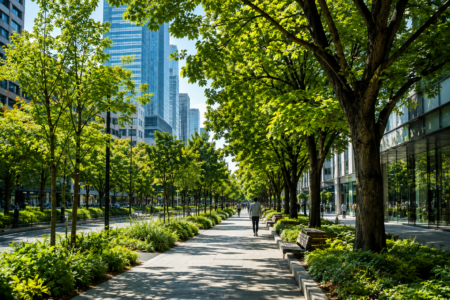
Urban infrastructure must be reframed not as a fixed set of pipes and pavements, but as a living system that reduces emissions, manages water, and creates health benefits. Green infrastructure—parks, green roofs, urban wetlands, and street trees—delivers measurable cooling, air purification, and biodiversity gains while also performing essential services like stormwater management. Cities that treat these elements as core infrastructure rather than optional amenities achieve both environmental and social returns.
Implementing green infrastructure at scale is an efficient climate adaptation choice and a public health investment. The evidence is clear: shading and evapotranspiration reduce urban heat island effects, vegetated corridors remove pollutants, and permeable green spaces lower flood risk. These are not nice-to-have projects; they are cost-effective substitutes for more expensive gray infrastructure when planned strategically and maintained over time.
Critically, sustainable infrastructure must integrate energy transitions. Renewables paired with distributed storage and smart grids change the calculus for new developments; see discussions on the broader renewable energy transition. Experimental technologies—ranging from tiny bioenergy devices to grid-level renewables—are reshaping possibilities for decentralized generation and resilience, as covered in reporting on how innovative tech is converting biological phenomena into energy sources (example).
Policy choices determine whether green infrastructure scales equitably or becomes a premium amenity. Cities must embed nature-based solutions in zoning, procurement, and maintenance budgets, and ensure access across neighborhoods. Integrated planning also must connect transport corridors, housing, and energy systems so green infrastructure reinforces broader sustainability goals rather than remaining fragmented.
| Project | City | Key interventions | Outcomes |
|---|---|---|---|
| Gardens by the Bay | Singapore | Large-scale parkland, integrated water features, conservatories | Improved urban biodiversity and cooling; demonstration of multifunctional public space |
| Carbon neutrality plan | Copenhagen | Wind and biomass investments, district heating | Progress toward city-scale emissions reduction and energy security |
| Greenest City Action Plan | Vancouver | Green roofs, renewable energy targets, urban forestry | Higher green cover and policy frameworks for low-carbon urbanism |
For a strategic review of how urban development must evolve, see work synthesizing future directions at Number Analytics and rigorous literature syntheses such as the systematic review on urban planning and sustainable development (researchgate).
Inclusive urban planning
Equity must be the organizing principle of urban design if cities are to be socially stable and economically productive. Inclusive zoning, community land trusts, and participatory budgeting are not merely progressive ideals; they are practical tools that preserve affordability and prevent displacement. When codes require a mix of housing types and integrate community benefits into development approvals, the benefits are distributed rather than concentrated.
Inclusive planning reduces segregation and unlocks broader economic opportunity. Requiring developer contributions to affordable housing, supporting community land trusts (CLTs), and investing in neighborhood amenities create both social cohesion and economic resilience. CLTs, in particular, secure land for long-term community benefit, enabling stable rents and community-led development decisions.
Public processes matter. Genuine community engagement avoids token consultations and empowers residents to shape priorities through mechanisms like participatory budgeting. Such approaches build trust, allocate resources to locally determined priorities, and increase civic buy-in for difficult trade-offs. Evidence from participatory experiments, including Porto Alegre and other documented cases, shows durable improvements in public service targeting and local accountability.
Policy design must combine regulatory levers, financial tools, and community capacity-building. Zoning reforms should be paired with subsidy programs and technical assistance for local organizations managing CLTs. International policy dialogues, such as OECD work on sustainable urban development, emphasize the need for integrated frameworks that align housing, transport, and climate goals.
Failing to prioritize inclusiveness turns green investments into drivers of inequality—what researchers call the “just green enough” dilemma. Sustainable futures require that public investments and regulations explicitly counteract the displacement pressures that can accompany improvements in urban amenity and environmental quality.
Resilient cities and climate adaptation
Resilience is not merely resistance to shocks but the capacity to adapt and reconfigure after disruption. Cities face intertwined climate, economic, and social risks that demand cross-cutting strategies: flood defenses, diversified local economies, and strengthened social networks. Adaptation must be spatially targeted and socially informed, with investments prioritized where vulnerabilities are highest.
Risk assessment is a political as well as technical exercise. Identifying vulnerabilities requires granular data, community input, and scenario planning; implementing responses requires governance arrangements that can deploy resources quickly and equitably. Rotterdam’s climate adaptation program illustrates how engineered solutions coupled with urban design and public engagement can reduce flood risk while creating recreational and economic value.
Economic resilience strategies include support for local enterprises, diversification of employment sectors, and shock-absorbing social programs. Social resilience depends on strengthening community institutions and fostering networks that can mobilize in crises. Policies that invest in education, public transport, and health systems increase baseline capacity to absorb shocks.
Adaptation must be anticipatory: investing now saves far greater costs later. Evidence from cities like Medellín—where transport and social infrastructure investments reduced violence and expanded opportunity—demonstrates that integrated investments yield compound benefits. Singapore’s comprehensive water management shows how proactive, multi-layered strategies combining conservation, recycling, and hard infrastructure protect both services and livelihoods.
Academic and practitioner resources, such as the UCCRN vision for resilient planning and recent research on adaptation pathways (Springer), provide frameworks for actionable adaptation that center equity and longevity.
Innovations in sustainable mobility and energy
Transport and energy are the twin arteries of urban function; decarbonizing them transforms emissions profiles and livability. Electric vehicle (EV) adoption, supportive charging infrastructure, public transit improvements, and design that prioritizes walking and cycling create modal shifts that reduce greenhouse gases and pollution. Shared mobility services and transit-oriented development also concentrate activity in ways that shorten trips and reduce vehicle dependence.
Technological innovation alone will not deliver equitable mobility; policy and design must enable access for all. Deploying EVs without addressing the needs of lower-income riders or without decarbonizing electricity simply shifts emissions rather than eliminating them. Integrated approaches that combine electrification, renewable power, and land-use reform produce the strongest outcomes.
Energy innovation extends beyond vehicles. Distributed renewables, microgrids, and novel generation methods can decentralize supply and increase local resilience. Reporting on renewable pathways and novel tech highlights how cities can harness both established renewables and emerging solutions to cut emissions while securing energy access (renewable energy overview).
Operational changes and pilot programs generate learning quickly and at lower cost than full-scale rollouts. Examples include electric heavy machinery in industrial sites (electric forklifts) and creative applications of energy-harvesting technologies reported in sustainability media. Policy should create space for pilots, scale successful ideas, and retire false starts without locking in inefficient systems.
Ultimately, mobility and energy strategies must be judged by accessibility, emissions reduction, and resilience. Cities that coordinate transport planning with renewable deployment and land-use policy will unlock compounded benefits for climate and equity; fragmented approaches will underdeliver.
Governance, community engagement and technology
Effective governance is the linchpin that determines whether sustainable initiatives translate into lasting public value. Strong, transparent institutions that use evidence, engage communities, and set enforceable targets outperform fragmented governance models. Data governance and the ethical deployment of smart-city tools can improve service delivery, but they require clear rules to protect privacy and prevent exclusion.
Community engagement is not a box to check; it is a performance multiplier for planning and resilience. Participation enhances legitimacy and produces better outcomes because local knowledge identifies real priorities and constraints. Practices such as participatory budgeting and support for community land trusts redistribute decision-making power and anchor benefits locally.
Digital tools—urban digital twins, sensor networks, and AI—can optimize resource allocation and model future scenarios, but they come with governance demands. Data must be interoperable, accessible, and governed by inclusive processes to avoid exacerbating inequality. The OECD and other bodies stress the importance of policy frameworks that ensure data-driven solutions align with social goals (OECD).
Technology should augment civic capacity, not substitute for it. Public agencies must retain the ability to set priorities, regulate markets, and mandate equitable access. Civic partnerships that combine municipal authority with community stewardship produce durable management regimes for green spaces, energy systems, and mobility services.
| Strategy | Mechanism | Expected benefit |
|---|---|---|
| Participatory budgeting | Community vote on local spending | Greater alignment of investments with local needs |
| Digital twins & sensors | Real-time modeling and monitoring | Improved planning precision and faster response |
| Community land trusts | Non-profit land ownership | Long-term affordability and community control |
Scholarly and industry sources emphasize integrating biodiversity and ecosystem services alongside technological advancement; reports on biodiversity’s role in sustainability and industry adaptations to greener practices are relevant reading (IPBES coverage, industry case). Governance choices will determine whether technology and nature-based solutions become inclusive engines of prosperity or reinforce existing inequalities.
Future Directions for Sustainable Urban Development
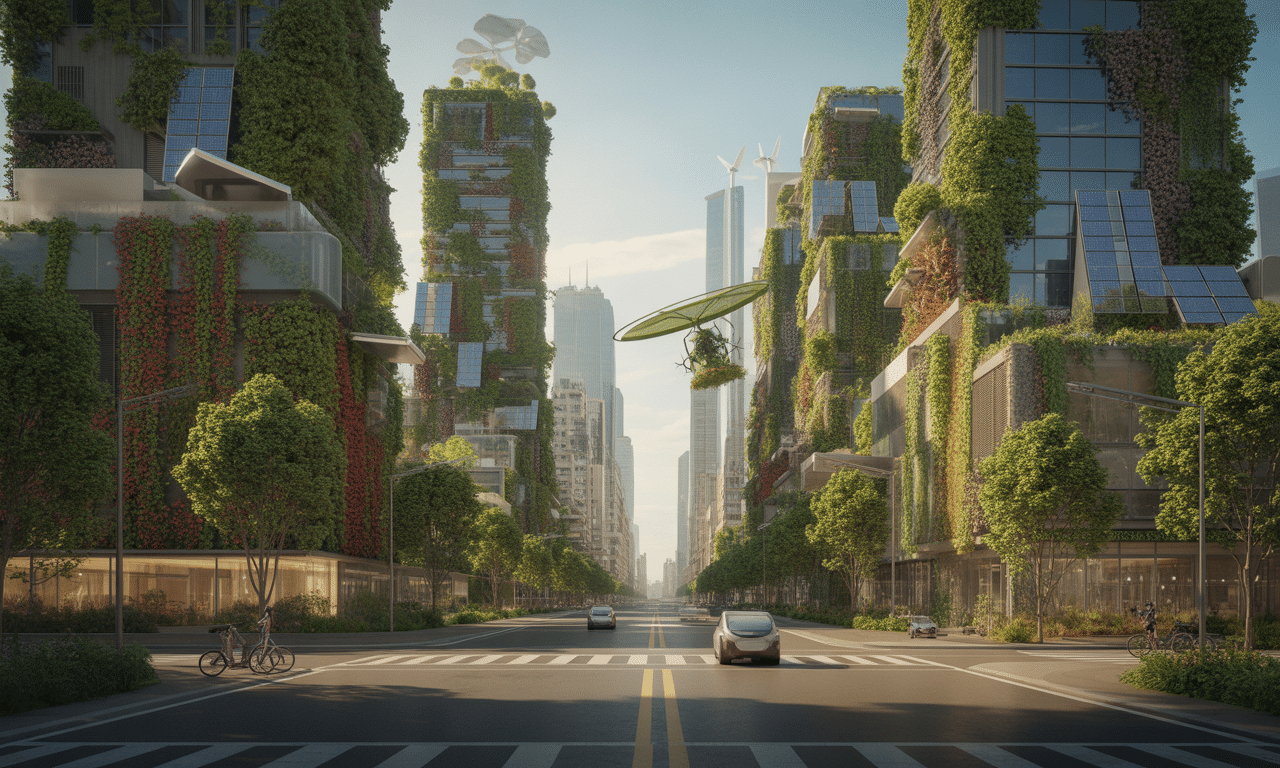
Rapid urbanization demands a decisive shift toward sustainable urban infrastructure. Cities that continue to prioritize short-term growth over environmental and social systems will compound heat, pollution, and inequality. Instead, urban policy must treat green infrastructure—parks, green roofs, wetlands—as essential assets that deliver measurable cooling, air purification, stormwater management, and biodiversity. Investment in these systems is not optional; it is a fiscal and moral imperative.
Transportation choices will define urban emissions and accessibility for decades. Prioritizing sustainable transportation—from expanded public transit and bus rapid transit to electrification and shared-mobility networks—reduces greenhouse gases while improving mobility equity. Design that privileges pedestrians and cyclists alongside integrated EV charging and multi-modal planning translates policy into everyday user behaviour and long-term carbon reductions.
Equity must be embedded in planning, not appended as an afterthought. Mechanisms such as inclusive zoning, community land trusts, and participatory budgeting reallocate power and stabilize affordable housing without stifling urban dynamism. Cities that make land stewardship and resident-driven decision-making central will better preserve affordability, social cohesion, and local economic opportunity.
Resilience requires a multi-dimensional approach: combine climate resilience measures (flood protection, resilient construction), targeted economic resilience (diversified local economies, support for small businesses), and deliberate social resilience (community capacity-building, inclusive governance). Routine risk assessment, scenario planning, and adaptable infrastructure design ensure cities can absorb shocks and evolve rather than break under pressure.
Policymakers must integrate these agendas through cross-sector collaboration, data-driven planning, and bold regulatory frameworks. Learning from exemplar cities demonstrates that coordinated action—backed by predictable finance and empowered communities—transforms pilots into scalable systems. The choice is clear: either urban development remains fragmented and reactive, or it becomes strategic, equitable, and resilient by design.
Frequently Asked Questions — The Future of Sustainability in Urban Development
Q: What is sustainable urban infrastructure and why must cities prioritize it?
A: Sustainable urban infrastructure uses natural and engineered systems to reduce environmental impact and improve living conditions; cities must prioritize it because continuing urbanization makes incremental fixes insufficient — only systemic investment in green networks, resilient utilities, and low-carbon mobility will deliver long-term health, climate, and economic benefits.
Q: How does green infrastructure actually reduce urban heat and improve health?
A: Green infrastructure like parks, green roofs, and urban wetlands lowers the urban heat island through shading and evapotranspiration, filters pollutants to improve air quality, boosts biodiversity, and reduces heat-related illness — meaning climate adaptation and public health goals are best pursued together, not separately.
Q: Which transportation strategies deliver the greatest sustainability gains?
A: Prioritize electrification, robust public transit (including BRT and light rail), and shared mobility options alongside safe pedestrian and cycling infrastructure; these measures cut GHG emissions, improve air quality, and expand equitable access to jobs and services — making them the most cost-effective investments for urban mobility.
Q: What does inclusive urban planning look like in practice?
A: Inclusive planning combines mandatory inclusive zoning, support for community land trusts, and genuine community engagement such as participatory budgeting; this approach prevents displacement, preserves affordability, and embeds equity in development decisions rather than treating equity as an afterthought.
Q: Why are community land trusts effective tools for equitable development?
A: Community land trusts secure land for public benefit, keeping housing and community facilities permanently affordable and under local stewardship; they are a pragmatic counterbalance to market-driven displacement and a way to align long-term social outcomes with urban growth.
Q: What defines a resilient city, and what must planners focus on?
A: A resilient city withstands and adapts to shocks via integrated measures: climate resilience (flood protection, climate-smart design), economic resilience (diverse local economies and support for SMEs), and social resilience (community capacity-building); planning must fuse these strands rather than treating resilience as purely engineering.
Q: Which strategies should policymakers prioritize now to achieve sustainable urban outcomes?
A: Policymakers should prioritize comprehensive risk assessment, targeted infrastructure investment, cross-sector governance, and deep community engagement; funding mechanisms must incentivize long-term gains (for example, blended finance and public–private partnerships) to overcome short-term political horizons.
Q: Are there concrete city examples that justify these approaches?
A: Yes — examples like Singapore (large-scale green infrastructure and water management), Copenhagen (ambitious carbon neutrality planning), Vancouver (citywide green initiatives), Rotterdam (climate adaptation), and Medellín (social and transport-led transformation) prove that integrated, bold strategies produce measurable environmental and social returns.
Q: How should cities measure progress toward sustainability and equity?
A: Use a compact set of transparent metrics: GHG emissions, heat island intensity, green space per capita, affordable housing units preserved, transit mode share, and resilience indicators; data-driven targets and regular public reporting force accountability and guide effective course corrections.
Q: What common barriers block progress, and how can they be overcome?
A: Typical barriers include fragmented governance, short-term financing, and political resistance. Overcome them with integrated institutional frameworks, stable long-term financing (including public–private partnerships), mandated inclusionary policies, and empowered community participation that converts residents from critics into collaborators.