




A Systemic Disconnect
Modern manufacturing has been a constant evolution of processes and systems, yet defined by a critical paradox. At the heart of this evolution are Manufacturing Execution Systems (MES) and Industry 5.0; two key concepts reshaping how modern factories operate, innovate, and compete within the global markets.
The synergy of Industry 5.0 principles and MES has revolutionized factory operations. While MES facilitates real-time visibility, granular monitoring, and control of processes on the shop floor, Industry 5.0 layers on intelligence and connectivity, enhancing the MES capabilities and transforming previously siloed physical operations into data-driven centers.
MES platforms are democratizing decision making on the factory shop floor, empowering plant operators and engineers, who are best positioned to utilize the generated insights to enhance production outputs and improve machine performance. Shop floor attendants and line managers can now access real-time insights on production outputs, quality metrics, and machine performance by leveraging MES dashboards.
Yet, this democratization halts at a critical area, carbon intensity (CI) tracking, where a systemic disconnect still exists. CI represents the amount of carbon dioxide equivalent (CO₂e) emitted per unit produced or per unit of energy consumed.
While CI is used by factories to benchmark emissions performance, it is rarely tracked live within the factories. Instead, outdated static tools like spreadsheets are still used to track carbon emissions via monthly utility bills, and annual energy estimates.
The systemic disconnect leaves machine operators and line managers without real-time insights on CI at the machine, shift or line level. Consequently, ESG and sustainability managers are forced to rely on lagged, static spreadsheet estimates for critical environmental performance reporting.
This is despite the tightening of sustainability regulations and investor scrutiny across manufacturing companies – with Veridion citing that 79% of investors consider ESG before making investments in companies.
The stark reality is that CI tracking in MES remains underdeveloped. As Lesia Yanytska, my work is dedicated to pioneering a radical shift to integrate real-time CI tracking capabilities in MES.
My guiding philosophy asserts that the MES, as the traditional backbone of factory operations, can be reimagined as a real-time carbon control tower, integrating CI as a dynamic performance indicator to bridge this systemic disconnect.
MES as the Backbone of the Digital Decarbonization Control Tower
Historically, MES excelled as a bridge between Enterprise Resource Planning (ERP) systems and shop floor operations. They managed, monitored, and synchronized the real-time execution of physical processes involved in the manufacturing operations.
However, the rapid acceleration of Industry 5.0 led to burgeoning data volumes from interconnected Industrial Internet of Things (IIoT) devices (projected by IBM to grow by 1000% by 2027) and a demand for hyper-responsiveness and mass customization. The inherent limitations of the traditional MES platforms were exposed in their rigidity as they could not deliver required real-time insights.
This context informed a human-in-the-loop design philosophy in which a synergistic model was engineered, using AI co-pilots to process large data volumes and identify existing complex patterns. The co-pilots shattered traditional data silos and allowed the non-technical staff to access complex production data using natural language queries.
Simultaneously, Machine Learning (ML) capabilities processed real-time data from interconnected IIoT devices, facilitating precise material tracking and proactively identifying operational inefficiencies.
Yet, as AI co-pilots and ML capabilities excelled in driving cost reductions and output production improvements, the MES critical role and potential in CI tracking remained overshadowed and underdeveloped.
This is despite compelling evidence from Siemens which showed that energy dashboards in MES’ could improve visibility in monitoring carbon emissions and Pfizer whose real-time energy monitoring, combining sub-metering with automated alerts lowered carbon emissions without sacrificing production efficiency.
As Industry 5.0 principles now emphasize human-centric, intelligent, and sustainable systems, the stakes for real-time CI monitoring in MES are significantly raised. Democratizing carbon tracking empowers operational teams and provides real-time data they can directly act on for decarbonization.
This synergy of sustainability and digitization is more than a profound shift and reinforces the idea that carbon management is not solely the responsibility of sustainability departments, but must be democratized across all layers of production.
Proposed Modular Solution for Real-Time CI Tracking
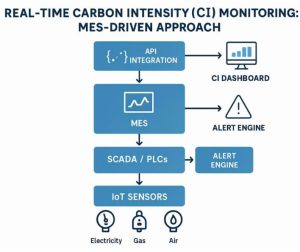
The proposed solution, a vendor-neutral and modular architecture, embeds real-time tracking within MES platforms across several integrated layers. At the foundational level, IoT sensors capture high-resolution energy consumption data from major loads (motors, HVAC units, and compressors).
These timestamped readings are routed reliably via SCADA and PLC systems and accurately delivered into the MES layer where CI is dynamically computed as either kgCO2e produced or kgCO2e per megawatt-hour consumed, based on the manufacturer’s context.
The uniqueness of this architecture lies in its granular control via dynamic carbon factors – values that reflect real-time changes in the energy mix or regional emission rates and facilitate CI visibility at the shift, line, and product level.
An embedded alert engine continuously assesses live CI values against thresholds, triggering automated diagnostics and recommending timely corrective actions to operators when anomalies are detected in real-time.
Finally, to complete the control loop, the MES seamlessly integrates with ESG platforms such as the SAP Sustainability Control Tower or Salesforce Net Zero Cloud via secure, standards-based APIs. This real-time data flow eliminates laborious manual data handling, accelerating ESG compliance and ensuring transparent emissions governance.
Real-World Validation of the Modular MES Solution
The potential of real-time CI tracking within MES is best validated by a simulation conducted in a virtual FMCG packaging facility. The facility involved three automated production lines (A, B, and C) each equipped with sub-metering, SCADA integration, and MES dashboards.
During the test, line C exhibited a spike in carbon intensity during Shift 2, rising to 0.87 kg CO₂e per unit, above its expected baseline of 0.73.
The system’s alert engine swiftly identified a pneumatic valve malfunction as the root cause driving excessive compressed air consumption. A diagnostic ticket was generated by the system, flagged for shift maintenance, and corrective actions suggested. Within 45 minutes of intervention, CI returned to 0.68, representing a 22% reduction from the peak value.
This entire sequence from anomaly detection to root cause resolution and ESG synchronization was completed in real time. Within only 30 seconds, the ESG system updated CI metrics, validating its capacity for accountability and rapid insights.
The real-world case study demonstrates that the proposed framework delivers both tangible technical benefits and strategic business value. ESG managers leverage CI as a visible KPI, empowering daily operational improvements.
The seamless integration of the MES with ESG platforms such as SAP Sustainability Control Tower or Salesforce Net Zero Cloud eliminates laborious manual traditional reporting and supports compliance mandates.
This translates to strategic business value including reducing Scope 1 and 2 emissions, enhancing auditability of CI emissions, improving brand credibility, and increasing investor trust.
However, future work in validating the framework ought to pilot the framework on a high-production line while simultaneously applying AI/ML for CI forecasting and predictive alerts.
Navigating the Road Ahead
The path to the full realization of the democratization of carbon tracking in MES platforms faces significant complexities. Foremost, data integrity and seamless integration with legacy systems are a persistent problem, contributing to interoperability issues with advanced MES platforms.
This is coupled with the spiraling threat of cybersecurity – with Valona Intelligence citing that 25% of all global cyberattacks targeted manufacturers – as disjointed systems become interlinked.
More fundamentally, the risk of ethical considerations in manufacturing are pivotal. This requires vigilance and human oversight over the autonomous systems and promoting transparency in AI decision-making.
Overcoming these hurdles necessitates the proactive investment by the industry in upskilling and developing the workforce, championing adaptation as a core skill to ensure workers can thrive alongside intelligent AI systems, and adopting data governance processes to ensure oversight and transparency.
Nonetheless, the proposed modular framework exemplifies the new frontier in sustainable manufacturing, embedding comprehensive real-time ESG reporting in MES intelligence. As ESG data becomes live, traceable, and audit-ready, this facilitates a smoother path to regulatory compliance and global competitiveness.
Ultimately, real-time CI monitoring will serve as the bedrock of modern sustainable manufacturing, evolving beyond a simple reporting function into a powerful system and systemic driver for regulatory alignment, operational control, and industrial innovation.
Embracing this revolution will be essential for competitive differentiation while unlocking long-term value creation in today’s demanding environment.
About the Author
Lesia Yanytska is a sustainability strategist and technology writer specializing in Industry 4.0 and 5.0 transitions. With expertise in ESG-driven innovation and industrial systems, she collaborates with manufacturing leaders to develop future-ready digital strategies that align operational performance with environmental goals. This framework is supported by a provisional U.S. patent application (#63/808,207), filed May 2025, for system and method innovations in real-time carbon intensity monitoring integrated with MES platforms.

Wow, this article is deep! But isn’t it risky to rely so heavily on MES for CI tracking? 🤔
Great read! It’s time factories got serious about real-time carbon tracking.
Lesia Yanytska seems to know her stuff. But how feasible is this for small manufacturers?
Why are we just now seeing the importance of CI in MES? Shouldn’t this have been addressed earlier?
Can you provide more examples of companies successfully implementing this framework?
Factory of the future sounds cool, but what about the cost of implementing these systems?
Real-time carbon data in factories could be a game-changer. Thanks for the insights!
Not sure if I trust IoT devices to handle such critical data. Cybersecurity issues, anyone?
How does this compare to traditional carbon tracking methods in terms of accuracy?