




| IN A NUTSHELL |
|
In the heart of Egypt’s arid desert, recent discoveries are reshaping our understanding of ancient engineering marvels. A sophisticated water management system has been unearthed around the Pyramid of Djoser, challenging long-held beliefs about Old Kingdom construction methods. This network, featuring elements such as dams and underground basins, suggests a level of technical prowess previously unimagined. These revelations not only highlight the ingenuity of ancient Egyptian builders but also prompt a reevaluation of other historical sites, as we begin to appreciate the profound knowledge embedded in these ancient structures.
Ingenious Stone Dam Capturing Desert Floodwaters
The mysterious structure at Saqqara, known as Gisr el-Mudir, has long puzzled archaeologists. Spanning nearly 1,180 feet, this ancient stone enclosure is among Egypt’s oldest constructions. Xavier Landreau and his team from the CEA Paleotechnic Institute have reinterpreted this enigmatic edifice. Their research, published in PLOS ONE, suggests it served as a stone dam, capturing seasonal floodwaters from nearby wadis.
By analyzing terrain slopes, ancient watercourses, and erosion marks, the team reconstructed a watershed capable of channeling water to the enclosure. This stone dam could hold up to 14 million cubic feet of water, supporting large construction projects. Seasonal floods would deposit sediments in basins, enhancing the site’s utility. This discovery repositions Saqqara’s significance in Egyptian history, indicating its location was chosen for both religious and geological reasons.
How Hydraulic Construction of Pyramids Worked
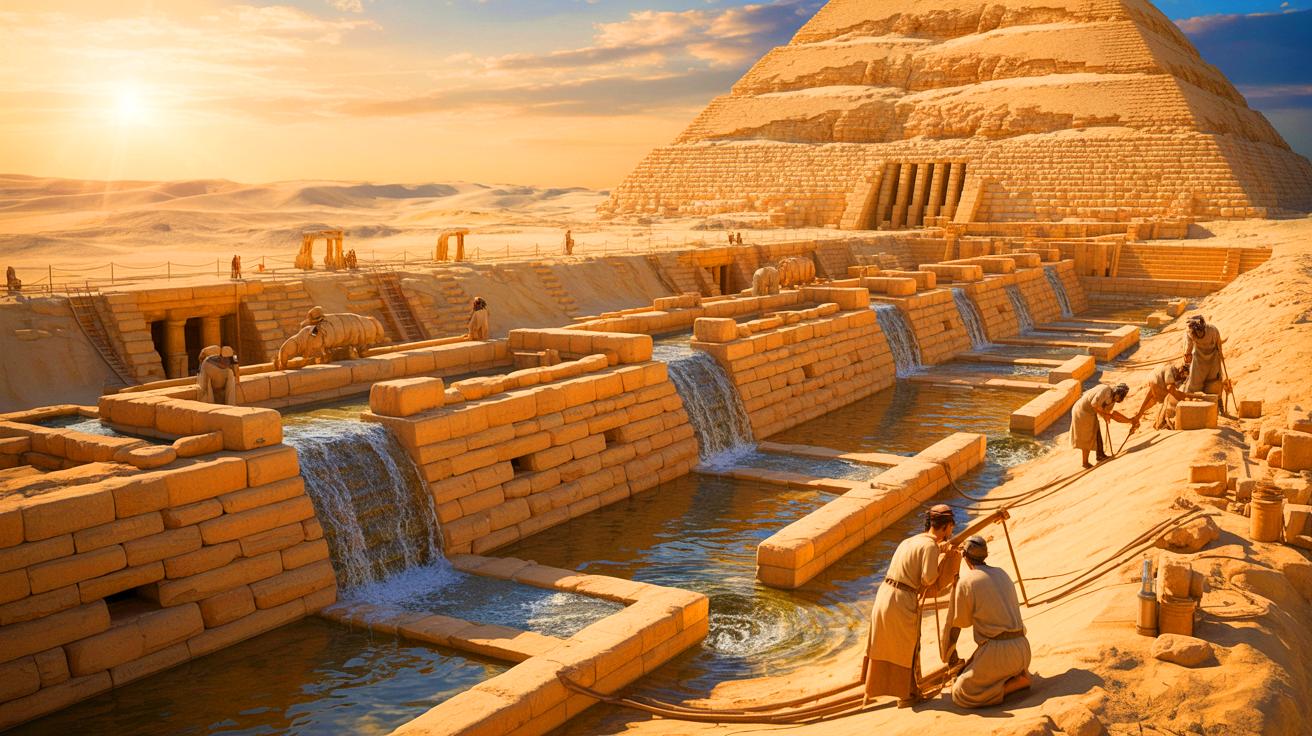
While having a sufficient water supply was crucial, it wasn’t enough to lift massive limestone blocks. The secret to this feat lies within the depths of the Djoser complex. South of the pyramid, a trench carved into the rock reveals interconnected basins and compartments. This “Deep Trench” functions as a water treatment system, gradually clarifying water before further use.
This purified water likely powered a vertical lifting system beneath the pyramid. Two vertical shafts, linked by an underground gallery, enabled a flotation device. Blocks on a floating platform could be elevated by water pressure injected into the shafts. Once the load reached a sufficient height, it could be moved onto the pyramid’s upper tiers. These structures suggest a hydraulic elevator system, utilizing water’s force to reduce mechanical effort.
Sophisticated Technology Matching Pharaohs’ Ambitions
The hydraulic construction hypothesis, though bold, is supported by direct evidence. The dam, basins, galleries, and shafts present a logical organization compatible with a hydraulic system. Contrary to popular belief, the Egyptians had mastered numerous water-related techniques. Their expertise in irrigation, wooden gates, and agricultural dams underscores their hydraulic knowledge.
This study suggests such a system could reduce the need for massive external ramps, lowering labor demands and logistical constraints. The project would gain efficiency, safety, and precision. This advanced engineering level prompts a reevaluation of Old Kingdom monuments. The Pyramid of Djoser, seen as a prototype, may represent a culmination of technology that later dynasties struggled to replicate. This challenges the narrative of pyramid construction, blending ingenious engineering with environmental adaptation.
How Saqqara’s Hydraulic Remains Alter Our Historical Perspective
Until now, pyramids were studied primarily from symbolic and architectural standpoints. The discovery of an integrated hydraulic system opens new exploration avenues. It reveals that builders crafted a sustainable technical ecosystem, adapted to the environment and resources.
This multidisciplinary approach, combining archaeology, hydrology, and geotechnics, enriches our understanding of the past. It unveils a sophisticated work organization, rigorous material management, and territory exploitation. It’s conceivable that pyramids were not solely the result of massive labor mobilization but also of underestimated technical genius. This perspective sheds new light on ancient Egyptian innovation, inviting reassessment of other monumental sites for similar hydraulic systems.
As we uncover more about ancient Egyptians’ engineering ingenuity, we are left to ponder: What other hidden technological marvels might lie beneath the sands, waiting to rewrite history once more?



Wow, who would have thought pyramids had their own “water parks”? 😂
This is fascinating! How did they figure out the hydraulic system without modern tech?
Big thanks to the researchers for shedding new light on ancient history! 🙌
How much evidence do we need to rewrite the history books on this one?
Water management skills were clearly advanced, but how did they maintain it?
Why haven’t we heard about this before? Feels like a well-kept secret! 😮
I wonder what else we might discover about ancient Egypt. New pyramids, perhaps? 🏺
The level of detail in these discoveries is absolutely astounding. Keep it coming!
Does this mean the pyramids were built with less labor than previously thought?
How did the water system remain hidden for so long? 🤷♂️
Could this lead to new archaeological methods focusing on hidden water systems?
I always thought alien theories were fun, but this is way cooler! 👽
What a well-researched piece! Kudos to the team for challenging old narratives.
Are there any other sites with similar hydraulic features? 🌊
It’s amazing to think of the knowledge and skill of the ancient Egyptians. Truly humbling.
Does this challenge the timeline of when we thought these pyramids were constructed?
Why haven’t Egyptian authorities acknowledged these findings? Seems important! 🤔
Incredible how a single discovery can change our entire understanding of history.
Could this technology have been passed down to other ancient cultures?
Thank you for opening our eyes to the hidden marvels beneath the sands of time.
Are there any plans for further excavation or research at this site?
Water elevators? Sounds like something straight out of a science fiction novel! 📚
This article is a game-changer! Thanks for sharing such intriguing insights!
Why do some scholars still resist these new interpretations? Seems convincing to me!
What other ancient sites might hold similar hydraulic secrets? 🏛️
Could climate change have affected these ancient water systems over time?
It’s amazing how much we’re still learning about ancient civilizations. Never gets old!
So much to rethink about how these colossal structures were erected. Truly fascinating!
Is it possible that these findings could lead to new technological advancements today?
Great read! Can’t wait to see what else we uncover about ancient engineering.
How do researchers determine the age of these hydraulic systems? 📅
Who knew that ancient Egyptians were such water wizards! 🌊🧙♂️
The ingenuity of ancient cultures never ceases to amaze me. Keep uncovering these truths!
Did they use similar systems for agriculture or just for construction?
So, are we saying the Egyptians invented the first elevators? Mind-blowing!
Didn’t expect to read about a dam in the desert. Nature sure has its surprises!
Could this discovery lead to more sustainable practices in modern construction?
What if the pyramids were just giant water storage facilities? 🤔
It’s incredible to think about the engineering feats accomplished so long ago.
Is it possible that other ancient civilizations used similar hydraulic techniques?
Wait till ya find out it was actually to produce electricity .