




| IN A NUTSHELL |
|
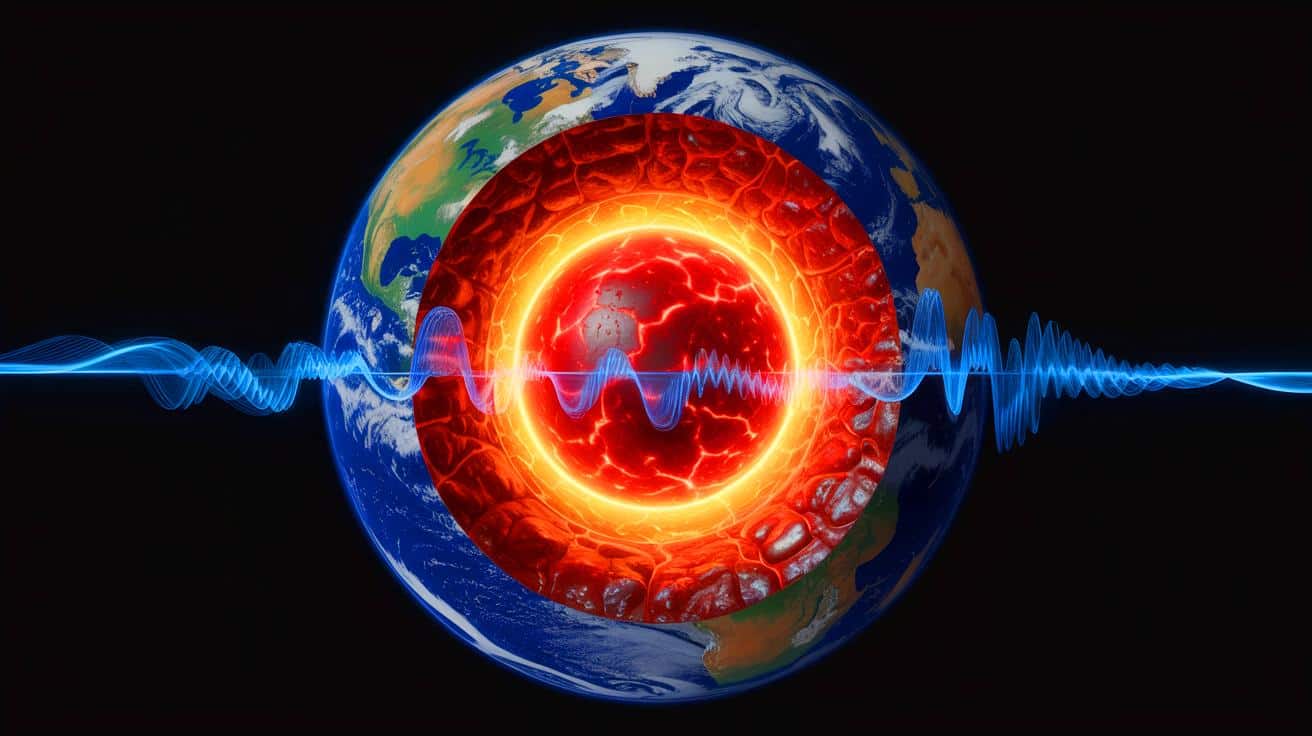
The Earth, a dynamic and complex planet, holds many secrets beneath its surface. For centuries, scientists have endeavored to uncover the mysteries hidden within its layers. Recent research suggests that Earth’s inner core, once thought to be a singular, homogenous entity, might consist of two distinct layers. This revelation challenges long-held beliefs and compels the scientific community to reconsider established theories. The implications of this discovery extend beyond academic curiosity, prompting questions about Earth’s formation and evolution.
Traditional Understanding of Earth’s Layers
Historically, the structure of Earth has been simplified into four primary layers: the crust, the mantle, the outer core, and the inner core. This model, while functional, has left gaps in our understanding of Earth’s interior. The crust and mantle, directly observable through geological activities such as volcanic eruptions, are relatively well understood. However, the inner core, lying thousands of miles beneath the surface, remains largely enigmatic. Our understanding of this region has largely been derived from indirect methods, such as analyzing seismic waves generated by earthquakes.
Seismic waves, which travel through the Earth, provide valuable clues about its internal structure. Variations in the speed and trajectory of these waves reveal differences in the material properties of Earth’s layers. For instance, the existence of a liquid outer core and solid inner core was inferred from the behavior of seismic waves. These waves fail to pass through the outer core, indicating its liquid state, while they travel through the inner core, suggesting its solidity.
New Insights into the Inner Core
Recent research by Joanne Stephenson and her colleagues at the Australian National University has uncovered evidence suggesting that the inner core may not be as uniform as previously thought. Using advanced algorithms to analyze decades of seismic data, the team identified patterns that indicate the presence of an additional layer within the inner core. This finding challenges the simplistic view of the inner core as a single, homogeneous layer. The study suggests that the inner core could be composed of two distinct layers, each with unique properties affecting seismic wave behavior.
The discovery hinges on the concept of anisotropy, where the properties of a material vary depending on the direction of measurement. The research indicates that seismic waves travel at different speeds depending on their orientation relative to Earth’s rotational axis. The team found that waves travel faster parallel to the axis compared to other directions. This anisotropy points to a possible structural change within the inner core, hinting at complex processes that have shaped Earth’s interior over billions of years.
Implications for Earth’s Geological History
The revelation of a layered inner core holds significant implications for our understanding of Earth’s geological history. It suggests that there may have been multiple cooling events in Earth’s past, influencing the formation and evolution of the inner core. This challenges the conventional view of a singular, uninterrupted cooling process. The presence of distinct layers within the inner core could indicate varying compositions or structural alignments of iron crystals, which constitute the core.
Such insights offer a new perspective on the dynamic processes that have shaped our planet. Understanding the inner core’s complex structure can provide clues about Earth’s magnetic field, which is generated by movements in the core. This field plays a crucial role in protecting the planet from solar radiation and maintaining conditions conducive to life. By unraveling the mysteries of the inner core, scientists hope to gain a deeper understanding of these fundamental processes.
Challenges and Future Directions
Despite the groundbreaking nature of these findings, challenges remain in fully understanding the inner core’s structure. The current limitations in data collection, particularly from polar regions, hinder the ability to draw definitive conclusions. Seismic data is primarily sourced from earthquakes and receivers distributed unevenly across the globe. This uneven distribution creates gaps in the data, reducing the certainty of the findings.
Future research aims to address these gaps by deploying more seismic sensors in underrepresented regions. Enhancing the global seismic network can provide a more comprehensive view of Earth’s interior. Additionally, advancements in computational methods and technology will enable more detailed analyses of seismic data. As scientists continue to investigate the inner core, they hope to piece together the complex puzzle of Earth’s geological history, gaining insights into the processes that have shaped our planet over billions of years.
The discovery of a potentially layered inner core opens new avenues for research and questions long-held assumptions about Earth’s structure. As scientists continue to explore these mysteries, how might these findings reshape our understanding of Earth’s formation and its ongoing evolution?