



| IN A NUTSHELL |
|
The discovery of a potential primordial black hole by the James Webb Space Telescope (JWST) has sparked significant interest in the scientific community. This finding could provide insights into the formation of the Universe just moments after the Big Bang. A red light blob, named QSO1, spotted by JWST could represent one of the earliest supermassive black holes, challenging existing theories about cosmic evolution. If confirmed, the existence of such a black hole could revolutionize our understanding of how galaxies and black holes formed in the early Universe. This article delves into the implications of this discovery and the ongoing research efforts to validate these findings.
The Epoch of Reionization and Its Significance
The epoch known as the Reionization period marks an era roughly 600 million years after the Big Bang. During this time, the first stars and galaxies began to illuminate the Universe, dispelling the cosmic fog that enveloped the early cosmos. This era is crucial for understanding the formation of cosmic structures and the evolution of the Universe. However, studying this period poses significant challenges due to its immense distance and the redshift of light over billions of years.
The James Webb Space Telescope, with its advanced infrared capabilities, is uniquely equipped to peer into this ancient epoch. By detecting light that has been redshifted, the JWST can provide unprecedented insights into the formation and evolution of the earliest cosmic structures. The detection of QSO1, a mysterious red light blob, is particularly intriguing as it may offer a glimpse into the processes that shaped the early Universe.
QSO1: A Potential Primordial Black Hole
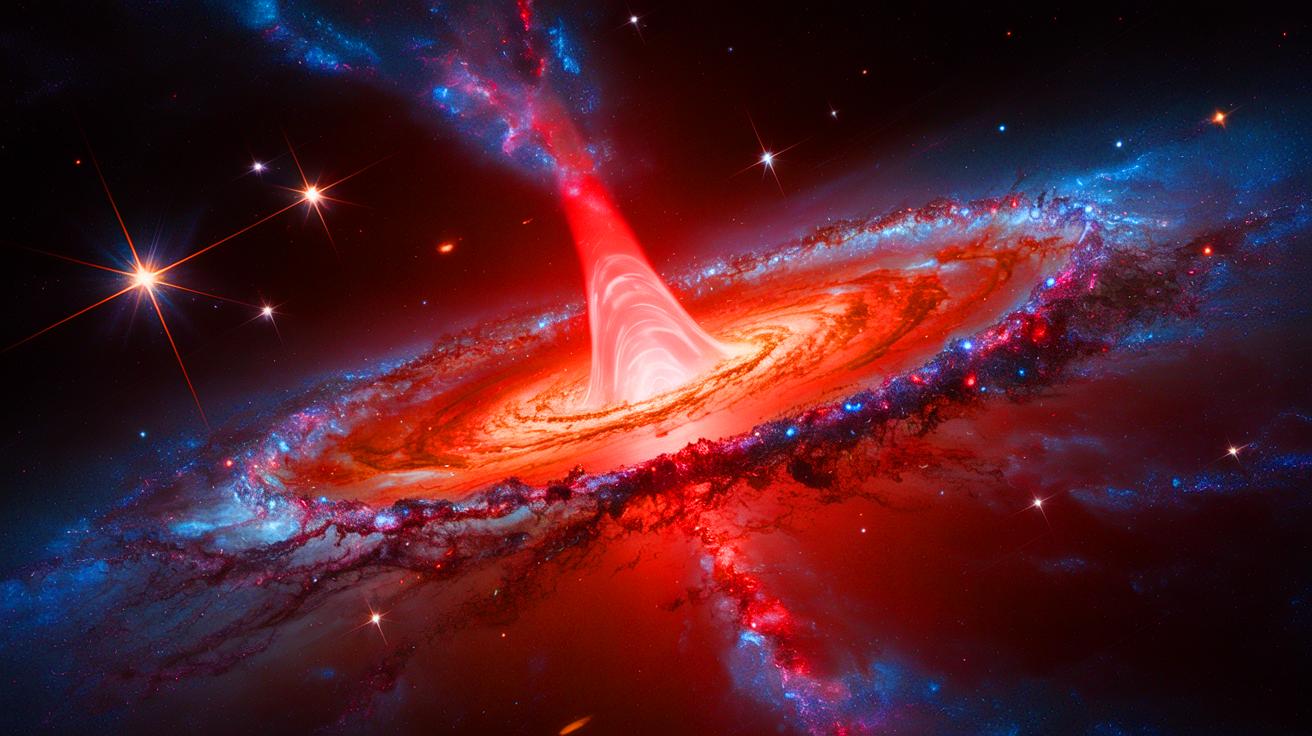
QSO1 has captured the attention of scientists due to its unusual characteristics. The object appears as a tiny red dot in the vast darkness of the Universe. Initial measurements suggest that it could be a black hole with a mass equivalent to 50 million Suns. This finding is significant, as it offers a potential pathway to understanding supermassive black hole formation.
Ignas Juodžbalis, an astrophysicist at the University of Cambridge, and his team have conducted extensive research to determine the nature of QSO1. Their analysis suggests that QSO1 could be a “massive black hole seed” in the early stages of accretion. This discovery challenges existing theories about black hole formation and suggests that such massive black holes might have formed far earlier than previously thought.
The Role of Gravitational Lensing
Gravitational lensing, a phenomenon where light from distant objects is magnified by massive galaxy clusters in between, plays a crucial role in the study of QSO1. This effect allows scientists to observe distant objects with greater clarity. In the case of QSO1, gravitational lensing enabled researchers to analyze its light and calculate its rotation curve, thereby estimating its mass.
The findings from the rotation curve analysis are incompatible with the star cluster interpretation of QSO1. Instead, the data aligns with the presence of a supermassive black hole, providing a compelling case for the existence of primordial black holes. This method of analysis underscores the importance of gravitational lensing in uncovering the mysteries of the early Universe.
Implications and Future Research
The discovery of QSO1 as a potential primordial black hole raises profound questions about the formation and evolution of the Universe. If validated, this finding could suggest that black holes were among the first structures to form, with galaxies subsequently assembling around them. This challenges the traditional understanding that galaxies and stars formed first, followed by black holes.
Further research is essential to confirm the nature of QSO1 and its implications for cosmic evolution. Scientists will need to explore whether QSO1 is a result of rapid growth through accretion and collisions, or if it represents a new pathway of black hole formation. The findings could also help refine existing models of the early Universe, providing a more comprehensive understanding of its origins.
The discovery of QSO1 as a potential primordial black hole represents a significant breakthrough in astrophysics. While the findings await peer review, the implications for our understanding of the Universe are profound. As researchers continue to analyze data from the James Webb Space Telescope, more insights into the early Universe are likely to emerge. What other mysteries of the cosmos might be uncovered as we delve deeper into the origins of our Universe?



Wow, mind-blowing! 🚀 Could this change how we teach cosmology in schools?
Wow, a black hole that old! I wonder what other secrets the universe is hiding. 🤔
Is it possible this “red dot” is just a cosmic mirage? 🤔
So if QSO1 is a primordial black hole, does it mean our current models are wrong? 🤯
Thanks for the article! The James Webb Space Telescope is truly amazing.
Thanks for the article! It’s mind-blowing how much we’re learning about the universe. 🚀
How does this discovery affect the current Big Bang theory?
Isn’t it amazing how a tiny red dot can change our understanding of the cosmos? 😮
Another win for science! Keep the discoveries coming!
Isn’t it too early to say this dot is a primordial black hole?
Why red? Is it a hot black hole? 😂
Great read, but how does gravitational lensing work exactly?
🌌 Does this mean galaxies formed around black holes?
Interesting article, but I’m a bit skeptical. Any peer reviews yet?
How long did it take for the light from QSO1 to reach us?
This changes everything I thought I knew about the universe! 😱
What are the chances of finding more primordial black holes with JWST?
Do we have any images of QSO1? Would love to see them!
Could this discovery help us understand dark matter better?
How does detecting a red dot lead to discovering a black hole?
I’m still trying to wrap my head around the concept of the Big Bang.
Why is it called “QSO1”? Seems like we could’ve had a cooler name! 😆
Any chance this could be a new kind of cosmic object we’ve never seen before?
Question: How does gravitational lensing help scientists determine the mass of QSO1?
Would love to know more about the gravitational lensing technique.
This is some sci-fi level stuff! Can’t wait for more discoveries.
Is this discovery being contested by other scientists?
Incredible! Could this change our timeline of the universe’s history?
How confident are scientists about QSO1’s mass and properties?
So, black holes could’ve been around since the universe’s birth? Fascinating!
Seems like we’re just scratching the surface of what’s out there. Exciting times!
How does this fit with the theory of cosmic inflation?
Are there any plans to study QSO1 further?
What if it’s not a black hole? Are there alternative explanations being considered?
How reliable is the JWST in detecting such distant objects?
Can this discovery help us predict the future of our universe? 🤓
I’m skeptical. How can we be sure QSO1 is a black hole and not just a star cluster?
Can we visit this black hole? Just kidding, I know we’d be spaghettified! 😄