




| IN A NUTSHELL |
|
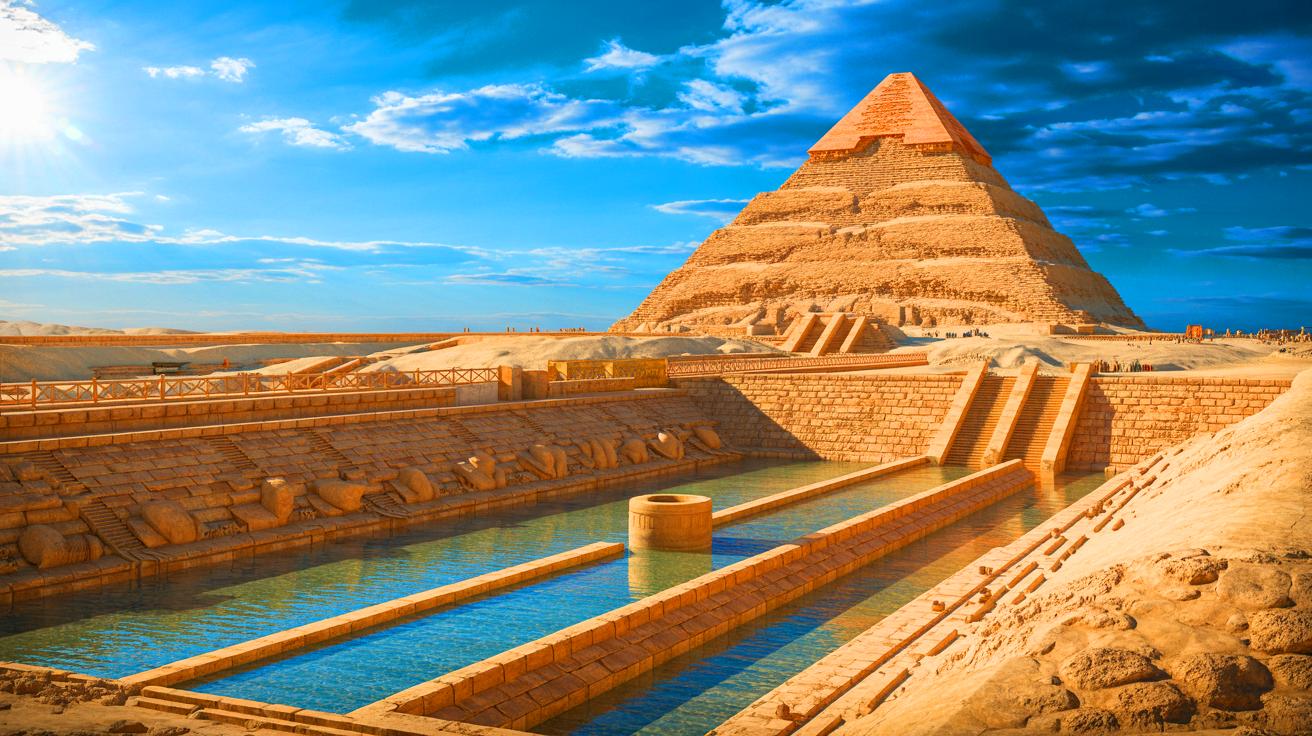
Deep within the Egyptian desert, new archaeological findings are challenging our conventional understanding of ancient Egyptian engineering and architecture. A sophisticated water management system, discovered around the Pyramid of Djoser, suggests that the builders of the Old Kingdom possessed advanced technical skills previously unappreciated. These discoveries, which include a stone dam, underground basins, and a network of galleries, open up new possibilities about how these monumental structures could have been constructed. The implications of this research not only illuminate the technological ingenuity of ancient Egypt but also invite a reevaluation of other historical sites across the region.
Ingenious Stone Dam Capturing Desert Floodwaters
The mysterious structure known as Gisr el-Mudir at Saqqara has long intrigued archaeologists with its vast size and enigmatic purpose. Recent studies by Xavier Landreau and his team have redefined its role. Rather than serving as a ritual or defensive construction, the edifice is now understood to be a stone dam, strategically designed to capture seasonal floodwaters flowing from nearby valleys. This dam, one of Egypt’s oldest stone structures, spans nearly 1,180 feet and could hold approximately 14 million cubic feet of water.
By carefully analyzing the terrain, ancient watercourses, and erosion patterns, researchers have reconstructed a watershed capable of channeling water to the dam, creating a temporary reservoir. The collected water would have been essential for supporting large-scale construction efforts, providing both a resource for the workers and a means of moving heavy materials. This discovery reshapes our understanding of Saqqara’s significance, suggesting its selection was influenced by its geological and hydrological potential, in addition to religious or political factors.
How Hydraulic Construction of Pyramids Worked
While the storage of water was crucial, the real breakthrough lies in the methods used to lift the massive limestone blocks. A vast trench south of the Pyramid of Djoser, initially thought to be symbolic, reveals a sophisticated system of basins and compartments. This “Deep Trench” likely functioned as a water treatment system, purifying water by allowing sediments to settle before it was used in construction.
The purified water, according to researchers, powered a vertical lifting system. Two vertical shafts connected by a 656-foot-long gallery could have functioned as a hydraulic elevator. Limestone blocks placed on floating platforms would be elevated through the simple pressure of water injected into the shafts. Once at the desired height, the blocks could be maneuvered onto the pyramid’s upper tiers. This theory is supported by the observed structures within the galleries, revealing a system that utilized water to significantly reduce mechanical effort.
Sophisticated Technology Matching Pharaohs’ Ambitions
While the hydraulic construction hypothesis might seem revolutionary, it’s well-supported by evidence found at the site. The coordinated arrangement of dams, basins, galleries, and shafts suggests a comprehensive hydraulic system. Contrary to traditional beliefs, the ancient Egyptians were proficient in various water management techniques, including irrigation canals and agricultural dams.
This study highlights the Egyptians’ ability to apply their hydraulic knowledge to monumental construction projects. By reducing reliance on massive labor forces and external ramps, the builders could achieve greater efficiency, safety, and precision. This revelation suggests that the Pyramid of Djoser might represent the pinnacle of a sophisticated technological tradition, one that later dynasties could not replicate. The findings challenge the prevailing narrative of pyramid construction, indicating a blend of innovative engineering and environmental adaptation.
How Saqqara’s Hydraulic Remains Alter Our Historical Perspective
Traditionally, pyramids have been studied primarily for their architectural and symbolic significance. The discovery of an integrated hydraulic system at Saqqara provides a new lens through which to view these ancient structures. The builders were not merely fulfilling religious mandates but were also creating a sustainable technical ecosystem tailored to their environmental and material constraints.
This interdisciplinary approach, combining archaeology, hydrology, and geotechnics, enhances our understanding of the past. It reveals a complex organization of labor, meticulous resource management, and sophisticated territorial exploitation. This perspective suggests that pyramids were not solely the result of vast labor mobilization but also of an underestimated technical genius. These insights invite scholars to reassess other monumental sites for similar hidden hydraulic systems, potentially rewriting the history of ancient Egyptian innovation.
As our understanding of ancient Egyptian engineering continues to evolve, we are left with a lingering question: What other remarkable technological achievements are buried beneath the sands, waiting to be discovered and to reshape our historical narratives?




Wow, water elevators in ancient Egypt? That’s some next-level engineering! 💧
This is fascinating! How did they manage to engineer something so advanced so long ago? 🚀
Can you imagine the look on Djoser’s face if he knew his pyramid had a hydraulic elevator? 😂
This is fascinating! I always thought ramps were used. How did they discover this water system?
Wow, I never knew the Egyptians were such skilled engineers! Thanks for sharing this amazing discovery.
Is there any evidence of similar systems in other pyramids or just at Saqqara?
I never thought ancient Egyptians were this advanced. Thanks for the enlightening read!
Wait, so you’re telling me the ancient Egyptians invented the first water elevators? Mind blown! 😲
Wait, so they used water to lift those massive stones? How is that even possible?! 🤯
Great article! But I wonder how they managed to maintain such a complex system in the desert.
Seems like quite a leap to assume they used water elevators. Any solid evidence besides the basins and shafts?
Do you think this could change our understanding of other ancient civilizations too? 🤔
What about the labor force? Did the Egyptians rely less on slave labor because of this technology?
Incredible to think about how much we’ve underestimated ancient civilizations. What else could they have achieved?
I’m skeptical. How can we be sure this wasn’t just a coincidence or misinterpretation?
Incredible! This sheds new light on the resourcefulness of ancient engineers.
Imagine what else could be out there waiting to be discovered. The past is so full of surprises!
This discovery is cool and all, but are there any actual written records supporting it?
Water elevators sound like something out of sci-fi, not ancient history! 😄
How did they manage to keep such a large water system from leaking or breaking?
The ancient Egyptians never cease to amaze me. What an incredible culture!
Could this technology have been passed down or inspired other civilizations?
I’m curious about the environmental impact. How did they ensure sustainability?
This changes everything I thought I knew about pyramids. Thanks for sharing!
Any plans to explore more sites for similar hydraulic systems? Would love a follow-up article!
What other secrets are hidden beneath the sands of Egypt? 🏜️
It’s amazing how ancient technology can be so sophisticated yet so simple at the same time.
Did they use similar techniques for other constructions besides pyramids?
Thank you for this article! It really opens my eyes to ancient Egyptian ingenuity.
How did they manage to calculate the water pressure needed for lifting those blocks?
This makes me wonder if other ancient myths might have a grain of truth in them too.
Was the discovery accidental, or were they looking for something like this?
Ancient Egyptians were not just builders but true engineers. What a revelation!
How come we didn’t know about this sooner? Seems like a major oversight.
This seems too advanced for the time. Are we sure this isn’t just wishful thinking?
Thank you for the detailed explanation. Truly an eye-opener! 📚
What other ancient engineering feats might still be undiscovered?
Does this mean we have to rewrite the history books? Exciting times ahead!
Water elevators are just a theory, right? Or is there solid evidence to back it up?
I hope they find more evidence to support this. It sounds groundbreaking! 🌟
My brain can’t comprehend how they managed to do all this without modern technology.
Is there any connection between this system and the Nile’s flood patterns?
How did they even come up with the idea of using water in such a way? Genius!
Thanks for sharing such an intriguing article. Can’t wait to see what they find next!
Does this discovery imply that ancient Egypt had its own version of hydraulic engineering?