



| IN A NUTSHELL |
|
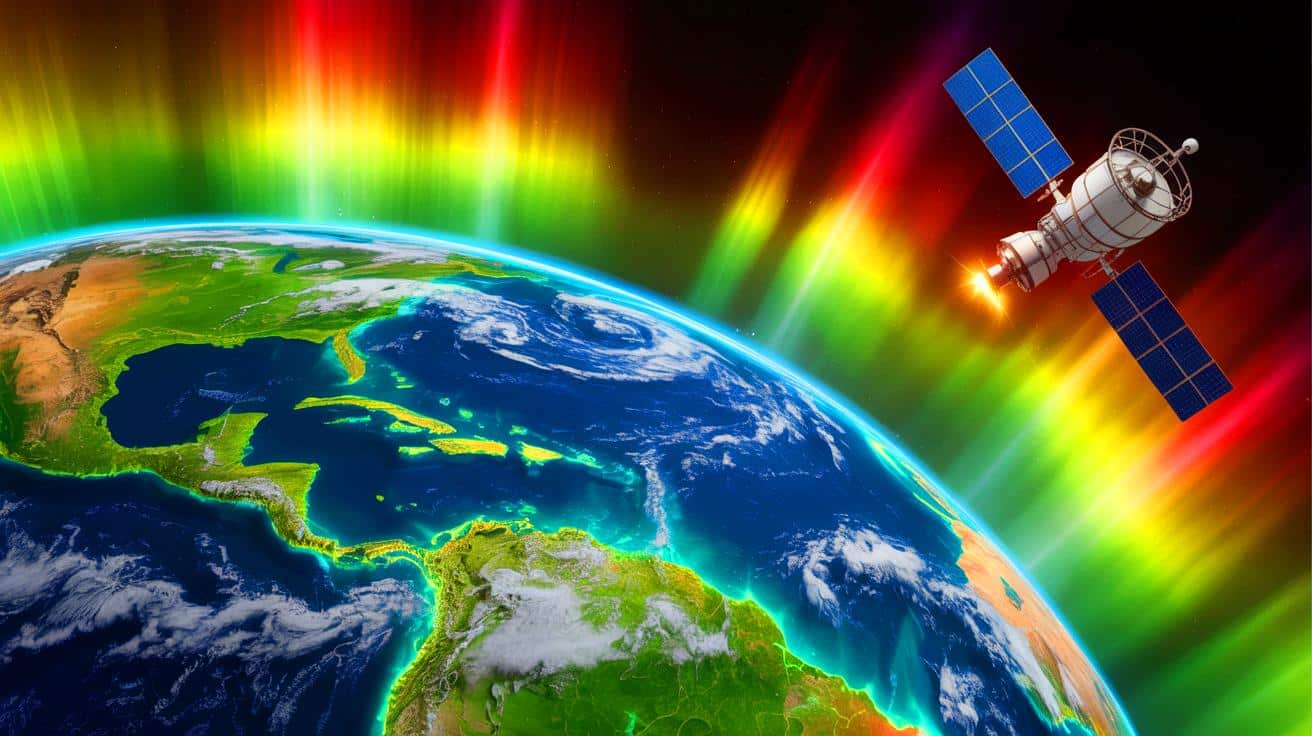
The South Atlantic Anomaly (SAA) has emerged as a significant concern for scientists and space technology operators. This region, stretching over South America and the South Atlantic Ocean, is characterized by a weakened magnetic field. It serves as a unique challenge for NASA and the broader scientific community. Originating from complex processes inside Earth’s core, the SAA is not just a natural phenomenon but a critical area of study due to its potential to impact space technologies. As the anomaly continues to evolve, understanding its mechanisms becomes crucial to anticipate and address the challenges it poses to our technological infrastructure.
Deep Origins and Complex Mechanisms
At the heart of NASA’s concerns is the South Atlantic Anomaly (SAA), a geomagnetic phenomenon both captivating and concerning. This immense region is characterized by a significant reduction in magnetic intensity compared to its surroundings. Far from being a mere scientific curiosity, this weakness acts as a breach in our natural protective shield, allowing high-energy solar particles to dangerously approach Earth’s surface.
The origins of the SAA are intricately linked to the geodynamo, a complex process occurring in Earth’s outer core. Here, the movement of molten iron and nickel generates the magnetic field that envelops us. However, this generation is not uniform. Two primary factors contribute to the formation of the SAA: the tilt of Earth’s magnetic axis relative to its rotational axis and the influence of a massive dense structure known as the African Large Low Shear Velocity Province, located about 1,800 miles beneath the African continent. These factors disrupt the magnetic field generation in this region, leading to a local polarity reversal within Earth’s magnetic field, further weakening the dipole field intensity in this specific area.
A Threat to Space Technology
This magnetic vulnerability poses significant risks to space technology. Satellites traversing the SAA are exposed to high levels of energetic protons, which can cause single event upsets (SEUs). These incidents can lead to temporary malfunctions, data corruption, or even permanent damage if critical systems are affected.
To mitigate these risks, many satellite operators take preventive measures, such as shutting down non-essential systems when passing through the anomaly. Even the International Space Station (ISS) crosses the SAA on each orbit. While its shielding effectively protects astronauts, external instruments remain more vulnerable. Bryan Blair, deputy principal investigator for the GEDI instrument on the ISS, reports occasional “glitches” and resets, resulting in a few hours of data loss each month. Other missions, like the Ionospheric Connection Explorer (ICON), also closely monitor the SAA and adjust their operations accordingly.
Dynamic Evolution and Challenges
The South Atlantic Anomaly is far from static. Recent data, particularly from the ESA’s Swarm constellation and historical measurements from NASA’s SAMPEX mission, confirm several alarming trends. The anomaly is slowly drifting northwest, expanding in surface area, and, as observed since 2020, beginning to split into two distinct lobes, creating two centers of minimum magnetic intensity.
This bifurcation increases the number of hazardous zones for spacecraft and complicates the task of scientists developing predictive models of geomagnetic conditions. Understanding the changing morphology of the SAA is crucial for the safety of current and future satellites. As Terry Sabaka of NASA emphasizes, these developments necessitate continuous monitoring and adaptation in satellite operations to mitigate potential disruptions.
Anticipating the Invisible
To refine their understanding and predictions, NASA combines satellite data with simulations of Earth’s core dynamics. These inputs feed global models like the International Geomagnetic Reference Field (IGRF), which track the evolution of Earth’s magnetic field. These models are essential not only for planning space missions but also for gaining a better grasp of our planet’s internal structure. The approach resembles weather forecasting but on much longer timescales, allowing scientists to estimate the secular variation—the slow yet persistent changes in the magnetic field over years and decades.
While the current evolution of the SAA is unprecedented in the space era, geological records suggest that such anomalies are not exceptional over long timescales. It is important to note that, according to scientists, the current SAA is not an early indicator of a magnetic pole reversal, a natural but rare phenomenon occurring over hundreds of thousands of years. Thus, studying the SAA remains a vital research area, crucial for protecting our orbiting technologies and deepening our understanding of the profound forces driving our planet.
As the South Atlantic Anomaly continues to evolve, the scientific community remains vigilant in its efforts to understand and mitigate its impact. With its potential to disrupt satellite operations and influence our understanding of Earth’s magnetic field, the SAA poses intriguing questions about the future of our planet’s magnetic dynamics. How will these changes shape our technological and scientific pursuits in the years to come?




Wow, 72 hours seems like a very short time for anything like this. Are we prepared enough? 🌍
Wow, 72 hours seems really urgent! Is this something we should be worried about? 🤔
Is there a chance this anomaly could affect GPS systems too? 🤔
Thanks for the detailed explanation. I had no idea about the South Atlantic Anomaly before!
Thank you for this information! It’s fascinating to learn about Earth’s magnetic mysteries.
So, if the SAA keeps evolving, could it become a serious problem for everyday tech? 🚀
Why is the anomaly splitting into two lobes such a big deal? Can’t NASA just adjust the satellites’ paths?
The article mentions a massive dense structure beneath Africa. Could that have other unknown effects?
This sounds like the plot of a sci-fi movie! Are there any plans to make a documentary on this?
Great read! It’s amazing how much we still don’t know about our own planet. 🌌
Can this anomaly impact climate change in any way? Just wondering.
So, should we expect more glitches with our GPS systems because of this anomaly?
Does NASA have a backup plan if satellites get permanently damaged by the SAA?
It sounds like something out of a sci-fi movie! Hope NASA got this under control. 😅
Wait, should we be worried about this? 72 hours isn’t much time!
Is there any correlation between the SAA and earthquake activities?
Fascinating article! How often do anomalies like these occur in Earth’s history?
Can this anomaly affect internet connections if it impacts satellites? 📡
Why is this only affecting the area over South America and the South Atlantic?
So the SAA is splitting into two? Does that mean it’s getting worse?
Is this a sign that Earth’s magnetic field could flip soon? 😨
Thanks for the detailed explanation! It’s comforting to know scientists are on it.
Does the SAA have any effect on animals that rely on Earth’s magnetic field for navigation?
Could this lead to a larger global event or is it just a localized phenomenon?
Should we be adjusting our technology based on the evolution of such anomalies?
What kind of data do satellites lose when they pass through the SAA? Is it recoverable?
I wonder if this could be linked to the Bermuda Triangle somehow. 🤔
How long has the SAA been around, and is it getting worse over time?
Is there a possibility that this anomaly could affect our weather systems?
Why don’t we hear more about these kinds of threats? Seems pretty important! 🌐
Are there any other anomalies like the SAA in different parts of the world?
Is the SAA a natural occurrence or is it influenced by human activity? 🤔
Can the anomaly impact airline communications when flying over the affected area?
Thanks for sharing this! It’s important to stay informed about space weather. 🚀
What measures are in place to protect astronauts on the ISS from this anomaly?
Is there a timeline for when the SAA might peak or resolve naturally?
Does the article suggest any long-term solutions to manage the anomaly’s effects?
Can regular people do anything to help mitigate the risks posed by this anomaly?
Will the SAA affect future Mars missions or is it only a concern for Earth orbit? 🚀
I hope this doesn’t mean another Y2K kind of panic! 😅
Is the anomaly’s impact on satellites similar to that of solar flares?
Could this be a reason for the weird weather patterns we’ve been experiencing? 🌦️
Is there any chance of this anomaly affecting human health directly?