




| IN A NUTSHELL |
|
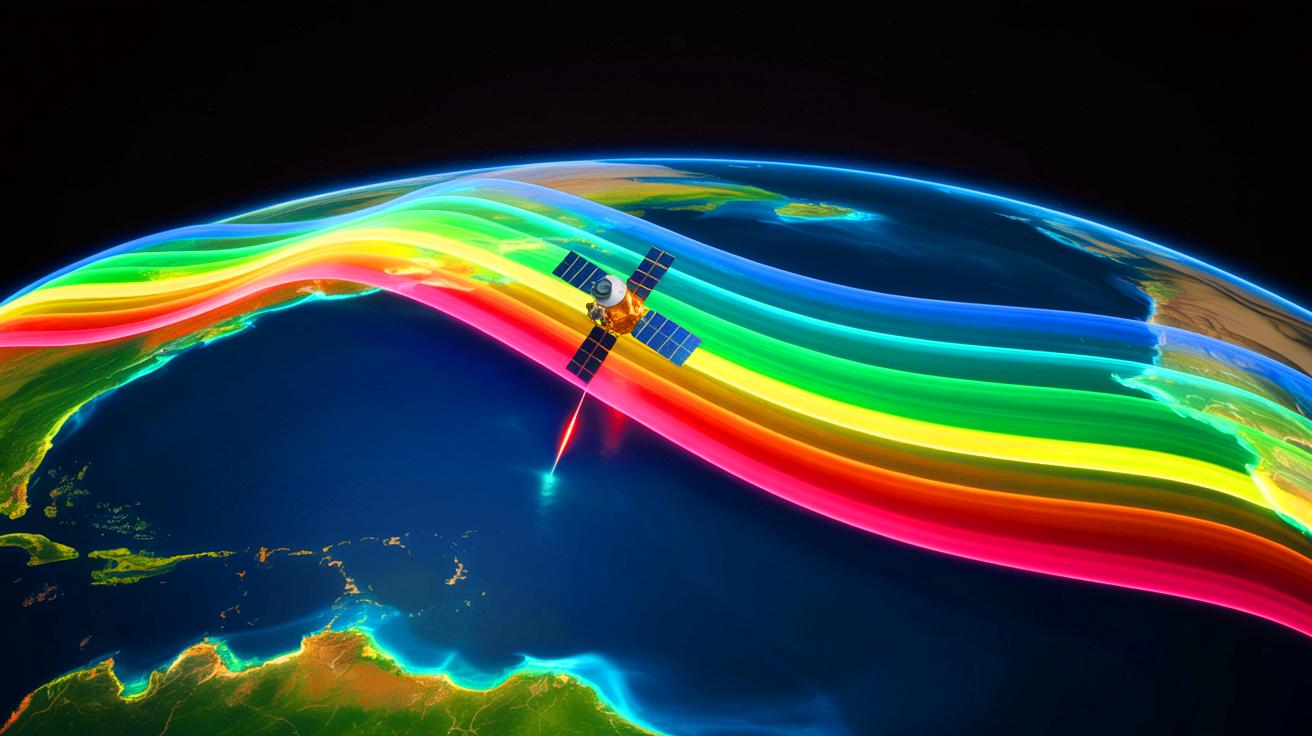
NASA’s ongoing surveillance of a peculiar anomaly in Earth’s magnetic field has raised both intrigue and concern among scientists. This vast region of lower magnetic intensity, known as the South Atlantic Anomaly (SAA), spans the skies between South America and southwest Africa. While it doesn’t pose a direct threat to life on Earth, it has significant implications for spacecraft and satellite operations. As these technologies navigate through the anomaly, they face the risk of malfunction due to exposure to charged solar particles. The SAA’s unpredictable nature continues to challenge researchers, prompting NASA to leverage its extensive resources to monitor and study this enigmatic phenomenon.
The South Atlantic Anomaly: A Closer Look
The South Atlantic Anomaly has long been a subject of scientific curiosity. This vast area of weakened magnetic intensity stretches over a significant portion of Earth’s atmosphere. NASA likens the SAA to a “dent” in our planet’s magnetic field, affecting satellites and other orbital technologies. The anomaly’s influence is particularly pronounced for spacecraft in low-Earth orbit, such as the International Space Station. As they pass through this region, they encounter a reduced magnetic shield, exposing them to high-energy protons from the Sun. This exposure can result in short circuits and malfunctions within technological systems onboard.
Satellite operators must remain vigilant to mitigate the risks posed by the SAA. Routine shutdowns of spacecraft systems are often necessary to prevent significant data loss or permanent damage. Despite these challenges, the anomaly offers a unique opportunity for scientific exploration. NASA’s dedicated research efforts aim to unravel the complexities of this mysterious phenomenon. By studying the SAA, scientists hope to deepen their understanding of Earth’s magnetic field and its broader implications for our planet.
Unraveling the Mystery of Earth’s Magnetic Field
Understanding the South Atlantic Anomaly requires a deep dive into the intricacies of Earth’s magnetic field. This magnetic shield is primarily generated by the movement of molten iron in Earth’s outer core. The dynamic nature of this swirling ocean of iron creates electrical currents that, in turn, generate the magnetic field. However, the field is not uniformly distributed. Geophysicists have identified a massive reservoir of dense rock beneath the African continent, known as the African Large Low Shear Velocity Province, which disrupts the field’s formation.
Located about 1,800 miles below the surface, this geological feature contributes to the anomaly’s dramatic weakening effects. The tilt of Earth’s magnetic axis further complicates the field’s behavior. As a result, the SAA emerges as a region where the dipole field’s dominance is weakened. This localized field, with its reversed polarity, creates a pocket of reduced magnetic intensity. NASA’s research endeavors aim to shed light on these complex interactions, offering insights into the mechanisms driving the SAA’s evolution.
Tracking the Anomaly’s Dynamic Evolution
Recent studies have revealed that the South Atlantic Anomaly is not a static feature. Instead, it is subject to dynamic changes in both size and shape. In 2016, NASA heliophysicist Ashley Greeley led a study that demonstrated the SAA’s slow drift across the Earth’s surface. Subsequent research using CubeSats confirmed the anomaly’s movement, providing valuable data for tracking its evolution. Even more intriguingly, the SAA appears to be splitting into two distinct cells.
In 2020, researchers discovered that the anomaly seemed to be dividing, creating separate centers of minimum magnetic intensity. This finding raises questions about the future trajectory of the SAA and its long-term implications. While the anomaly’s precise impact on Earth’s magnetic field remains uncertain, evidence suggests that it is not a recent development. Studies indicate that the SAA may have been a recurring event for millions of years, dispelling fears of an imminent magnetic field reversal.
The Broader Implications of the Anomaly
The South Atlantic Anomaly’s influence extends beyond spacecraft and satellites. Recent research has highlighted its impact on auroras, adding another layer of complexity to its effects. As scientists continue to unravel the anomaly’s mysteries, they are left with more questions than answers. The SAA serves as a reminder of the dynamic nature of Earth’s magnetic field and the need for continued observation and research.
NASA’s commitment to monitoring the SAA underscores the importance of understanding this vast magnetic oddity. By studying its behavior and evolution, researchers can develop models and predictions that enhance our knowledge of Earth’s magnetic environment. The anomaly’s ongoing transformation emphasizes the need for ongoing missions and data collection. As the SAA continues to evolve, it offers a unique opportunity for scientific discovery and exploration.
As NASA diligently monitors the South Atlantic Anomaly, the scientific community remains captivated by its complexities. The anomaly’s dynamic nature and potential implications for Earth’s magnetic field pose a wealth of research opportunities. As we strive to understand this enigmatic phenomenon, we are left with a pressing question: How will the South Atlantic Anomaly continue to evolve, and what does its future hold for our planet and its technological advancements?




This is fascinating! Could the anomaly actually affect our daily technology use on Earth? 🤔
Wow, twice the size of Florida? That’s massive! 😮
Is there a possibility that this anomaly could lead to a global magnetic field reversal?
How does the anomaly impact the International Space Station? Do astronauts notice anything unusual?
Kinda scary to think about how much we rely on satellites. 🛰️
What are the long-term implications if this anomaly keeps growing?
Why is it called “South Atlantic Anomaly”? Wouldn’t “Space Bermuda Triangle” be cooler? 😉
Has there been any historical evidence of similar anomalies affecting past technology or civilizations?
How often does NASA update its data on this anomaly?
Is there a chance this could affect climate change? Seems like everything is connected these days. 🌍
Love articles like this that make science accessible. Keep it up!
What’s the most significant satellite malfunction attributed to this anomaly so far?
Thank you for breaking down such a complex topic! Really appreciate it. 🙌
This anomaly sounds like something out of a sci-fi movie! 😅
Can we expect more detailed studies about the anomaly’s impact on wildlife migration patterns?
How does this anomaly relate to the concept of pole reversal? Are they connected?
I’m skeptical about these anomalies. Seems like fear-mongering to me. 😒
Have there been any attempts to “fix” or mitigate the effects of this anomaly?
Is this the largest magnetic anomaly ever recorded?
Does this mean we’ll need to build more robust satellites in the future?
Is this anomaly unique to Earth, or do other planets experience similar phenomena?
How does the anomaly affect solar energy collection in space?
Why aren’t more people talking about this? It sounds pretty important! 🤷♂️
Could this anomaly have any influence on seismic activity?
What tools or technology does NASA use to monitor the anomaly?
Can amateur astronomers observe any effects of the anomaly from Earth?
With the anomaly growing, should we expect disruptions in internet services?
Is there any connection between this anomaly and the Earth’s tectonic movements?
Wow, the Earth’s magnetic field is more complex than I thought! Mind blown! 💥
Are there any plans to launch new satellites specifically to study this anomaly?
Is it possible for this anomaly to affect GPS systems on Earth?
Feels like we’re only scratching the surface of understanding Earth’s magnetic mysteries!
This was a great read! More articles like this, please! 😊
Does this mean we’ll get more or less auroras? 🌌