



| IN A NUTSHELL |
|
In the depths off the coast of North Wales, a groundbreaking discovery is challenging our understanding of marine ecosystems. Marine biologists have identified rare underwater volcano-like structures that are not geological but biological in origin. These formations, crafted by the elusive volcano worms, are reshaping the seabed into a mysterious new world. Recent sonar surveys have revealed that these colonies are far more extensive than previously believed, offering fresh insights into their distribution and ecological impact. This discovery raises profound questions about the role of these creatures in marine environments and their potential implications for biodiversity.
Discovery of Volcano Worms Off the Llŷn Peninsula
The initial discovery of the volcano worms off the Llŷn Peninsula was a serendipitous event. In September 2005, researchers dredging for bivalves inadvertently unearthed dozens of these peculiar creatures. Prior to this, volcano worms, known scientifically as Maxmuelleria lankesteri, were thought to inhabit only ultra-sheltered Scottish sea lochs. The dredge nets retrieved 20–30 specimens each time, with some worms measuring over 12 inches in length, despite their contracted state. As noted by a marine biology lecturer, the worms’ robust and elastic body walls allowed many to remain intact during their capture.
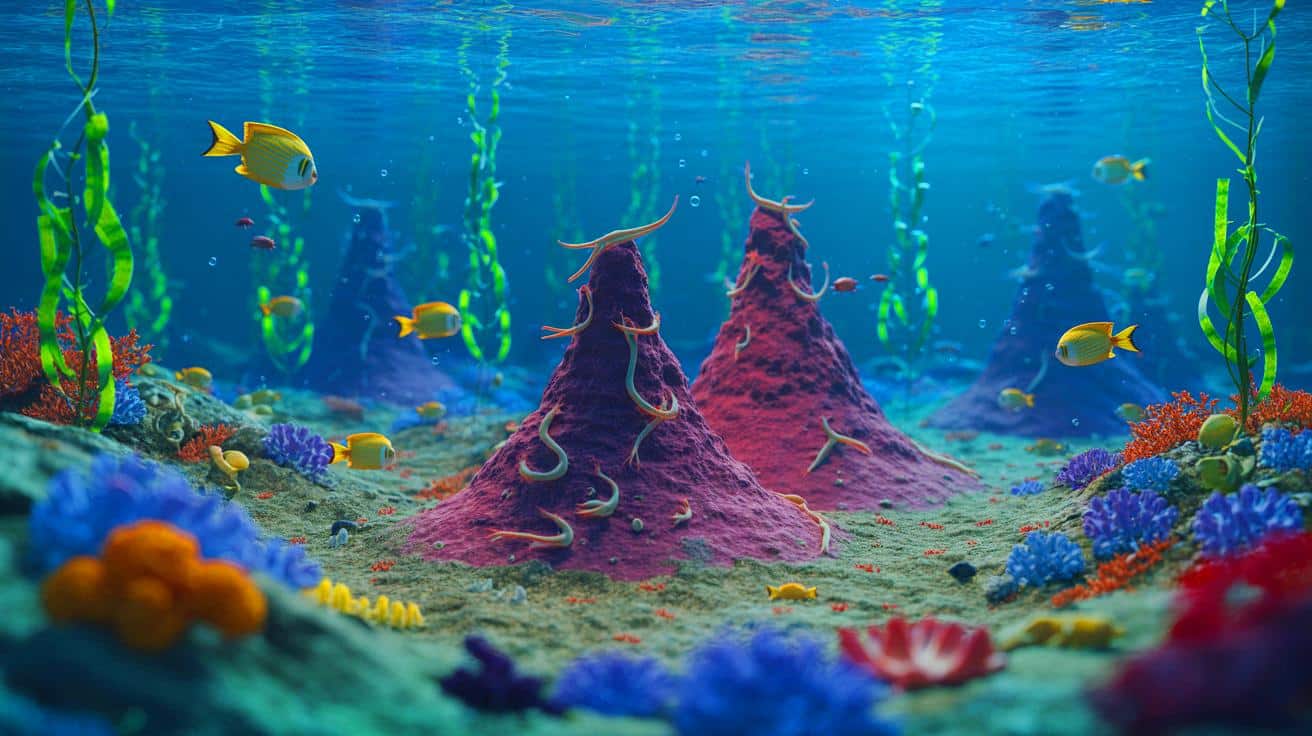
These nocturnal worms are adept at engineering their environment. They burrow into the seabed, crafting intricate, volcano-shaped mounds by ejecting mud and organic matter. Each mound can reach up to 12 inches in height, with burrows extending up to 31 inches deep. With their feather-like proboscis coated in mucus, the worms capture sediments and nutrients, recycling substantial amounts of material daily. This activity positions them as significant bioturbators, transforming benthic habitats by stirring and mixing the seabed sediments.
New Sonar Surveys Reveal Vast Colonies
Advanced surveys conducted by Marine Ecological Solutions, commissioned by Natural Resources Wales, have illuminated the vastness of these colonies. Utilizing side-scan sonar technology in Tremadog Bay, researchers identified that the extent of these volcano worm habitats was far larger than initially anticipated. A spokesperson for the survey team remarked, “Our scientific dive team recently surveyed the seabed at Tremadog Bay with side-scan sonar, confirming the presence of a large community of volcano worms stretching over several miles.”
The seabed appeared pockmarked with these peculiar burrows, resembling an alien landscape. This discovery highlights that the worms are not limited to isolated patches but may be flourishing across broader areas of the Irish Sea. Previous surveys had identified a secondary colony southeast of Pwllheli, suggesting that North Wales may host multiple distinct populations. This finding prompts new inquiries into their distribution, reproductive behavior, and ecological role in shaping marine ecosystems within relatively shallow coastal zones.
The Role of Habitat and Ocean Currents
The presence of volcano worms off the Llŷn Peninsula could be attributed to the region’s unique geographic and hydrodynamic characteristics. Marine biologists propose that the hook-shaped peninsula and the Sarn Badrig reef serve as a natural barrier, deflecting strong tidal currents and creating sheltered mud-filled areas. These conditions are ideal for the worms, which necessitate stable, muddy environments to build their burrows.
Although the worms’ life cycle remains largely enigmatic, their engineering activities have considerable implications for local biodiversity. By consistently expelling mud and organic material, they generate microhabitats that sustain other species. Despite their size, these worms do not seem to attract many predators. Out of more than 1,500 hours of video analysis, scientists observed no predation activity. Only one fish species has been documented with a volcano worm in its stomach, emphasizing their mysterious ecological niche.
An Under-Recorded Species With Hidden Potential
The rarity of these creatures may be more a reflection of their elusiveness than their actual numbers. Traditional mesh trawling methods have long failed to capture them due to their deep burrowing habits. The chance use of deeper dredging techniques in 2005 provided the first significant breakthrough, indicating that volcano worm populations may be more widespread than current records suggest.
Colonies have since been documented not only in North Wales but also in western Scotland, the Irish Sea, and parts of the English Channel. Each new finding adds to the puzzle of their actual range and distribution. Scientists now speculate that there may be more undiscovered colonies along Britain’s coasts, awaiting detection with enhanced survey technologies. The designation of these habitats as part of the Llŷn Peninsula and Sarnau Special Area of Conservation under the OSPAR Convention underscores their significance in marine conservation.
The discovery of volcano worms off the coast of North Wales is a testament to the intricate and often hidden dynamics of marine ecosystems. As researchers continue to unravel the complexities of these remarkable creatures, new questions emerge about their ecological roles and potential contributions to biodiversity. How will our understanding of marine biology evolve as we uncover more about these elusive engineers of the deep?


Wow, 12-inch worms? That’s both fascinating and a little creepy! 🪱
Wow, 12-inch worms building underground cities? That’s both fascinating and terrifying! 🪱👽
Are these worm cities dangerous to other marine life? 🤔
Is this for real? Sounds like something out of a sci-fi movie! 🤔
Thank you for such an enlightening article! Nature never ceases to amaze.
Do we know if these worms have any natural predators?
Can these volcano worms be found anywhere else in the world, or are they unique to Wales?
Could this discovery lead to new insights in marine biology?
How do scientists know that these structures are built by worms and not some other marine creatures?
I’m skeptical. How do we know these aren’t just geological formations? 🤨
So are these worms good or bad for the ecosystem? 🤷♂️
Thanks for this amazing article! Nature never ceases to amaze me. 🌊
12-inch worms building cities? Sounds like a B-movie plot! 🎬
Is it safe for divers to explore these worm colonies, or could they be dangerous?
Is it possible to see these structures via underwater tours?