




| IN A NUTSHELL |
|
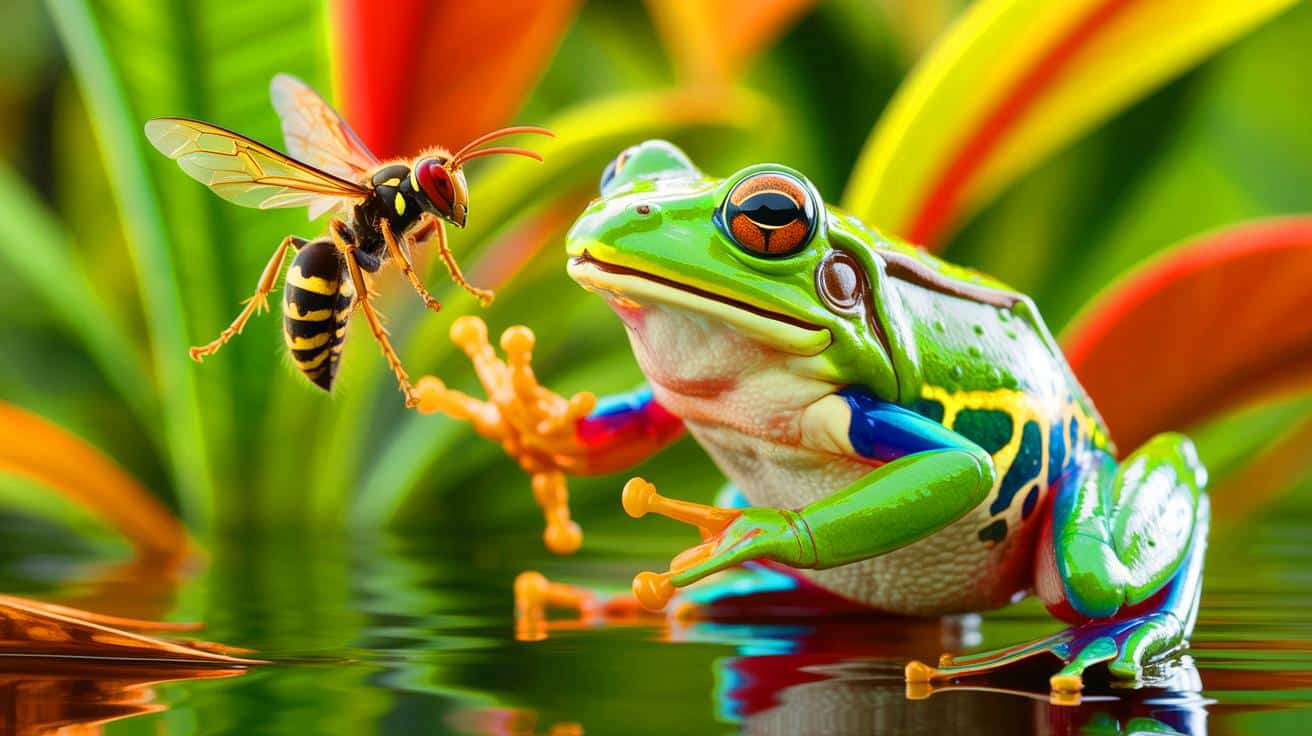
In a surprising discovery, researchers have identified a frog species with a remarkable resistance to hornet venom, defying expectations as it preys on these dangerous insects. The ability of this frog to withstand venomous stings opens new avenues for scientific exploration into how certain animals develop venom tolerance. This finding not only deepens our understanding of the natural world but also highlights a potential model organism for future studies. As scientists delve into this fascinating phenomenon, they aim to uncover the mechanisms behind the frog’s extraordinary resilience, offering insights that could have broader implications for both ecology and medicine.
Understanding the Frog’s Venom Resistance
The notion of an animal regularly consuming hornets without succumbing to their venomous stings is intriguing. Hornet stings are notorious for causing intense pain and can lead to severe systemic issues, including cardiac dysfunction and the destruction of red blood cells. Yet, certain animals, such as some birds, spiders, and frogs, have evolved to prey on these potentially lethal insects. The question that researchers, including Kobe University ecologist Shinji Sugiura, sought to answer was whether these animals were naturally resistant to the venom or simply adept at avoiding stings.
Initial studies involved examining the stomach contents of pond frogs, which sometimes revealed the presence of hornets. This led to further investigations to determine the frogs’ actual interaction with hornets. Sugiura’s research suggested that these frogs might possess an inherent ability to withstand hornet venom rather than merely evading stings. This revelation prompted a series of controlled laboratory trials to explore the frogs’ resilience further.
Laboratory Trials and Unexpected Findings
In a controlled environment, Sugiura conducted experiments to test the frogs’ responses to hornet stings. Adult frogs were paired with hornets of three species: Vespa simillima, V. analis, and V. mandarinia. Each frog encountered a hornet that matched its size, ensuring a fair test of its resistance. The results were striking: a significant majority of frogs successfully consumed the hornets despite being stung, sometimes in sensitive areas like the mouth or eyes.
Remarkably, the frogs exhibited no visible harm even after multiple stings. For instance, 93% of frogs consumed V. simillima, 87% consumed V. analis, and 79% consumed V. mandarinia. This level of resistance is extraordinary, especially considering that a similarly sized mouse could succumb to a single sting. The findings, published in the journal Ecosphere, underscore the unique and exciting nature of this discovery, highlighting the frogs’ potential as model organisms for studying venom resistance.
The Nature of Pain and Lethality in Venom
Research into stinging insects has revealed that the pain inflicted by a sting does not always correlate with the venom’s lethality. Some insects, such as certain bees and wasps, deliver painful stings that are not necessarily life-threatening. Conversely, some species possess highly toxic venom that causes minimal pain. In the case of the hornet-eating frog, it is hypothesized that the animal has developed resistance to both the painful and lethal components of hornet venom.
This dual resistance could be a key factor enabling the frogs to hunt and consume hornets successfully. Understanding the nature of this resistance is crucial for researchers aiming to uncover the physiological adaptations that protect these frogs. The study’s implications extend beyond ecology, as insights into pain and venom resistance might inform medical research and lead to novel approaches in treating venomous stings.
Implications and Future Research Directions
The discovery of the frog’s venom resistance raises several questions for future exploration. Scientists are keen to determine whether the frogs possess specific physiological traits, such as proteins or physical barriers, that neutralize the pain and toxicity of hornet venom. Alternatively, it is possible that certain hornet toxins are less effective against amphibians, which rarely attack hornet colonies.
These frogs may become vital model organisms for studying how vertebrates develop resistance to venom and pain. The research, funded by the Japan Society for the Promotion of Science, opens new paths for understanding venom tolerance. By exploring these fundamental biological processes, scientists hope to gain insights that can be applied to broader contexts, potentially benefiting both ecological studies and medical advancements.
As researchers continue to investigate the extraordinary venom resistance of these frogs, the findings could lead to breakthroughs in understanding how animals adapt to dangerous environments. The implications extend beyond the realm of biology, potentially influencing fields like pharmacology and medicine. With so much left to discover, what other unexpected adaptations might the animal kingdom reveal?


Wow! A frog that eats hornets and survives? Nature never ceases to amaze me! 🐸
Wow, nature never ceases to amaze! 🐸
Is this frog a superhero in disguise? 😂
So, does this mean frogs are going to become superheroes now? 🦸♂️
Great article! Thanks for sharing these insights. 🙌
I wonder if this discovery could lead to new painkillers. 🤔
Could this research help develop new pain medications?
Interesting study! But how did they even start looking for hornet-eating frogs? Seems like quite the niche. 😂
I wonder if other animals have similar venom resistances?
Fascinating read, but I’m curious if there are other animals with similar venom resistance.
Frogs eating hornets sounds like a cartoon episode! 😄
Thanks for sharing this article! It’s always exciting to learn about new scientific breakthroughs. 😊
This is fascinating! What other animals are resistant to venom?
Is this frog’s venom resistance an evolutionary trait or a recent adaptation?