




| IN A NUTSHELL |
|
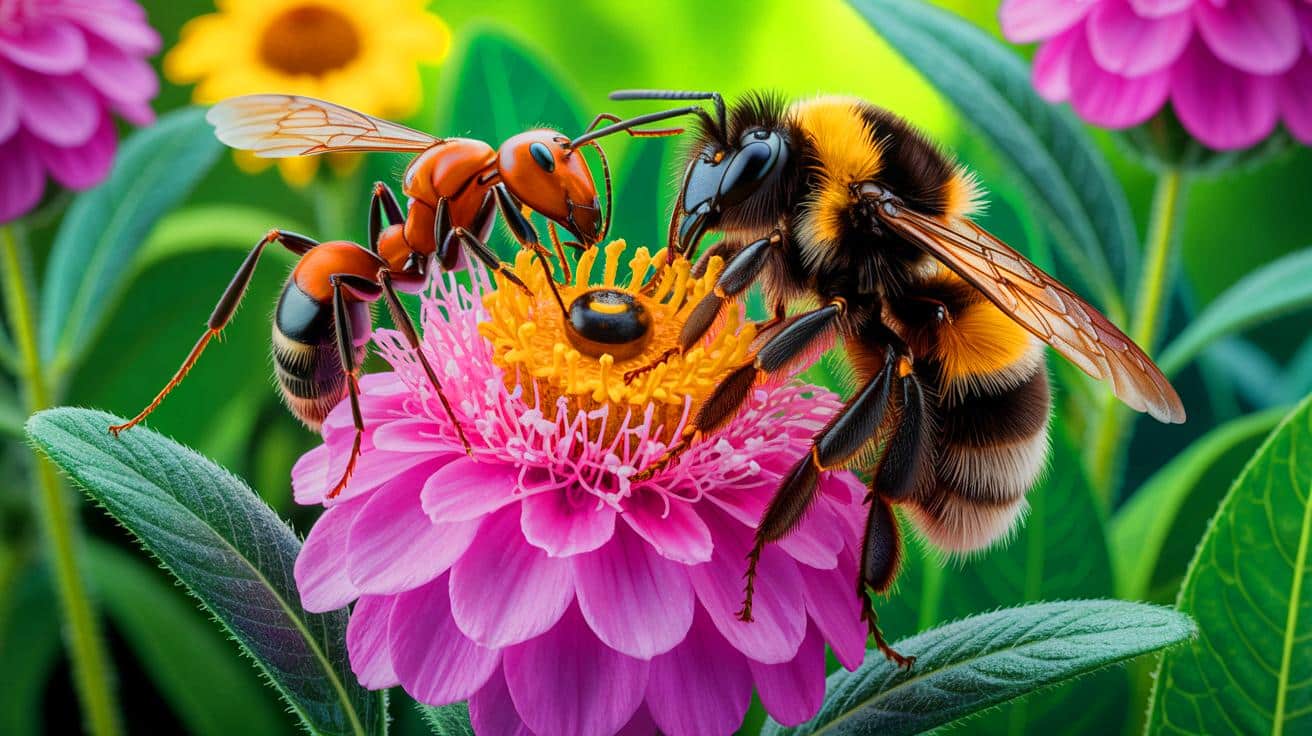
Bumble bees are facing a new threat in the form of invasive Argentine ants, which are affecting their ability to gather food. While bumble bees might win direct confrontations with these ants, they often return to their colonies with less food. This emerging challenge compounds existing pressures from pesticide exposure, habitat loss, and diseases. Entomologist Michelle Miner from the University of California, Riverside has been investigating these interactions, aiming to understand the impact of these “nectar wars” on the vital pollinators. Her research suggests that while bees may appear to come out ahead in individual battles, the overall effect on their colonies could be detrimental.
Understanding Ant and Bee Interactions
Michelle Miner’s study, published in the Journal of Insect Science, offers an in-depth look at the dynamics between bumble bees and Argentine ants. Over 4,300 individual behaviors from more than 415 bumble bees were meticulously recorded. These experiments, conducted in the lab of UCR professor Erin Wilson Rankin, involved setting up an arena where bumble bee colonies could forage at feeders, some of which were surrounded by ants.
Argentine ants, often called sugar ants, are known for their collective strength. They tend to overwhelm other insects by gathering in large numbers rather than using individual strength. “They can dominate a food resource just by showing up en masse,” Wilson Rankin explained. This collective behavior poses a unique challenge for bumble bees, whose role as pollinators is crucial for many ecosystems.
“With how important bumble bees are as pollinators, it made sense to try and understand more about what’s going on in these tiny nectar wars, because they could have a big impact,” Miner said.
Bees Avoid Ant Crowds but Still Risk Bites
During the research, it was observed that bumble bees consistently avoided feeders with ants. As the number of ants increased, the bees’ willingness to approach the feeders decreased. More ants also meant a higher likelihood of the bees getting bitten, although the bites were not deadly. In some cases, the bees retaliated, showcasing a bi-directional aggression.
While bumble bees can sting without dying, unlike honeybees, Miner noted that stinging was not a common response during these experiments. Instead, bees used their mandibles—sharp, tooth-like structures—to defend themselves. “Mandibles are like teeth but not only used to chew,” Miner explained. “They can flare open to handle flowers or crunch a foe.”
“We do see the aggression being bi-directional,” Wilson Rankin said. “Sometimes you’ll see ant heads on the bee legs because they were feeding and in response to an attack, the bee bit the ant and decapitated it.”
Winning Fights but Losing Foraging Time
Despite the bees’ larger size, which often helped them win against individual ants, the overall impact on the colony was less positive. After encounters with ants, bees frequently engaged in prolonged aggressive exchanges, delaying their return to foraging. “The ant presence induced prolonged aggressive exchanges,” Wilson Rankin noted. While aggression might benefit an individual bee in the short term, it could be disadvantageous for the colony as a whole.
These aggressive interactions mean that bees spend more time in conflict rather than gathering food. This shift in behavior can lead to energy loss and reduced food intake for the colony. The study highlights a critical question: how does the colony compensate when foragers return with less food than expected?
“Even though that one bee might benefit from being aggressive in the short term, it may not be beneficial for the colony overall,” Wilson Rankin said.
Energy Loss and Uncertain Colony Impacts
Once bees engage in attack behavior, they stop gathering food. “They’re wasting energy, they could be getting harmed, and they’re not bringing food back,” Wilson Rankin stated. This shift in behavior raises questions about the overall impact on the colony’s health and sustainability.
The internal dynamics of the colony in response to reduced food intake remain unclear. “We do know that the youngest bees don’t leave the colony. Once they’re old enough to ‘get their licenses’ they go out and forage,” Wilson Rankin explained. “We don’t know if the colony sends out additional foragers when one comes back short. That’s the next question it’s important to answer.”
As researchers continue to explore the interactions between bumble bees and Argentine ants, the findings emphasize the complexity of these ecological relationships. The impact of these “nectar wars” could have far-reaching implications not only for bumble bee colonies but also for the wider ecosystems that rely on them for pollination. What strategies can be devised to support bumble bee populations in the face of such multifaceted challenges?



This is such a fascinating read! I never knew ants could impact bees so much. 🐝
Is there any way to control the ant population without harming the bees? 🐜
This sounds like a bee version of Game of Thrones. 🐝⚔️
Can bumble bees adapt to this new threat somehow?
Thanks for highlighting this issue! It’s crucial for our ecosystem.
Why are these ants called “Argentine”? Are they from Argentina?
Wow, I had no idea ants could be so aggressive. That’s some serious competition for nectar!
So, bees are losing because they get tired from fighting too much?
Thank you for shedding light on this issue. Our poor bees need all the help they can get!
Do the ants have any natural predators that could help control their numbers?
I wonder how climate change might be affecting this situation.
So, are there any solutions being proposed to help the bumble bees?
Interesting research! How can we help support local bee populations?