




| IN A NUTSHELL |
|
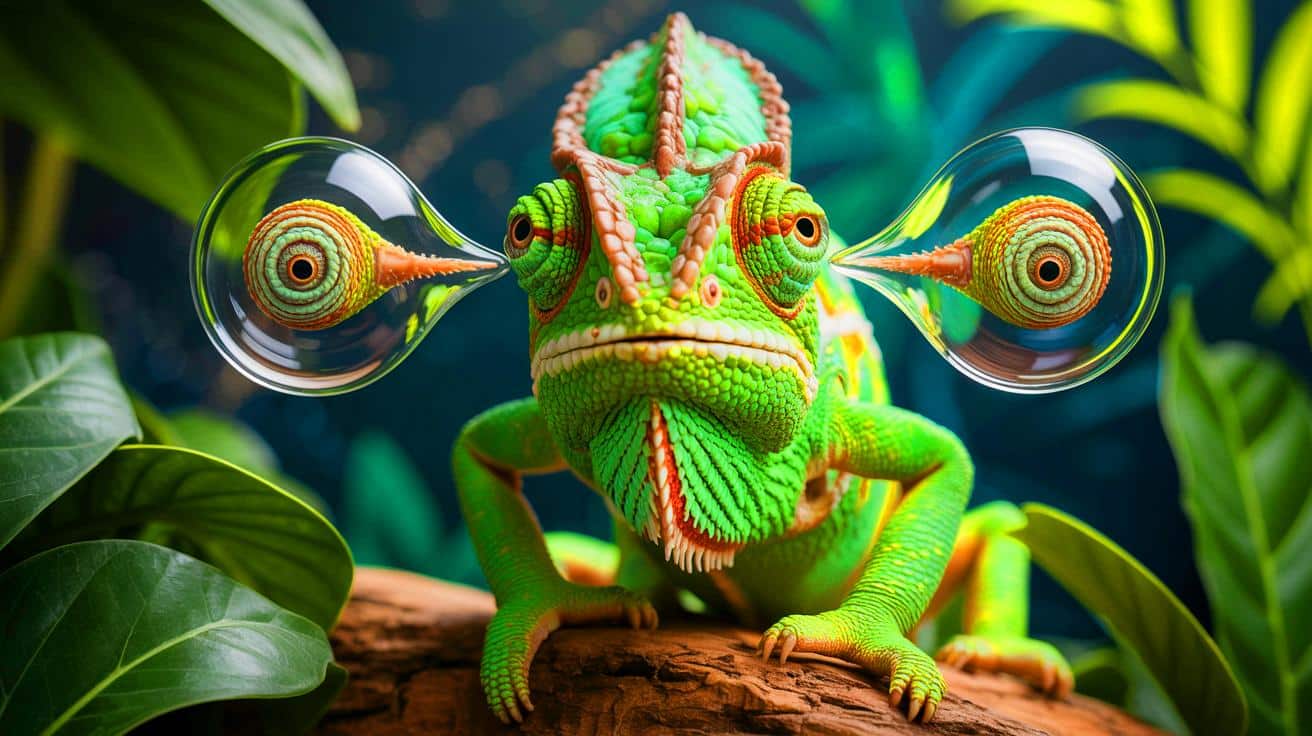
For thousands of years, chameleons have captured the imagination of observers with their extraordinary ability to move their eyes independently. This characteristic, likened to security cameras by modern scientists, has puzzled researchers for centuries. Now, a breakthrough in imaging technology has unveiled the mystery behind this unique adaptation. Researchers have discovered that chameleons possess a distinctive anatomical feature: long, spiraled optic nerves hidden behind each protruding eye. This revelation not only broadens our understanding of chameleon vision but also challenges long-held assumptions about these fascinating reptiles.
A Surprising Discovery in the Lab
The journey to uncovering the secrets of chameleon vision began with a surprising discovery in a laboratory. In 2017, Edward Stanley, the director of the digital imaging laboratory at the Florida Museum of Natural History, noticed something unusual while visiting a colleague’s lab. A CT scan of a minute leaf chameleon revealed tightly coiled optic nerves, a feature not previously documented. Despite the excitement of this discovery, both researchers hesitated to draw conclusions immediately. They assumed that such a distinctive structure must have been reported before, given the extensive scientific history surrounding chameleons.
Juan Daza, an associate professor at Sam Houston State University, expressed his astonishment at the finding. “I was surprised by the structure itself,” he admitted, “but I was more surprised that nobody else had noticed it.” This revelation prompted a thorough search of historical anatomical literature, which, surprisingly, confirmed that the coiled optic nerves had never been fully described. The discovery marked a significant advancement in understanding chameleon biology and opened new avenues for further research.
Chameleons’ Distinctive Biology
Chameleons are renowned for their remarkable adaptations, which extend far beyond their ability to change color. These reptiles inhabit diverse regions across Africa, Europe, and Asia, and exhibit unique traits that have fascinated humans for millennia. Their prehensile tails provide balance as they navigate through trees, while their mitten-like feet enable a deliberate, measured stride. Despite their slow movement, chameleons possess a high-speed weapon: a tongue capable of accelerating from zero to 60 miles per hour in a fraction of a second. This elongated tongue can strike prey at distances more than double the chameleon’s body length.
Their intriguing biology has made chameleons a subject of cultural and scientific interest throughout history. The research team, convinced that someone must have described the optic nerve coils in earlier literature, embarked on an extensive investigation. They consulted language experts to interpret old anatomical works written in various languages, including French, Italian, and Latin. However, their search yielded no evidence of prior documentation, underscoring the uniqueness of their discovery and the importance of revisiting historical assumptions with modern technology.
Historical Attempts to Explain Chameleon Vision
The mystery of chameleon vision has intrigued scholars for centuries, leading to various theories and misconceptions. Over two thousand years ago, Aristotle suggested that chameleons lacked optic nerves entirely, instead proposing a direct connection between their eyes and the brain. This idea was later refuted by Roman physician Domenico Panaroli in the mid-1600s. Panaroli asserted that chameleons did possess optic nerves, but that these did not cross as they do in many other animals. He believed this absence of crossing granted chameleons greater freedom of eye movement.
Even Isaac Newton, a giant in the field of optics, ventured into the debate. In his 1704 book Optiks, Newton referenced chameleons to support Panaroli’s conclusions. Yet, Claude Perrault, a French anatomist, had already provided a more accurate depiction in 1669, showing two optic nerves that crossed and then continued straight. Unfortunately, Perrault’s illustration received little attention at the time. These historical attempts to unravel the complexities of chameleon vision highlight the enduring curiosity surrounding these reptiles and the challenges of accurately documenting their anatomy using the tools available at the time.
CT Imaging and Open Access Data Transform Research
The advent of CT scanning technology has revolutionized the study of chameleons and other reptiles. High-resolution X-ray CT allows researchers to view structures concealed within preserved specimens, offering unprecedented insights into chameleon anatomy. The discovery of coiled optic nerves in a single chameleon provided an essential clue, but researchers needed broader evidence to confirm the finding. Fortunately, they had access to the oVert project, an initiative led by the Florida Museum of Natural History, which offers public access to 3D digital models of vertebrate anatomy.
This digital resource enabled the team to examine CT scans from over thirty lizards and snakes, including several chameleon species. The results were compelling: all chameleon species displayed optic nerves longer and more tightly coiled than those of other lizards. This confirmed that the initial discovery was representative of chameleons as a group. The ability to study intricate anatomical details without damaging specimens marks a significant advancement in the field, allowing scientists to uncover new aspects of chameleon biology and inspire further research into their fascinating adaptations.
In light of these discoveries, chameleons continue to captivate researchers and enthusiasts alike. Despite centuries of study, these reptiles still hold secrets waiting to be uncovered. As scientists explore the evolutionary context and potential parallels with other tree-dwelling lizards, new questions arise. How might these findings reshape our understanding of chameleon evolution and adaptation? What other surprises might still be hidden within the world of these enigmatic reptiles?



Wow, 2,000 years is a long time to solve a mystery. What took so long? 😅
Wow, this is mind-blowing! Who knew chameleons had such complex eye structures? 🤯
This is fascinating! How do the spiraled optic nerves impact a chameleon’s vision compared to other reptiles?
Can this discovery have implications for other species with unique vision capabilities?
I never knew chameleons had such complex adaptations. Nature is truly amazing! 🌿
Thanks for the article! It’s amazing how technology keeps revealing nature’s secrets.
So, Newton was wrong about chameleons? That’s a twist I didn’t expect!
How did they manage to miss this for so long? 🤔
Incredible discovery! What does this mean for the future of chameleon research?
Great read, but I wish the article explained more about how CT imaging works.
I’m curious, are there any other animals with similar optic nerve structures?