


| IN A NUTSHELL |
|
Russia’s recent announcement of discovering a colossal oil reserve beneath the Antarctic seabed has sent ripples through the geopolitical landscape. The reported 511 billion barrels of oil in the Weddell Sea, if verified, could potentially redefine global energy dynamics. This discovery, however, challenges the longstanding treaties that have preserved Antarctica as a zone of peace and scientific exploration. As nations grapple with the implications of this find, questions arise about international treaties’ strength and the potential for resource-driven conflicts in the region.
A Deposit Larger Than Saudi Arabia’s Known Reserves
The magnitude of the potential oil reserve discovered by Russia is staggering. With 511 billion barrels, this find is nearly double the proven reserves of Saudi Arabia, the world’s leading oil exporter. To put this in perspective, it’s more than ten times the North Sea’s oil production over the last five decades. Such a find is not just significant; it stands among the largest globally reported reserves.
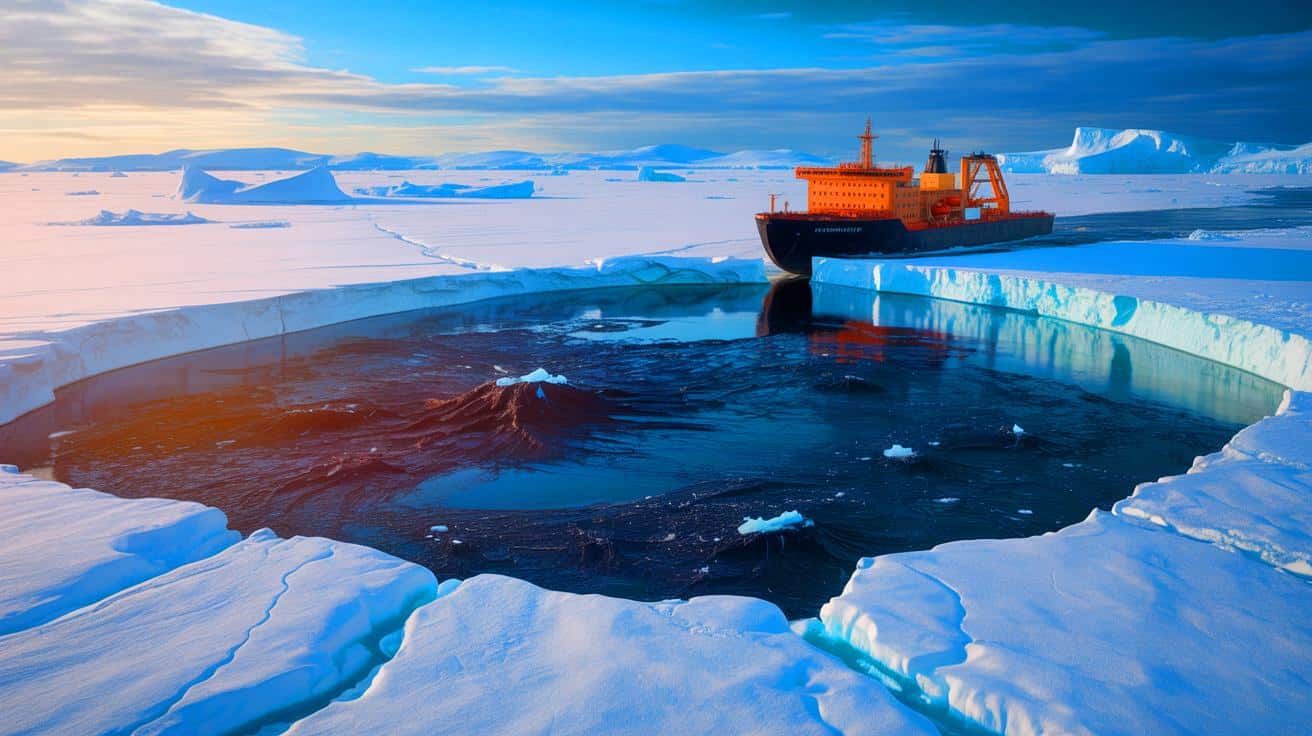
Russian research vessels made this discovery during recent expeditions in the Weddell Sea. Although these missions were ostensibly scientific, there are rising concerns in the United Kingdom and beyond that Russia might be masking resource exploration activities as scientific research. This suspicion challenges the 1959 Antarctic Treaty, which explicitly forbids mineral and oil extraction.
Antarctic Treaty Under Strain as Tensions Grow
The Antarctic Treaty, signed in 1959, represents a pivotal international agreement involving 54 nations. It dedicates the continent to peace and science, explicitly prohibiting military activities and commercial resource extraction. However, Russia’s activities have cast a shadow over the treaty’s effectiveness and relevance amidst growing geopolitical tensions.
Professor Klaus Dodds, a geopolitics expert from Royal Holloway, University of London, expressed concerns during a UK Parliamentary session. He noted that Russia’s data collection could be perceived as prospecting rather than genuine scientific research. Dodds also linked Russia’s actions to broader international tensions, particularly following its 2022 invasion of Ukraine. He warned that Moscow’s strained relations with the West might lead to increased strategic competition in Antarctica.
Russia Denies Mining Intent, but Seismic Data Raises Eyebrows
Russian officials maintain that their missions comply with the Antarctic Treaty. According to UK Foreign Office minister David Rutley, Russia has assured that its surveys are solely for scientific purposes. Despite these assurances, skepticism persists about the true intent behind the seismic studies conducted by Russian teams.
Seismic data acquisition, often employed in petroleum exploration, maps underground structures in great detail. While not explicitly prohibited by the treaty, such activities raise questions when aligned with known petroleum-rich formations. Experts argue that despite Russia’s claims, the nature of the data collection suggests a commercial motive.
A New Front in Global Resource Competition
This report emerges at a time when major global powers are discreetly increasing their presence in Antarctica. Since 1957, Russia has established five research stations on the continent. China, another significant player, has recently inaugurated its fifth Antarctic base.
Both nations have also opposed Western-backed initiatives to expand marine protected areas in Antarctica, notably in 2022. This opposition has fueled concerns that environmental protections are being sacrificed for strategic interests. As Arctic and offshore reserves dwindle and energy market pressures mount, previously untapped regions like Antarctica are drawing heightened attention for oil, natural gas, rare earth elements, and future strategic leverage.
A Legal and Diplomatic Challenge With No Clear Solution
The legal landscape surrounding this discovery is complicated by overlapping territorial claims. The United Kingdom asserts sovereignty over the British Antarctic Territory, including the Weddell Sea. However, Argentina and Chile also lay claim to the region. Many countries, including the United States and Russia, do not recognize any Antarctic claims, further complicating enforcement of the treaty.
While Russia cannot legally extract oil under current international law, the Antarctic Treaty lacks a formal enforcement mechanism. Countries are expected to hold one another accountable, but this has become increasingly challenging in a fragmented geopolitical environment. As Professor Dodds suggests, the true test lies in whether the international community can uphold the treaty framework against gradual erosion.
The discovery of potential oil reserves beneath Antarctica’s seabed presents significant challenges and opportunities. It questions the durability of international treaties and raises concerns about future resource-driven conflicts. As nations navigate this complex landscape, the critical question remains: Can the world balance the pursuit of valuable resources with the preservation of international peace and scientific collaboration?


Isn’t the Antarctic Treaty supposed to prevent this kind of thing? 🤔
Wow, 511 billion barrels! Is it April Fool’s Day or something? 😂
Russia and oil… classic combo. What’s next, drilling on the moon?
Can international treaties actually stop a country like Russia? 🤨
Can someone explain how this violates international treaties? I’m a bit lost. 🤔
This could be the beginning of a new era of energy wars. Scary thought.
Hold on, 511 billion barrels? Did they count those barrels themselves?
Sounds like Russia is playing a dangerous game here. 🌍
Thank you for the informative article! I’ll be keeping a close eye on this. 👍
Is this a real discovery, or just Russia flexing its muscles?
This is a disaster waiting to happen… or maybe it’s already happening. 😟
What are the chances this leads to a global conflict? Pretty high, I’d say.
Oh great, just what we needed, more oil. 😒
Look on the bright side! You’ll have new clothes, shoes, cars, food, materials for A, B, C D, E , F and G, H, I, J, K, L and most of M.. N,O, P and Q, al of R, S, T and U, V, W, X, Y aaaaand Z..
Looks like oil is back on the menu girls!!! 😉👍
How many treaties does it take to stop a superpower? Apparently more than one.
Why does it feel like every major discovery is followed by looming conflict?
Wouldn’t it be better to invest in renewable energy instead of new oil reserves?
This is a huge geopolitical mess. How can it be resolved peacefully?
Russia’s claims seem a bit too convenient, don’t they? 🤷♂️
Seriously, who needs Antarctica’s oil? Leave it alone already! 🛑
Is there any hope for enforcing the Antarctic Treaty in this situation?
Imagine the logistics of extracting oil from Antarctica. It’s mind-boggling!
Thanks for covering this important issue. It’s alarming but necessary to know. 🙏
Does anyone else feel like we’re living in a James Bond movie? 🎬
What role will other countries play in this unfolding drama?
Are we seriously talking about drilling in Antarctica now? 😳
Every major discovery seems to come with a major downside. Why is that?
If true, this could change everything. Are we ready for the consequences?
Love how the world ignores treaties when there’s money involved. 🤦♀️
Why is no one talking about the environmental impact? We should be worried!
Russia again? Why am I not surprised? 😒
How can they even verify such a massive reserve without drilling?
Does this mean cheaper gas prices for everyone? One can dream! 🤑
Another cold war, this time literally cold! 😂
How will this impact global warming if they start drilling?