



| IN A NUTSHELL |
|
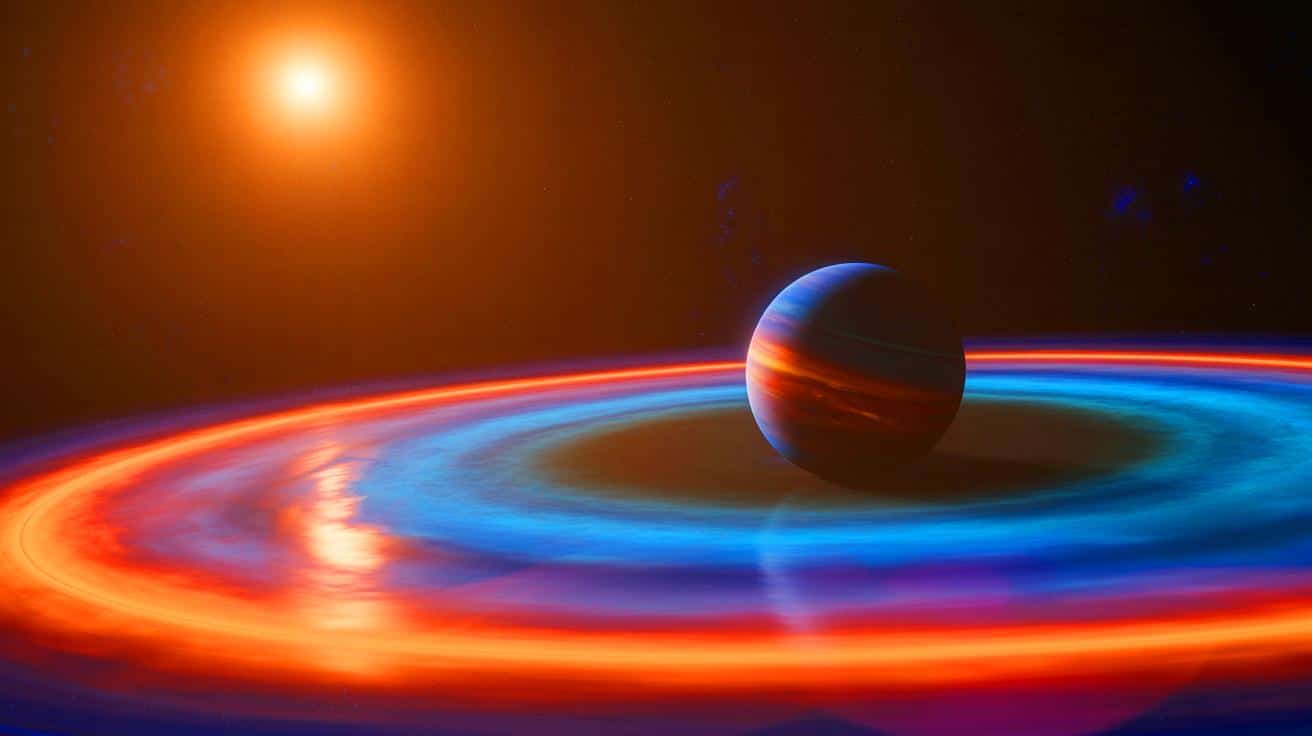
The discovery of a potential exoplanet orbiting Alpha Centauri A, one of the stars in the stellar system closest to our own, has reignited excitement in the astronomical community. NASA’s James Webb Space Telescope, equipped with its Mid-Infrared Instrument (MIRI), has provided compelling evidence of a gas giant within this system. Alpha Centauri, located just 4 light-years away from Earth, has long intrigued researchers due to its proximity and similarity to our Sun-like stars. While the newfound planet is unlikely to support life as we know it, its presence in the habitable zone of a Sun-like star offers tantalizing possibilities for future research and exploration.
The Promise of the Alpha Centauri System
The Alpha Centauri system, visible only from Earth’s Southern Hemisphere, consists of three stars: Alpha Centauri A, Alpha Centauri B, and Proxima Centauri. Alpha Centauri A and B form a binary system and are often referred to as Sun-like stars, while Proxima Centauri is a faint red dwarf. Despite the presence of three confirmed planets orbiting Proxima Centauri, confirming additional planets around Alpha Centauri A and B has been a daunting challenge for astronomers.
Recent observations using NASA’s James Webb Space Telescope have provided the strongest evidence yet of a gas giant orbiting Alpha Centauri A. The Mid-Infrared Instrument (MIRI) on the telescope has detected signals that suggest the existence of this planet, which, if confirmed, would be the closest planet to Earth orbiting in the habitable zone of a Sun-like star. While this gas giant may not support life, its proximity to Earth makes it a prime candidate for further study.
Challenges in Exoplanet Discovery
Detecting exoplanets, especially around bright stars like those in the Alpha Centauri system, presents numerous challenges. These stars are not only bright but also move quickly across the sky, complicating observations. To overcome these hurdles, the operations team at the Space Telescope Science Institute devised a custom observing sequence tailored specifically for this target. This effort has paid off, enabling the detection of a potential planet in the system.
Charles Beichman, a co-first author on the newly published papers, highlighted the difficulties of these observations:
“These are incredibly challenging observations to make, even with the world’s most powerful space telescope.”
The dedication to customizing observation strategies underscores the significance of this discovery and the potential insights it offers into planetary systems beyond our own.
The Disappearing Planet Mystery
The initial detection of the potential planet was made in August 2024. However, subsequent observations in February and April 2025 did not reveal the same object, leading researchers to investigate the mystery of a “disappearing planet.” Ph.D. student Aniket Sanghi of Caltech, a co-first author on the research papers, explained the approach taken to solve this puzzle.
Using computer models, the research team simulated millions of potential orbits, incorporating data from both Webb and previous observations. These simulations accounted for gravitational stability in the presence of Alpha Centauri B and considered various orbital paths. The results suggested that the planet may have moved too close to the star during certain observations, rendering it invisible to the telescope. This complex analysis highlights the dynamic nature of exoplanet research and the challenges of confirming such discoveries.
Implications for Exoplanet Science
If confirmed, the potential planet orbiting Alpha Centauri A would mark a significant milestone in exoplanet imaging efforts. Aniket Sanghi emphasized the importance of this discovery: “Of all the directly imaged planets, this would be the closest to its star seen so far.” The planet’s proximity, temperature, and age make it a compelling target for further study and could provide valuable insights into the formation and evolution of planetary systems.
Future missions, such as NASA’s Nancy Grace Roman Space Telescope, are poised to build on Webb’s findings. By complementing Webb’s infrared observations with visible light data, Roman could offer unique insights into the planet’s size and reflectivity. This collaborative approach between current and future telescopes promises to expand our understanding of exoplanets and their potential for hosting life.
The discovery of a potential exoplanet in the Alpha Centauri system is a testament to the capabilities of modern telescopes and the ingenuity of astronomers. As researchers continue to explore this intriguing system, new questions arise about the nature of planetary formation and the potential for life beyond our solar system. What other secrets might the Alpha Centauri system hold, and how will future missions unlock these mysteries?



Wow, a new planet so close to us! Can’t wait for future updates from NASA. 🚀
Wow, a planet just 4 light-years away! 🚀 Can’t wait to see what they find next! 🌟
Is this gas giant similar to Jupiter in our solar system?
Are they sure it’s not just a glitch in the matrix? 🤔
How confident are scientists that this planet truly exists and isn’t a fluke in the data?
Will this discovery affect plans for a future Alpha Centauri mission?
You make it sound as if doing that is just around the corner. Hate to break it to you, but it ain’t happening anytime soon. You do realize how far 4 light years is right? And what our capabilities are, right? Even the ambitious proposals to go there are questionable at best. It just isn’t that easy.
Thank you NASA and James Webb team for pushing the boundaries of space exploration!
How does the James Webb Space Telescope compare to Hubble in terms of capabilities?
Is there any chance this gas giant could have moons that support life? 🌑
This ^^^
4 light-years away is still pretty far. How long would it take a spacecraft to get there?
At Voyager 1 speed – over 73,000 years.
At Parker solar probe speed (430k mph) – 6,700 years
At 10 percent speed of light (67 million mph) – 45 years.
Can we expect more discoveries like this from the James Webb Telescope soon?
It’s amazing what technology can do. Kudos to the NASA team! 🎉
Did the researchers find anything else interesting around Alpha Centauri A?
This is great news, but when do we get to visit? 😉
We don’t. Not anytime soon. It’s a long, long, long way.
How does this discovery affect our understanding of the habitable zone?
Could the planet’s orbit be affected by Alpha Centauri B?
What does “habitable zone” really mean if the planet can’t support life?
Another gas giant… when will we find a “New Earth”? 🌎
Hope the Nancy Grace Roman Space Telescope can confirm this soon!
Why can’t they find a planet with life on it yet? What’s taking so long?
If it’s so hard to confirm, how do we know it’s really there? 🤔
The disappearing planet mystery sounds like a sci-fi plot! Are aliens involved? 👽
Are there any plans for a mission to send a probe to Alpha Centauri?
I’m excited but also skeptical. Let’s see what future observations reveal.
Another gas giant? When will we find a new Earth? 🌎
How does this planet’s discovery influence the search for extraterrestrial life?
Amazing discovery! Does this mean more funding for space research? 💸
What other instruments, besides MIRI, were involved in this discovery?
So close yet so far! When will we have the tech to explore these planets directly?
What’s the next step after they confirm this planet’s existence?
Why does it take so long to confirm these discoveries? Seems like ages! 🕰️
What if the disappearing planet is actually a cloaked spaceship? 😲