




| IN A NUTSHELL |
|
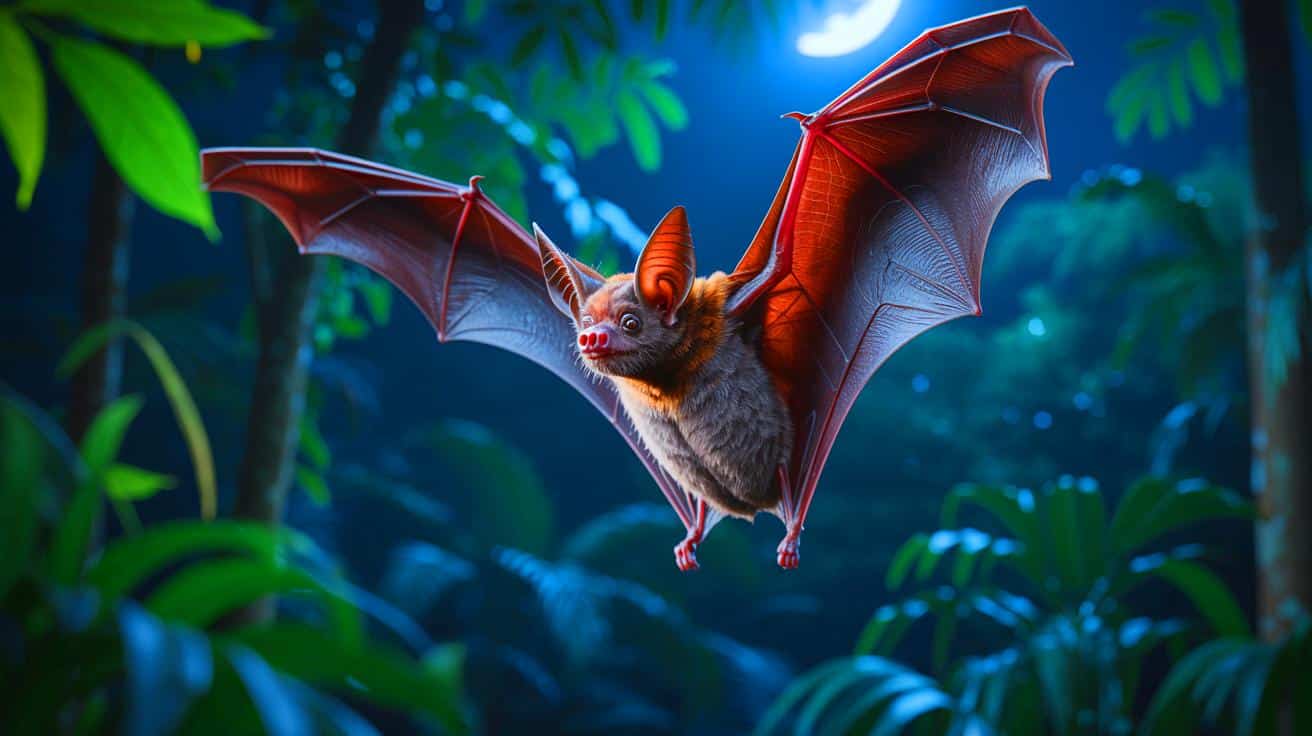
In the dense forests of Panama, a remarkable discovery challenges our understanding of predator behavior. Researchers from Aarhus University and the Smithsonian Tropical Research Institute have uncovered how fringe-lipped bats, tiny creatures weighing around 30 grams, rival the hunting prowess of lions. Equipped with miniature “backpacks,” these bats were observed capturing large prey, such as frogs and small mammals, with astonishing precision. The findings, published in Current Biology, reveal that these bats can consume nearly their own body weight in one meal. This efficiency places them among the most energy-conservative predators, despite their small size. The study sheds light on a curious anomaly in nature: how these petite predators manage to thrive on large prey.
A Puzzling Exception in Nature
In the animal kingdom, size typically dictates hunting strategies. Larger predators like lions and polar bears can afford to pursue big, energy-rich prey due to their slower metabolism and vast energy reserves. Smaller predators, on the other hand, must hunt frequently and typically target smaller, more abundant prey. Yet, fringe-lipped bats defy this norm. These small bats are among the select few true carnivorous bats, relying heavily on vertebrates such as frogs and birds for sustenance.
The critical question arises: how do such diminutive creatures with limited energy reserves manage to hunt large and often elusive prey? To unravel this mystery, researchers focused on the fringe-lipped bat as their model species. These bats are notorious for feeding on túngara frogs, leading scientists to anticipate capturing numerous instances of these amphibians in their recordings. However, the reality proved far more intriguing.
Hunting More Like Lions Than Bats
Contrary to expectations, fringe-lipped bats demonstrate hunting behaviors more akin to big cats than other bat species. These bats exhibit patient “hang-and-wait” tactics, remaining motionless for extended periods to ambush unassuming prey. Their attacks, when they occur, are swift and precise. After successfully capturing prey, the bats often rest for much of the night, much like lions and leopards do after a substantial meal.
The combination of sensory abilities — hearing, sight, and echolocation — allows these bats to detect low-frequency sounds, such as frog mating calls, with remarkable accuracy. This sensory cocktail enables them to pinpoint and capture large prey with exceptional precision, turning conventional assumptions about small predators on their head.
Big Hunters in Small Bodies
Leonie Baier, the lead author of the study, expressed awe at the discovery: “It was incredible to discover that these bats hunt like big predators trapped in tiny bodies.” The bats spend approximately 89 percent of their time conserving energy by resting. When they do take flight, their hunting forays are brief, with most lasting under three minutes. The average hunting flight is a mere eight seconds.
This hunting efficiency is not just impressive; it is extraordinary. Fringe-lipped bats have a success rate of about 50 percent in their hunts, starkly contrasting with larger mammals such as lions, which have success rates of around 14 percent, and polar bears, which can be as low as two percent. Such high efficiency in a small predator fundamentally challenges our understanding of energy dynamics in hunting.
Meals That Test Their Limits
The size of the prey these bats capture often exceeds expectations. On average, the prey accounts for about seven percent of the bat’s body weight, akin to a 154-pound human consuming an 11-pound meal. Some bats have even captured prey nearly matching their size, such as the Rosenberg’s gladiator tree frog, which can weigh up to 20 grams.
Researchers determined prey size by measuring the duration of the bats’ chewing, with the longest recorded meal lasting a staggering 84 minutes. The ability to handle such large prey with skill and efficiency suggests a sophisticated hunting strategy honed by experience.
Experience Sharpens Skill
Older bats exhibit a heightened aptitude for managing larger prey, indicating that skill improves with practice. These bats are known for their long-term memory, specifically regarding frog calls, and their capacity to learn new techniques by observing others. Laura Stidsholt, a senior author of the study, noted, “We wanted to understand what these bats are actually doing out there in the dark — so we listened in, much like the bats themselves listen to their prey.”
By using biologging tags that combine high-resolution sound recordings with movement data, researchers could reconstruct entire hunting sequences in the wild. This innovative approach allowed scientists to experience the forest from the perspective of the bats, unveiling a hidden world of patience, precision, and survival in the dark.
The revelations from this study not only reshape our understanding of predator behavior but also highlight the extraordinary adaptability of nature’s hunters. As we continue to explore the complexities of ecological interactions, what other secrets might the natural world hold? What might we learn from the smallest of creatures that challenge the status quo of survival strategies?



Wow, bats hunting like lions? Nature never ceases to amaze! 🦇
Wow, bats hunting like lions? Nature never ceases to amaze me! 🦇
How do the backpacks not affect the bats’ flight abilities?
Is there a video of these bats hunting? I’d love to see it in action!
Could this behavior be found in other small predators too? 🤔
Incredible efficiency for such a small creature. Makes me question what else we might be missing in nature.
This is fascinating. Thank you for sharing such intriguing research! 😊
Fascinating read! I had no idea bats could hunt prey their own size. Thanks for the insight!
I’m skeptical. How do they know the bats’ success rate is 50%?
So bats are the new lions? What’s next, mice as elephants? 😂
50% success rate in hunting? Those bats are real pros! 🏆
Does this mean bats are smarter than we thought, or just instinctively skilled?
Why is it surprising that older bats are better hunters? Isn’t that the case with most animals?
I wonder how climate change might affect their hunting behavior over time.
Is there any evidence that other bat species might adopt similar tactics?
What’s the significance of the bat’s “hang-and-wait” strategy? Sounds like my cat!