




| IN A NUTSHELL |
|
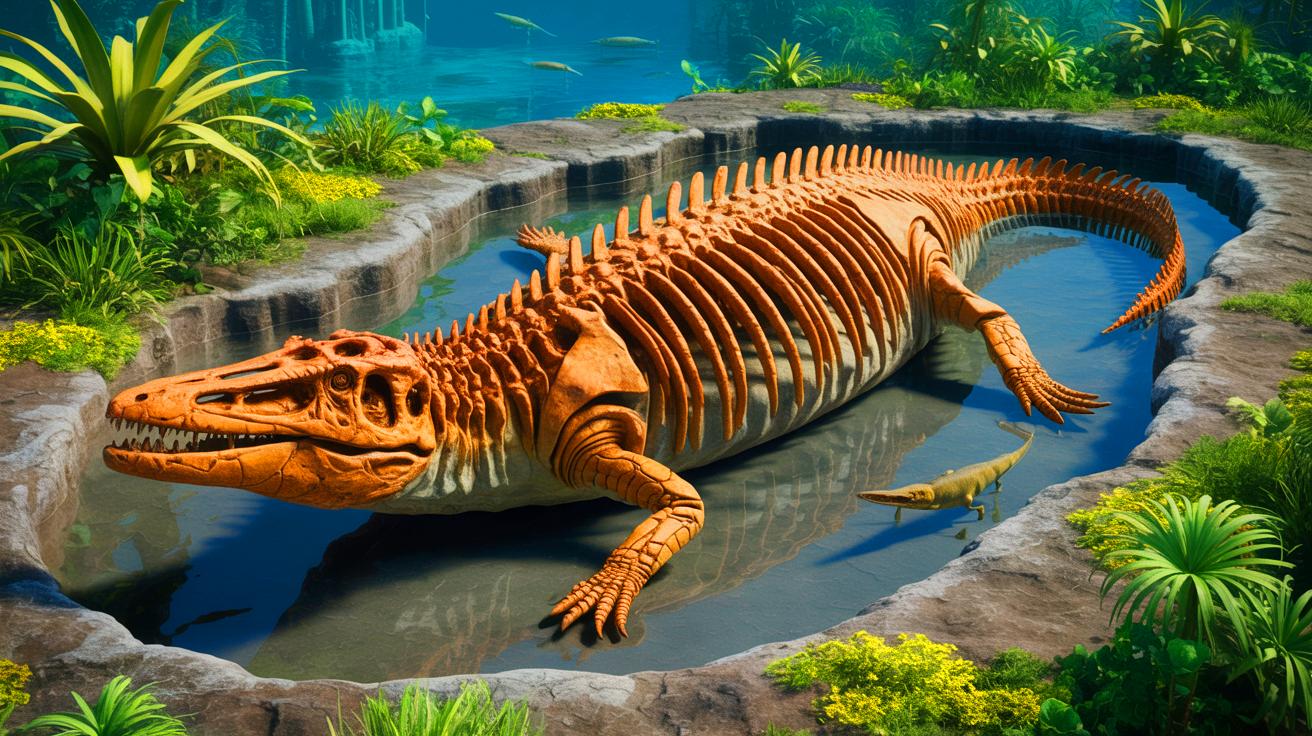
A groundbreaking discovery in Switzerland has unveiled a fossil that could reshape our understanding of ancient marine life. The fossil belongs to Lariosaurus valceresii, an aquatic reptile that lived 240 million years ago during the Middle Triassic period. What makes this find particularly remarkable is the presence of preserved skin and scales, offering unprecedented insight into the anatomy and lifestyle of these ancient creatures. This rare preservation was made possible by the unique conditions of the Monte San Giorgio area, a UNESCO World Heritage site. As researchers delve deeper into this exceptional find, the fossil is beginning to reveal secrets that challenge long-held assumptions about marine reptiles.
Exceptional Preservation of Ancient Skin
The fossilized remains of Lariosaurus valceresii were discovered in a state of preservation that is rarely seen in paleontological finds. The skin is preserved as a carbon film, providing a detailed outline of the scales and revealing much about the animal’s physical characteristics. This kind of preservation is especially significant because soft tissues typically decay over time, leaving only bones behind.
The Monte San Giorgio region, once a tropical lagoon, had environmental conditions that favored fossil preservation. The low-oxygen waters and chemical-rich environment discouraged scavengers, allowing soft tissues to remain intact when animals sank to the bottom. This unique setting has turned the area into a treasure trove for paleontologists, offering a window into the past that is rarely available.
High-resolution photographs and scanning electron microscopy were employed to study the fossil. These advanced techniques have confirmed that the reptile’s body was largely covered in scales, unlike some other marine reptiles of its time. This discovery provides a clearer picture of the reptile’s anatomy and offers insights into its adaptive strategies.
Revolutionary Insights into Swimming Techniques
The preserved skin and scales have allowed researchers to make significant deductions about the swimming style of Lariosaurus valceresii. The fossil clearly outlines webbed hands and feet, indicating that the reptile was well-adapted to an aquatic lifestyle. The presence of powerful muscles behind the upper arms and on the trunk suggests a unique method of propulsion.
Researchers propose that Lariosaurus used its front limbs in a "rowing-flying" motion, similar to the way modern seals use their flippers. This finding challenges previous assumptions that nothosaurs primarily used their tails for propulsion. Instead, the forelimbs may have played a crucial role in their swimming technique, allowing for rapid acceleration and agile maneuvering in the water.
This adaptation would have given Lariosaurus an edge in its environment, possibly setting it apart from other marine predators of its time. The discovery highlights the diversity of swimming strategies employed by ancient marine reptiles and underscores the evolutionary innovations that arose in response to ecological pressures.
Implications for Understanding Marine Reptile Evolution
The discovery of the Lariosaurus valceresii fossil offers valuable insights into the evolution of marine reptiles following the Permian mass extinction. This catastrophic event, which occurred 252 million years ago, wiped out a significant portion of Earth's biodiversity. The ensuing environmental conditions created niches that allowed for the emergence of new species, including marine reptiles.
The oceans, once devoid of competitors but rich in resources, provided an ideal setting for small reptiles to evolve and diversify. The adaptations seen in Lariosaurus, such as its specialized swimming technique, illustrate the innovative strategies that emerged in response to ecological challenges. This find not only sheds light on the evolutionary trajectory of nothosaurs but also contributes to our broader understanding of marine reptile evolution.
The study of Lariosaurus and its unique adaptations continues to offer new perspectives on the evolutionary history of marine reptiles. As researchers explore these ancient creatures, they uncover the complex interplay of environmental factors and evolutionary pressures that shaped the biodiversity of our planet.
Future Research and Unanswered Questions
The discovery of the Lariosaurus valceresii fossil opens the door to further research into the lives of ancient marine reptiles. By examining other fossils from the Monte San Giorgio area, scientists hope to gain a more comprehensive understanding of the ecological dynamics that existed during the Middle Triassic period.
Future studies may focus on comparing the swimming techniques of Lariosaurus with those of other nothosaurs and marine reptiles. This could provide insights into the evolutionary pressures that influenced the development of different swimming strategies. Additionally, researchers are interested in exploring the role that environmental factors played in shaping the adaptations observed in these ancient creatures.
As we continue to uncover the mysteries of the past, questions remain about the broader implications of these findings. How did the unique adaptations of Lariosaurus influence its survival and success in the ancient oceans? What can these discoveries teach us about the resilience and adaptability of life in the face of environmental challenges?
The discovery of the Lariosaurus valceresii fossil represents a significant milestone in our understanding of ancient marine reptiles. As researchers continue to investigate this remarkable find, they will undoubtedly uncover more secrets about the evolutionary history of these fascinating creatures. What other groundbreaking discoveries might lie hidden beneath the sands of time, waiting to enrich our understanding of Earth's distant past?


Wow, a 240-million-year-old reptile with skin still intact? That’s some serious skincare routine! 😂
Wow, 240 million years old and still intact? That’s older than my grandma’s fruitcake! 🎂🦕
Incredible find! How does this change our understanding of marine reptile evolution?
This discovery could really shake up what we know about marine reptiles. Are there any plans to search for more fossils in Monte San Giorgio?
Thank you for sharing this amazing discovery! The details about the preserved skin are fascinating. 🦎
What are the chances of finding more fossils like this in the Monte San Giorgio area?
Great article! It’s fascinating to see how ancient creatures adapted to their environments. Thanks for sharing this amazing find! 🌊
Wait, did I read that right? Skin still intact after 240 million years? 😲
This is mind-blowing! How do they even know what kind of swimming style it used?
Does this mean Lariosaurus might have been the Michael Phelps of its time? 🤔
As a paleontology enthusiast, I’m thrilled by this discovery. Keep up the great work! 🌟
Does this mean our previous theories on marine reptile evolution are completely wrong?
How does this discovery compare with other nothosaur fossils in terms of preservation and insights?
Can someone explain how the swimming style of Lariosaurus compares to that of modern seals?
I wonder how many more secrets are hiding beneath Monte San Giorgio’s surface. 🏔️
How does this fossil help us understand the impact of the Permian extinction on marine life?
Are there any plans for a public exhibit of this fossil? I’d love to see it in person. 🏛️
Wait, so these guys were basically the Michael Phelps of the Triassic seas? 🏊♂️
What’s next for the researchers? More digs in the Monte San Giorgio area, perhaps?
Can the techniques used in this study be applied to other fossil discoveries?
Great article! The connection between environmental conditions and fossil preservation is so interesting.
I guess the Lariosaurus had some fancy moves back in the day! 😂
How does this fossil compare to other marine reptile fossils in terms of preservation?
Is there a possibility that similar fossils could be found in other parts of the world?
I’m skeptical. How can we be sure the skin is really 240 million years old? 🤔
This has got to be one of the coolest discoveries in paleontology this year! 🦖
Were there any other significant finds in the same area as the Lariosaurus fossil?
How do researchers date fossils like this one so accurately?
It’s amazing that such fine details can be preserved for millions of years. Nature is incredible!
What do these findings tell us about the diet of Lariosaurus? 🐟
The evolutionary adaptations post-Permian extinction are truly fascinating. Thanks for the insights!
Is it possible to determine the age of the Lariosaurus when it died from the fossil? 📏
Can’t wait to see what other groundbreaking discoveries come from this area. ⛏️
How did the researchers ensure the fossil wasn’t damaged during the study?
What other tools or techniques might help in studying such well-preserved fossils?