




| IN A NUTSHELL |
|
The discovery of dinosaur eggs dating back 85 million years has captivated the scientific community. This achievement is made possible through a groundbreaking laser technique developed by researchers from the Hubei Institute of Geosciences in China. This method has enabled scientists to directly date dinosaur eggshell fragments, providing a more accurate understanding of the Late Cretaceous period. The study, published on September 11, marks a significant milestone in paleontology, offering insights into the species Placoolithus tumiaolingensis and their environment. This article delves into the details of this innovative technique and its implications for understanding the Earth’s prehistoric climate and biodiversity.
Innovative Laser Technique in Paleontology
Dating dinosaur eggs has long posed a challenge for paleontologists, primarily due to reliance on indirect methods such as dating surrounding volcanic rocks. These traditional methods often yield inaccurate age estimates because the proxy materials may have undergone geological alterations over time. The newly introduced laser technique, known as carbonate uranium-lead (U-Pb) dating, offers a more direct and reliable solution.
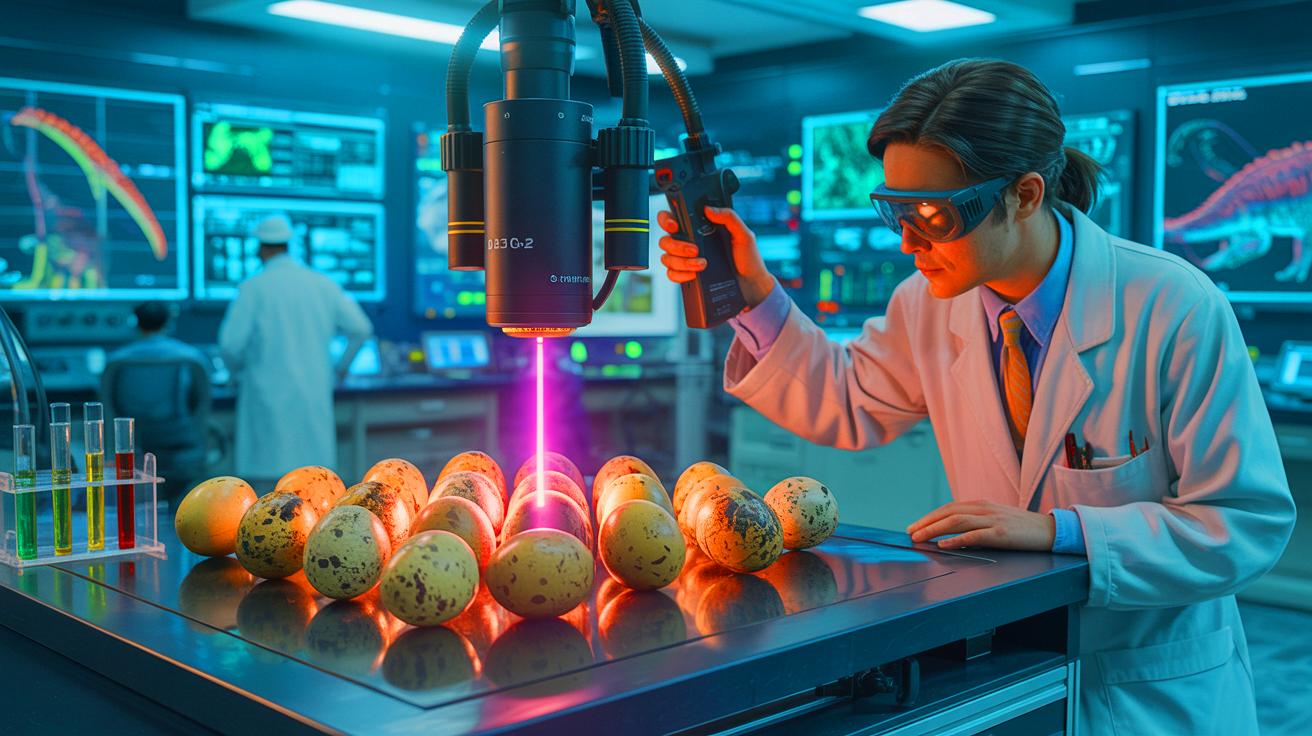
This method involves firing a micro-laser at an eggshell fragment to measure the ratio of uranium to lead atoms within the carbonate minerals of the shell. The uranium decays into lead at a constant rate, allowing researchers to calculate the age of the fossils by measuring the accumulated lead. Dr. Bi Zhao, a leading researcher at the institute, describes this process as an “atomic clock for fossils.”
The team applied this innovative technique to dinosaur eggs discovered at the Qinglongshan site in central China. This site is China’s first national dinosaur egg fossil reserve, containing approximately 3,000 fossilized eggs. The majority of these fossils belong to the species Placoolithus tumiaolingensis, known for their highly porous eggshells.
Unraveling the Cretaceous Period
The laser-based dating method has revealed that the dinosaur eggs are approximately 85 million years old, with a margin of error of 1.7 million years. This discovery offers a more accurate timeline for the Cretaceous period, a time of significant global change marked by intense volcanic activity and mass extinctions.
Fossils from the Cretaceous period provide invaluable clues about the Earth’s past climate. The dinosaur eggs were laid during the Turonian epoch of the Late Cretaceous, following a period of global cooling. This climatic shift likely contributed to a decline in dinosaur diversity and may have influenced the egg-laying behaviors of species at the Qinglongshan site.
Dr. Zhao notes that the specialized pore structures found in the eggs of Placoolithus tumiaolingensis may represent evolutionary adaptations to the changing climate. These adaptations highlight the impact of environmental changes on the evolution and extinction of dinosaur species during the Late Cretaceous period.
Implications for Dinosaur Evolution
The successful application of this laser technique has significant implications for understanding dinosaur evolution and extinction events. The ability to establish a more precise timeline for dinosaur eggs provides insights into how these creatures adapted to environmental changes.
Researchers are already planning to expand their sampling efforts, examining eggs from different rock layers to create a more detailed regional timeline. This expanded research will help scientists understand the broader patterns of dinosaur evolution and extinction during the Late Cretaceous period.
The findings, published in the journal Frontiers in Earth Science, underscore the importance of this dating method for reconstructing the history of life on Earth. By providing robust chronological constraints, this technique resolves long-standing uncertainties about the age of these fossils and enhances our understanding of prehistoric ecosystems.
Future Research Directions
The development of this laser technique marks a new era in paleontology, offering a more reliable method for dating dinosaur eggs and other fossils. The research team is optimistic about the potential applications of this method in other paleontological studies.
As scientists continue to refine this technique, it may open new avenues for understanding the evolutionary history of various species and their responses to climate change. The insights gained from this research could also inform our understanding of modern-day climate change and its potential impacts on biodiversity.
As researchers explore the depths of prehistoric life, they continue to unravel the mysteries of Earth’s past. What other secrets might this innovative technique reveal about the history of life on our planet?



Wow! 85 million years old? That’s older than my grandma’s cookie recipe! 🍪
Wow, 85 million years! That’s a mind-boggling figure. Great job, scientists! 🦖
I’m curious about how the laser works without damaging the fossils.
What are the potential errors or limitations of this new dating method?
So cool! This makes me want to become a paleontologist. 🦕
Does this mean we can also date dinosaur nests with this technique?
Thank you to the Chinese scientists for this amazing contribution to science!
How many researchers were involved in this groundbreaking study?
This is the most exciting dinosaur news I’ve read all year!
Did the eggshells reveal anything about the dinosaur embryos inside?
How far can this technique be applied in terms of fossil age?
Laser dating sounds like something out of a sci-fi movie. Love it! 🚀
How will this discovery impact our understanding of the Cretaceous period?
Can this laser technique be used on other types of fossils, like bones or plants?
What else can this laser technique help us discover? The possibilities seem endless!
This is a game-changer for paleontology. Kudos to the research team!
Can this technique be used to date fossils found outside China?
What other prehistoric secrets could this technique help uncover?
Is there a risk of contamination when using this laser method?
Amazing work! How accurate is the margin of error in this dating technique?
I’m blown away by this discovery. Science never ceases to amaze me! 🌟
Will this technique change how museums handle their fossil collections?
I’m curious about the technology behind the laser. Can anyone explain?
This article was a fantastic read! Thanks for sharing such innovative research.
What are the next steps for the research team after this discovery?
Is it possible this technique could work on human fossils too? 🤔
How does this affect our understanding of the mass extinction events?
Will this lead to any changes in the current dinosaur evolutionary timeline?
Can this technique help in studying other prehistoric animals besides dinosaurs?
It’s fascinating that we can now date something as delicate as an eggshell!
This new laser technique sounds like a game-changer! How does it compare to other dating methods in terms of accuracy?
How do they ensure the laser doesn’t alter the chemical composition of the fossils?
Thank you for this detailed explanation. It was very enlightening! 📚
This is incredible! How long did it take to develop this laser technique?
What kind of equipment is needed for this laser dating method?
Why has it taken so long to find a direct method for dating dinosaur eggs? 🤔
Can this technique be applied to other types of fossils, or is it specific to dinosaur eggs?
What exactly is Placoolithus tumiaolingensis? Never heard of it before!
How does this new dating method compare in cost to traditional methods?
Big thanks to the researchers for pushing the boundaries of paleontology! 👏
Thank you for explaining this complex topic so clearly. It’s fascinating!
Do these findings change the way we understand dinosaur evolution?
So, does this mean dinosaurs might have been dealing with climate change too? 🤔
Is this new laser technique available for other researchers to use?