



| IN A NUTSHELL |
|
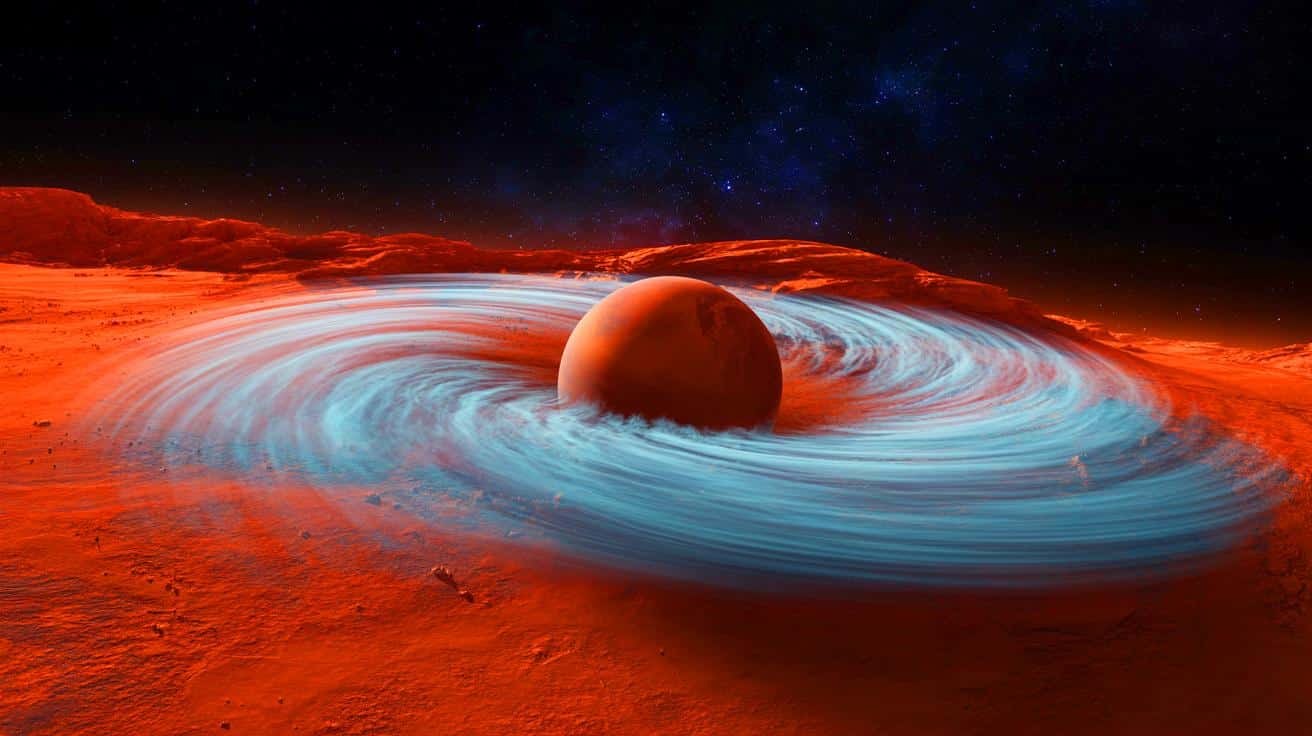
Scientists have recently unveiled a compelling phenomenon above Mars’ north pole: the planet’s polar vortex. This swirling mass of air plunges temperatures significantly lower than the surrounding Martian atmosphere, creating a unique environment that affects atmospheric chemistry. During the long, dark Martian winter, the polar vortex becomes a sanctuary for ozone, a critical component that could provide insights into the planet’s past. The study of this vortex not only helps us understand Mars’ atmospheric dynamics but also raises questions about the planet’s capability to support life billions of years ago.
Understanding Mars’ Polar Vortex
At the heart of Mars’ atmospheric intrigue lies its polar vortex, a seasonal feature driven by the planet’s axial tilt of 25.2 degrees. This tilt, akin to Earth’s, creates seasonal shifts that culminate in the formation of the polar vortex as summer fades. The vortex remains a fixture above the north pole until the arrival of spring. Mars’ polar vortex shares similarities with Earth’s, including the potential to destabilize and drift, thus offering a rare glimpse into its interior.
Dr. Kevin Olsen of the University of Oxford notes that the atmosphere inside the polar vortex is remarkably cold, about 40 degrees Celsius (72 degrees Fahrenheit) colder than the air outside. This extreme cold causes water vapor to freeze, impacting the ozone levels significantly. The absence of ultraviolet sunlight during the Martian winter halts the reactions that typically break down ozone, allowing it to accumulate within the vortex.
Ozone’s presence is not merely a chemical curiosity. It is a reactive form of oxygen, providing clues about the rate of atmospheric chemistry on Mars. By studying ozone concentrations, scientists can infer how Mars’ atmosphere has evolved over time, shedding light on whether the planet once had an ozone layer similar to Earth’s. Such a layer could have shielded the surface from harmful ultraviolet radiation, making Mars potentially hospitable to life.
Probing the Polar Vortex
The quest to understand the Martian polar vortex involves sophisticated tools and international collaboration. Olsen’s work with the European Space Agency’s ExoMars Trace Gas Orbiter plays a crucial role. The spacecraft’s Atmospheric Chemistry Suite (ACS) examines Mars’ atmosphere by observing the sunlight passing through the planet’s limb. This method helps identify which molecules are present and their altitude above the surface.
However, the total darkness of the Martian winter poses a significant challenge, as the Sun does not rise over the north pole during this period. This makes direct observations inside the vortex difficult. To overcome this, Olsen also utilizes data from NASA’s Mars Reconnaissance Orbiter’s Mars Climate Sounder. This instrument measures temperature variations, allowing researchers to pinpoint the location and extent of the vortex.
By combining data from both orbiters, Olsen and his team can distinguish between atmospheric conditions inside and outside the vortex. This comprehensive approach reveals the fascinating chemical dynamics occurring within the vortex, providing a clearer picture of how the Martian atmosphere behaves during its darkest season.
Implications for Discovering Ancient Life
The implications of these findings extend far beyond atmospheric chemistry. The European Space Agency’s ExoMars Rosalind Franklin rover, scheduled to launch in 2028, aims to search for signs of ancient life on Mars. Understanding the planet’s past atmospheric conditions is crucial to this mission. If Mars once had an ozone layer, it could have played a significant role in protecting any potential life forms from ultraviolet radiation.
The presence of an ozone layer would suggest that Mars had a more stable and life-friendly environment billions of years ago. This raises intriguing questions about the planet’s capacity to support life and how it might have evolved. The ongoing research into Mars’ polar vortex thus serves as a vital piece of the puzzle in understanding Mars’ history and its potential to harbor life.
As scientists continue to unravel the mysteries of Mars’ polar vortex, they also keep an eye on the future. The upcoming ExoMars mission could provide further insights into the planet’s past, potentially revolutionizing our understanding of Mars and its capacity to sustain life. These discoveries not only enrich our knowledge of Mars but also inspire curiosity about the possibilities of life beyond Earth.
Mars’ Polar Vortex: A Window Into Planetary Evolution
The study of Mars’ polar vortex offers a unique window into the planet’s atmospheric and potentially biological history. The extreme conditions within the vortex provide a natural laboratory for understanding atmospheric processes that might have occurred in Mars’ past. By examining these processes, scientists can piece together a more comprehensive picture of the planet’s evolutionary trajectory.
Moreover, the research into Mars’ atmosphere has broader implications for planetary science. It can inform our understanding of atmospheric dynamics on other planets and moons, expanding our knowledge of the solar system’s diverse environments. As we continue to explore Mars and its atmospheric wonders, we gain valuable insights into the fundamental processes that shape planetary environments.
By integrating data from multiple sources and missions, researchers are building a detailed understanding of Mars’ polar vortex and its role in the planet’s atmospheric chemistry. This knowledge not only deepens our understanding of Mars but also contributes to the broader field of astrobiology, as scientists seek to answer fundamental questions about the potential for life beyond Earth.
The exploration of Mars’ polar vortex is a testament to the power of scientific inquiry and international collaboration. As we push the boundaries of our knowledge, we are reminded of the vastness and complexity of the universe. What other secrets might the polar vortex hold, and how will they shape our understanding of the Red Planet and its potential to support life?



Wow, did not know Mars had a polar vortex! Makes me wonder what else we’re yet to discover up there. 🚀
Wow, Mars is full of surprises! Can’t wait to see what else we find up there. 🚀
Does this mean we might find Martians someday? 👽
Is the presence of ozone really a sign of potential ancient life, or are we just speculating here?
Why is the ozone layer important for discovering life on Mars?
Thank you for this fascinating article! It’s amazing what we’re learning about Mars. 🌌
Thanks for the insightful article! I’m excited about the future ExoMars mission.
Is it possible that Mars’ polar vortex could affect future human missions?
So, Mars has its own version of the polar vortex? That’s wild!
How do scientists study the vortex if it’s always dark during the Martian winter?
The science behind this is incredible. Kudos to the researchers involved!
This is fascinating! Do you think we’ll find actual evidence of past life on Mars within our lifetime?
How does the Martian vortex compare to Earth’s polar vortex in terms of size and strength?
Why does the absence of UV light affect the ozone in Mars’ polar vortex?
The idea of an ancient ozone layer is mind-blowing. Could Mars have been a paradise at some point? 🤔
Absolutely thrilling stuff. Hope we find something groundbreaking soon!