




| IN A NUTSHELL |
|
Deep beneath the Earth’s surface in South Dakota, scientists are drawing closer to understanding one of the universe’s most profound mysteries: dark matter. This elusive substance, which makes up most of the universe, has long puzzled physicists. Thanks to the groundbreaking LUX-ZEPLIN (LZ) experiment, researchers are setting new records in sensitivity and narrowing down the possibilities of what dark matter could be. As they continue their work, the scientific community holds its breath, hoping these efforts will finally illuminate the nature of the universe’s most enigmatic component.
The Search for Dark Matter’s Elusive Nature
Dark matter remains one of the biggest mysteries in modern physics. Despite its substantial influence on the universe, it has yet to be directly detected. The LUX-ZEPLIN (LZ) experiment, the world’s most sensitive dark matter detector, is leading the charge in this quest. Scientists are particularly interested in weakly interacting massive particles, or WIMPs, as a primary candidate for dark matter.
As physicist Hugh Lippincott explains, setting bounds on what dark matter could be is crucial for particle physics. While discovering a new particle remains the ultimate goal, understanding the limits of current candidates is just as important. The universe’s unseen mass shapes galaxies and holds the cosmic web together, yet continues to evade direct detection, challenging scientists to push the boundaries of their understanding.
A Mile Underground: Hunting for WIMPs
Located nearly a mile beneath South Dakota’s surface at the Sanford Underground Research Facility, the LZ experiment searches for dark matter interactions shielded from background radiation. This subterranean location allows researchers to detect weaker signals than ever before. Over 280 days of observations, the team has gathered significant data, further constraining the possibilities for WIMPs.
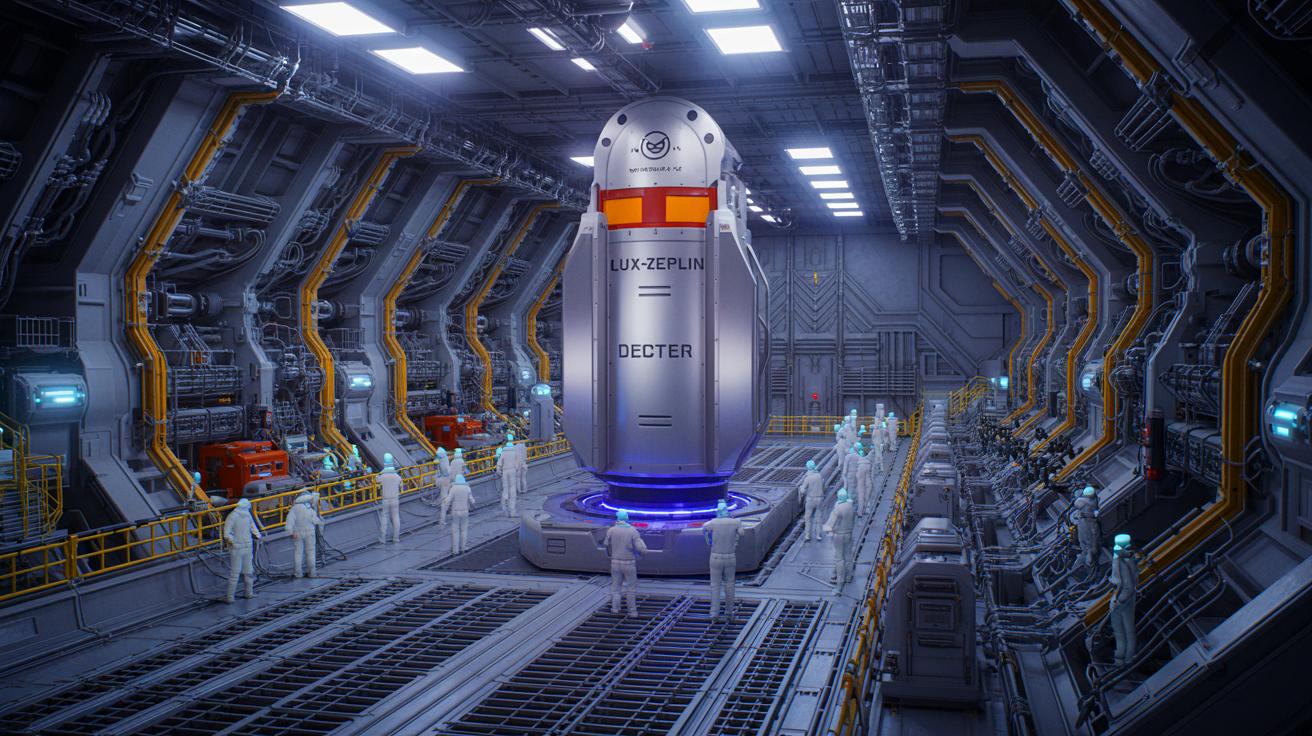
The experiment’s core features two titanium vessels filled with ten tonnes of ultra-pure liquid xenon. This environment is crucial for detecting the tiny flashes of light that a passing WIMP might create. When a WIMP collides with a xenon nucleus, it’s expected to cause a small recoil, similar to a cue ball striking another in billiards. The LZ records these interactions, identifying potential dark matter events. Surrounding the core is a larger Outer Detector, which helps differentiate genuine signals from background noise.
Shielding from the Universe: Reducing Background Noise
The LUX-ZEPLIN’s sensitivity is due to its effective reduction of background noise, which can mimic dark matter signals. Deep underground, the detector is shielded from cosmic rays, and it employs thousands of ultra-clean, low-radiation components to minimize interference. Each layer of the detector either blocks outside radiation or tracks interactions to rule out false positives.
The collaboration, led by UCSB physicists, has developed sophisticated techniques to reduce background interactions. This includes the use of low-radiation parts and advanced analysis methods. The team consists of a diverse group of researchers, including faculty, postdoctoral researchers, and graduate students, all contributing to this monumental effort to uncover the secrets of dark matter.
Neutrons: The Tricky Impostors
Neutrons, found in every atom except hydrogen, are notorious for mimicking WIMP signals. The LZ’s Outer Detector, designed with UCSB’s leadership, plays a crucial role in ruling out neutrons that could be mistaken for dark matter. This component allows scientists to differentiate between genuine WIMP detections and neutron interactions.
Makayla Trask, a graduate student involved in the project, notes that neutrons give off signals identical to those expected from WIMPs. The Outer Detector excels at detecting these particles, ensuring that any potential WIMP detection is not a false positive. This capability is vital for the integrity of the experiment’s results, allowing researchers to confidently pursue their search for dark matter.
A Global Collaboration Looking Ahead
The LUX-ZEPLIN experiment is a testament to international scientific collaboration, involving about 250 scientists from 38 institutions across multiple countries. This global effort is not only about detecting dark matter but also about refining the techniques and technologies used in such experiments. As the collaboration looks forward, there’s excitement about the potential for new discoveries and advancements.
With the current results narrowing the field of possibilities for WIMPs, scientists are eager to analyze future data sets and explore even lower-mass dark matter. This collaboration’s success is supported by numerous institutions and funding bodies, underscoring the importance of teamwork in tackling some of the universe’s most challenging questions.
As the LUX-ZEPLIN experiment continues to gather data and refine its techniques, the scientific community remains hopeful. Could the next breakthrough in dark matter detection come from this pioneering experiment? And what new questions will arise as we inch closer to understanding the universe’s most mysterious substance?



Wow, this sounds like the plot of a sci-fi movie! Are there aliens down there too? 👽
Wow, a mile underground? That’s some serious dedication! 🌍🔍
I’m curious, how do they get all the equipment down there?
Thank you for this fascinating article. The work being done on dark matter is truly groundbreaking!
Fascinating read, but does this mean we’re any closer to actually finding dark matter?
Why do we need to go underground to study dark matter? 🤔
Did they really find anything new, or is it just more speculation? 🤔
Isn’t it amazing how much we still don’t know about the universe? 🤯
How do they ensure the detector is not affected by other underground activities?
What happens if they do find dark matter? What’s the next step?
Can anyone explain why neutrons are such tricky impostors?
Is this the same detector that was used in that 2017 experiment? I remember reading about it.
This sounds like a sci-fi movie plot. Incredible stuff! 🚀
Great article! Makes me want to go back to school and study astrophysics. 😄
Thank you for such an insightful article! I’m learning so much.