




| IN A NUTSHELL |
|
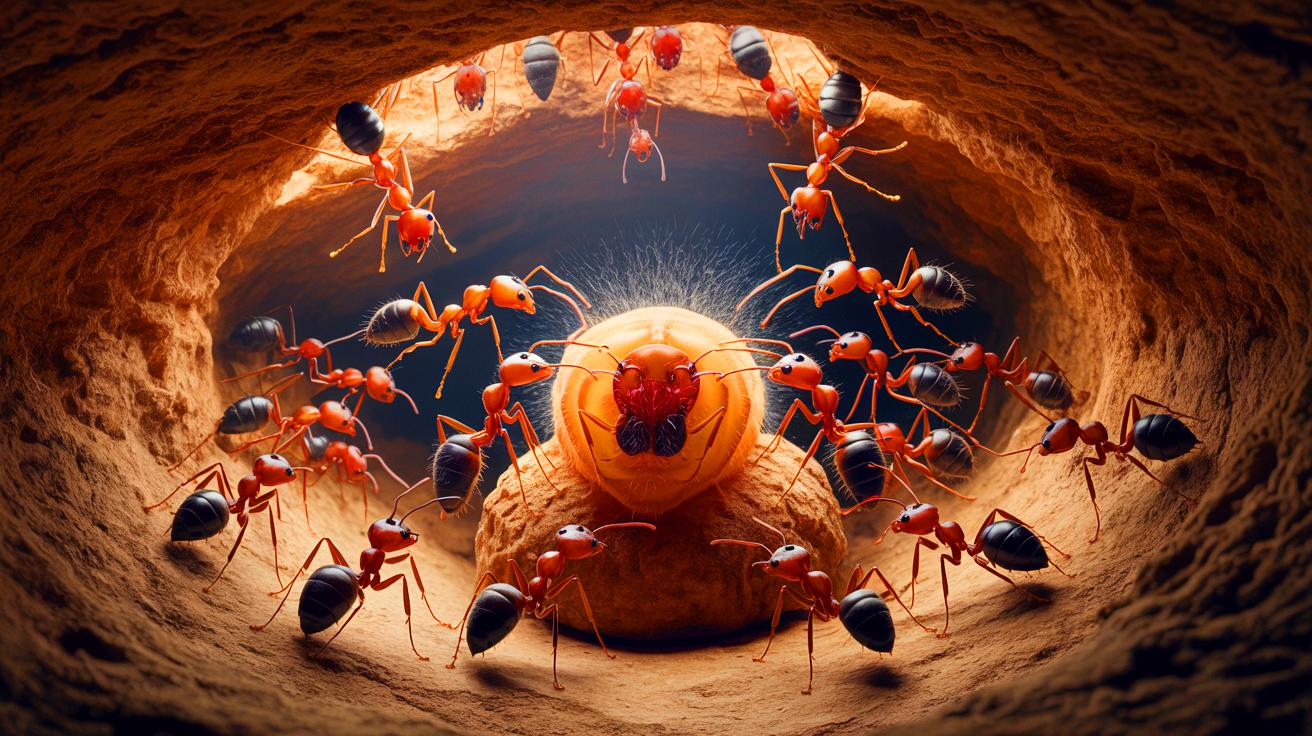
Ant societies, often described as “superorganisms,” operate with remarkable coordination, where thousands of individuals work as a cohesive unit. Recent research from the Institute of Science and Technology Austria (ISTA) has unveiled that terminally ill ant brood emit a unique odor, akin to distress signals in infected human cells. This scent acts as an alert, enabling the colony to swiftly detect and eliminate infections. This discovery, detailed in Nature Communications, highlights the sophisticated mechanisms ants use to maintain colony health and prevent the spread of disease by sacrificing individuals for the greater good.
Self-Sacrifice for Colony Survival
When worker ants detect the distress signal from an infected pupa, they spring into action. Their response is both swift and lethal for the infected individual. Workers open the pupa’s cocoon, create incisions, and apply formic acid, an antimicrobial substance they produce. This process eradicates the pathogens but also results in the death of the pupa. Despite appearing as self-sacrifice, this behavior benefits the signaler by protecting its genetic lineage. By alerting the colony, terminally ill ants help to ensure the colony’s survival, indirectly passing their genes to future generations.
Researchers, including Erika Dawson and Thomas Schmitt, document this altruistic disease signaling in social insects for the first time. Without such a system, a dying ant could become a vector for infection, threatening the entire colony. The early warning allows for timely intervention, preventing the escalation of the threat. This discovery underscores the complex social structure and the evolutionary strategies ants have developed to safeguard their communities.
The Superorganism: Extreme Cooperation
Ant colonies operate as a “superorganism,” with roles divided among members to ensure survival. Queens focus solely on reproduction, while workers handle tasks such as foraging, nest maintenance, and healthcare. This division mirrors the human body’s cellular functions, where reproductive cells create offspring while others perform essential tasks. The colony’s success hinges on cooperation between reproductive and non-reproductive members.
This cooperation extends to behaviors that sacrifice the individual for the colony’s benefit. Fatally infected brood are sacrificed to protect the larger group. Such extreme cooperation highlights the evolutionary pressures that shape ant societies. The colony’s survival takes precedence over individual lives, a strategy that has allowed ants to thrive in diverse environments across the globe.
Necessity of an Early-Warning System
One might wonder why such a sophisticated alarm system evolved when sick ants can simply leave the colony. According to Sylvia Cremer, adult ants often exit the nest to die when nearing death. Workers exposed to disease also practice social distancing. However, brood, being immobile, cannot take such actions. Instead, they rely on chemical cues to attract help.
Researchers liken this to the immune response in humans, where distressed cells emit signals to summon immune cells. The “find-me and eat-me” signals draw worker ants to infected brood, allowing them to remove potential threats. Cremer emphasizes that the signal’s sensitivity and specificity are crucial. It must identify terminally sick pupae while avoiding false positives. This precision is critical for the colony’s efficient functioning and survival.
Changes in Pupal Scent
Chemical ecologist Thomas Schmitt highlights that the scent change is non-volatile, meaning it remains close to the infected pupa. This specificity allows workers to target a single sick pupa amidst many. Researchers tested this by transferring the altered scent to healthy pupae, which prompted workers to treat them as infected. This experiment confirmed that the altered odor functions like the “find-me and eat-me” signal seen in other organisms.
The study demonstrated that only worker pupae emit this warning signal, as they lack the immune defenses of queen pupae. This selectivity ensures the colony responds to genuine threats, preventing unnecessary sacrifices. The research reveals the intricate communication systems ants use to manage colony health, a testament to their evolutionary success.
The study of ant societies offers valuable insights into the complexity of social structures and survival strategies. By understanding these systems, researchers can draw parallels to other organisms, including humans. As we continue to study these fascinating creatures, new questions arise: How do other social insects manage disease threats? What can we learn from ants about resilience and adaptation in the face of environmental challenges? The answers may reshape our understanding of nature’s intricacies.


Wow, ants are like tiny superheroes! 💪🐜
Wow, ants are just incredible! I had no idea they were so organized. 🐜
Isn’t it amazing how ants communicate through scents? It’s like they have a secret language!
Does this mean ants have a “healthcare” system? Fascinating!
Fascinating read! I didn’t know ants had such complex social structures. Thank you for sharing!
Isn’t it sad that the pupae have to die? Couldn’t there be a better way?
So, do the worker ants ever misinterpret the scent signals, or are they always spot on?
This sounds like a sci-fi movie plot. Ants are amazing! 😄
This article makes me wonder how other insects handle diseases. Any ideas?
Thank you for sharing this intriguing research. It’s mind-blowing how complex ant societies are!
Just when I thought ants couldn’t get any cooler! 🐜✨
Is this altruistic behavior unique to ants, or do other insects do it too?