



| IN A NUTSHELL |
|
In the arid expanse of Egypt’s Western Desert, a groundbreaking discovery has emerged, reshaping our understanding of crocodile evolution. Researchers have uncovered fossils of a previously unknown species, Wadisuchus kassabi, which roamed the earth approximately 80 million years ago. This find, reported in The Zoological Journal of the Linnean Society, offers new insights into the evolutionary lineage of crocodiles, particularly the Dyrosauridae family. These ancient creatures, distinctly different from today’s river-dwelling crocodiles, thrived in oceanic environments. The study not only highlights the adaptability of these reptiles but also underscores the rich paleontological heritage embedded within Egypt’s sands.
Uncovering the Marine Lifestyle of Ancient Crocodiles
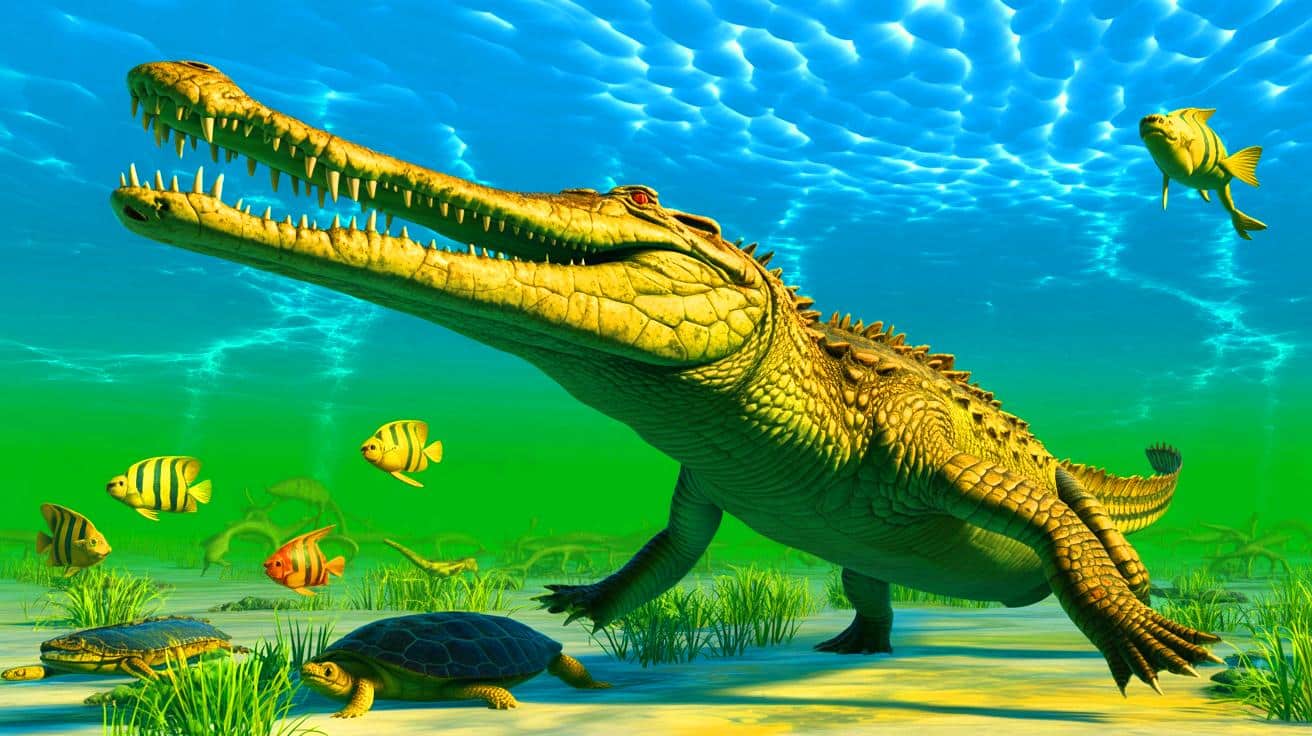
Dyrosaurids, the ancient relatives of modern crocodiles, lived in coastal and marine habitats, unlike the freshwater environments associated with their contemporary descendants. Their elongated snouts and sharp, pointed teeth were adapted for catching swift marine prey, such as fish and turtles. This adaptation underscores a significant evolutionary shift, enabling dyrosaurids to thrive after the cataclysmic events that led to the dinosaurs’ extinction. The discovery of Wadisuchus kassabi adds a crucial chapter to this evolutionary narrative. The name, reflective of its origins, combines “wadi,” Arabic for “valley,” with “Suchus,” a nod to Sobek, the ancient Egyptian crocodile deity.
The significance of this species lies in its ability to illuminate how reptiles adapted to dramatic environmental changes millions of years ago. By thriving in marine environments, dyrosaurids exemplify a remarkable evolutionary resilience, paving the way for future generations of crocodiles. Understanding these adaptations provides valuable insights into the evolutionary pressures and ecological niches that shaped the diversity of life on Earth.
Insight Through Fossil Examination
Professor Hesham Sallam of Mansoura University, a leading figure in the study, explained that the fossils of Wadisuchus kassabi were unearthed near the Kharga and Baris oases. This collection includes two partial skulls and two snout tips from four different individuals, each at varying growth stages. These fossils offer a rare glimpse into the development of dyrosaurids, allowing researchers to piece together their evolutionary journey. Advanced techniques, such as high-resolution CT scans and 3D surface modeling, have revealed unprecedented anatomical details of these ancient creatures.
These insights are critical for paleontologists striving to understand the morphological changes that occurred over millions of years. By examining the skulls and snouts of Wadisuchus kassabi, researchers can trace the evolutionary adaptations that enabled these reptiles to adjust to changing environments. Such detailed examinations not only enhance our knowledge of dyrosaurid anatomy but also contribute to broader discussions on reptilian evolution during periods of significant environmental upheaval.
“They’ve Been Hiding This Monster”: Student Discovers 23 Foot Killer Dinosaur In Museum Storage
Unique Features and Evolutionary Implications
The features of Wadisuchus kassabi set it apart from other members of the Dyrosauridae family. This crocodile-like reptile, measuring approximately 11 to 13 feet long, had a notably elongated snout with tall, sharp teeth. Unlike its predecessors, it had fewer teeth at the snout’s front and nostrils positioned for surface breathing. These adaptations suggest a gradual evolution in the dyrosaurid bite, marking a pivotal point in their evolutionary history.
Assistant Lecturer Sara Saber from Assiut University highlighted that these unique features push back the timeline for the African origin of Dyrosauridae. The diversification of this group likely began during the Early Coniacian-Santonian period, between 87 and 83 million years ago. This challenges previous assumptions that their evolution commenced in the Maastrichtian period. By revisiting these timelines, the study sheds light on the dynamic evolutionary paths that shaped the diversity of ancient crocodiles.
Egypt’s Role in Crocodile Evolution
Belal Salem, a PhD student at Ohio University, emphasized the broader implications of this discovery. The fossils suggest that Africa, particularly Egypt, was the birthplace of dyrosaurid evolution. The phylogenetic analysis positions Wadisuchus as a crucial ancestor within the dyrosaurid lineage. This reinforces the idea that Egypt’s Western Desert holds significant paleontological treasures, offering glimpses into the deep past of our planet.
This discovery is more than a scientific milestone; it is a reminder of the untapped potential within Egypt’s fossil-rich landscapes. These sites are not only scientific resources but also cultural legacies that must be preserved against threats like urban expansion and agricultural encroachment. As researchers continue to uncover these ancient secrets, they bear the responsibility of safeguarding these sites for future generations, ensuring that the story of Earth’s ancient inhabitants remains accessible to all.
The unearthing of Wadisuchus kassabi has opened new avenues for understanding crocodile evolution and the environmental factors that influenced their adaptations. As scientists continue to explore the mysteries held within Egypt’s Western Desert, what other ancient secrets might they uncover, and how will these discoveries reshape our understanding of Earth’s evolutionary history?


This is mind-blowing! Who knew ancient crocodiles had such a wild marine lifestyle? 🐊🌊
Wow, the ancient Egyptian crocodile sounds like a real-life sea monster! 🐊
Wait, so now crocodiles were ocean creatures too? What’s next, flying elephants? 😂
Can someone explain how this discovery changes our understanding of evolution?
Can someone explain how they determined these fossils belonged to a marine species?
It’s fascinating how much we still don’t know about evolution. Thanks for sharing this discovery! 🙌
Fascinating article! Thanks for sharing these amazing insights. 😊
Is there a chance we might find more species like Wadisuchus kassabi in the future?
Egypt sure has some incredible paleontological treasures. What’s next, mummified dinosaurs? 😂
So cool! I love learning about ancient creatures. Thanks for the great read! 📚
The article mentions advanced techniques. What kind of tech are they using for these discoveries? 🤔
How do they know the exact age of these fossils? Always wondered about that.
I’m skeptical. How can we be sure these fossils are really that old? 🧐
Not sure I buy this “new insight.” Sounds like they just found a big lizard. 🤔
Why do we always find these exciting fossils in deserts? Were they not underwater once?
Incredible discovery! This really puts Egypt on the map for paleontology. 🇪🇬
Great work by the researchers! This is a major milestone for paleontology.
How does this change our understanding of current crocodiles? Are they related? 🐊