



| IN A NUTSHELL |
|
Recent paleontological discoveries are offering unprecedented insights into the world of dinosaurs, particularly through the discovery of fossilized dinosaur eggs. These eggs, unearthed in the Hubei province of China, have been preserved for approximately 85 million years and are providing researchers with valuable data about the climatic conditions of the Cretaceous period. This discovery not only highlights the incredible preservation of these eggs but also showcases the advanced techniques being used to date them accurately. Such findings are reshaping our understanding of how dinosaurs adapted to changing climates millions of years ago and could potentially illuminate patterns of migration and extinction.
Discovery of Thousands of Fossilized Eggs in Qinglongshan
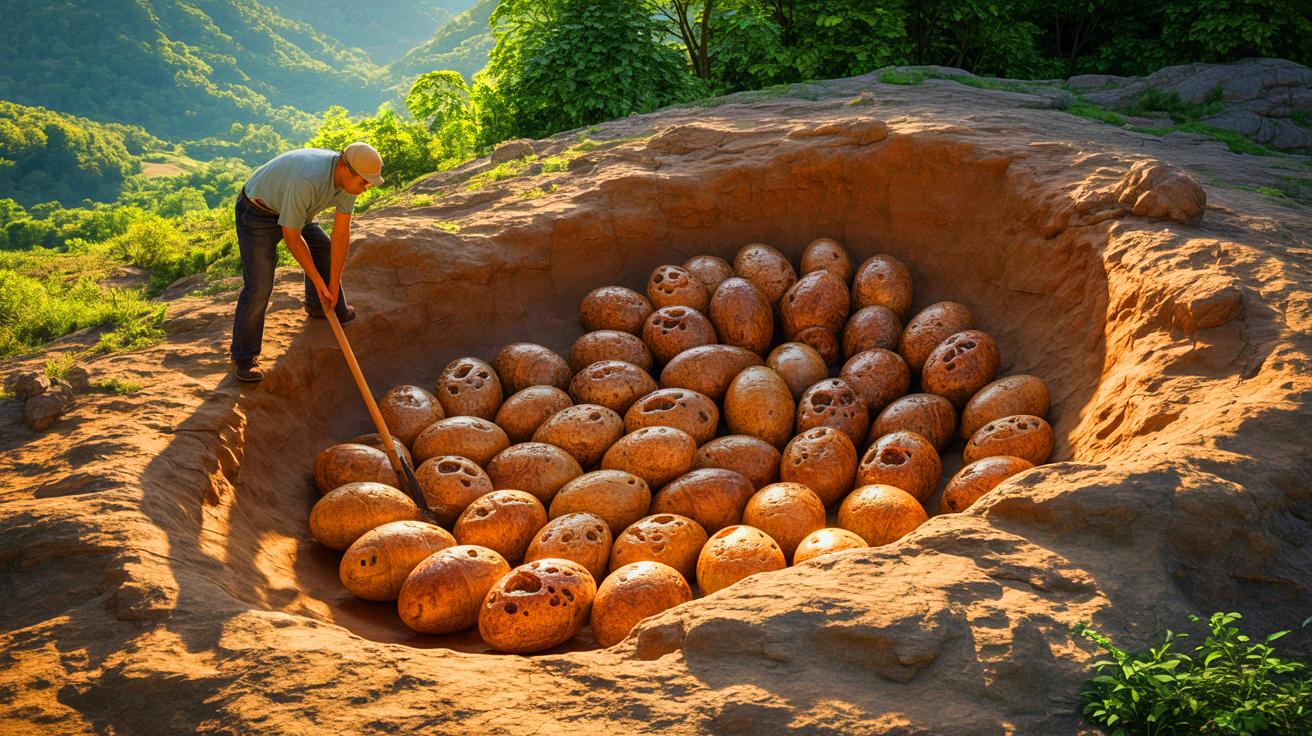
In the mountainous region of Qinglongshan, located in China’s Hubei province, paleontologists have made a groundbreaking discovery. More than 3,000 fossilized dinosaur eggs have been unearthed in recent years, marking one of the world’s largest reserves of such specimens. The sheer quantity of these eggs is impressive, but their state of preservation is even more remarkable. Many of these eggs remain intact, encased in fine sandstone or breccia, and some are found in complete nests.
One particular nest has garnered significant attention. It contains 28 perfectly grouped eggs attributed to the species Placoolithus tumiaolingensis, part of the Dendroolithidae family. These eggs, with their porous shells and unique patterns, provide evidence that certain dinosaur species were adapting to a changing climate even during the Cretaceous period. This discovery underscores the importance of fossilized eggs in understanding the reproductive behaviors and environmental adaptations of dinosaurs.
Direct Dating of Shells Reveals Precise Age
Traditionally, dating dinosaur fossils involved analyzing surrounding sediment layers or nearby volcanic ash. While useful, these methods can sometimes lead to inaccuracies. In this study, researchers employed a more direct approach by dating the eggshells themselves. Utilizing uranium-lead dating, a precise technique, they used a micro-laser to excite carbonate minerals within the eggshells.
This process creates an aerosol analyzed through mass spectrometry, which measures the natural decay of uranium into lead, a known and irreversible phenomenon. The results indicate that these eggs were laid approximately 85 million years ago, with a margin of error of only 1.7 million years. This precise dating offers a new temporal marker for the late Cretaceous period, a time characterized by a gradual cooling of the planet.
Shell Structures Indicate Climate Adaptation
During this era, long before the catastrophic comet impact, dinosaurs dominated the earth, but subtle climate changes were underway. The planet was gradually moving away from a thermal optimum, initiating a climatic shift. The porous structure of these eggshells is not coincidental; it likely represents an adaptation to a drier or cooler climate, as suggested by Dr. Bi Zhao's team, whose study was published in Frontiers in Earth Science.
The alignment of precise dating with other global sites could allow researchers to map dinosaur nesting patterns, akin to modern bird migrations.
https://www.sustainability-times.com/research/scientists-panic-over-132-million-year-old-sea-monster-colombian-fossil-discovery-reveals-massive-marine-turtle-that-survived-ancient-ocean-apocalypse/
Some researchers even propose that species like P. tumiaolingensis may have faced extinction due to an inability to adapt to these climatic changes, a narrative that echoes throughout history. This potential link between climate adaptation and extinction events emphasizes the broader impact of environmental shifts on biodiversity.
Methodology Applicable to Other Sites for Reconstructing Migrations and Extinctions
The implications of this direct dating method are vast. If applied to other fossil sites, it could allow for comparisons of eggs discovered thousands of miles apart, thereby reconstructing a global chronology of species, their habitats, and possibly their extinctions. Dinosaur eggs could thus serve as temporal markers, independent of geological uncertainties, providing precise insights in a continually evolving world.
This approach represents a paradigm shift in how we interpret the past. Rather than relying solely on skeletal remains or ancient rocks, scientists can now leverage the stories told by silent eggs, offering a novel perspective on the history of life on Earth. This innovative method not only enhances our understanding of dinosaur behavior but also contributes to broader discussions on climate change and its historical impacts on life.
The discovery of these fossilized eggs and the novel techniques used to date them open new avenues for understanding the prehistoric world. By examining the adaptations and survival strategies of dinosaurs in response to climate changes, researchers can draw parallels to today's environmental challenges. As we continue to unearth and analyze such ancient relics, what other secrets might they reveal about the history of life on our planet?



Wow, 3,000 eggs! That’s a real “eggstravaganza”! 🥚
Wow, 3,000 eggs! Imagine the size of the omelette… 🥚😄
How do they know the eggs are exactly 85 million years old? Seems too precise!
How reliable is uranium-lead dating for something this old? 🤔
Thanks for the informative article. The new dating method sounds revolutionary!
Thank you for sharing this fascinating discovery! It’s amazing how much we can learn from ancient eggs.
Does this mean dinosaurs were already struggling with climate change before the asteroid hit?
What kind of climate changes were happening 85 million years ago?
3,000 eggs and not one omelet in sight. 😉
I’m curious, what kind of dinosaurs laid these eggs?
Incredible! This could really change the way we understand dinosaur extinction.
Why is this discovery in China and not somewhere else?
Just me or does “Placoolithus tumiaolingensis” sound like a spell from Harry Potter? 😂
This is mind-blowing! Can’t wait to see what more we learn from these eggs. 🦕
Fascinating read! But what happens next with these findings?
The use of uranium-lead dating is fascinating. How reliable is this method?
3,000 eggs but no mention of hatchlings? Were they all just infertile?
Great article! Are there any plans to display these eggs in museums?
What’s the significance of the porous shell structure? 🤔
Did they find any dinosaur DNA in the eggs?
With this many eggs, it’s like the dinosaurs were having a prehistoric Easter hunt!
The climate adaptation angle is intriguing. What other adaptations might we find?
Why does the article focus so much on climate when the asteroid was the big killer?
Incredible preservation! How did these eggs survive for so long?
Maybe these eggs are just dino easter eggs waiting for someone to find them. 🐣
How do they protect these sites from looters or damage?
Did they find any adult dinosaur fossils nearby?
I’m skeptical about the dating accuracy. Can they really be sure?
This discovery could change everything we know about dinosaurs. Amazing!
Why have we only just discovered these eggs? 🤷
Thank you for sharing this exciting discovery!
3,000 eggs but no mention of a giant dinosaur mom? 🦖
Is there any evidence of what might have destroyed these nests?
How does this find compare to other dinosaur egg discoveries?
Will this method help us understand the extinction of other species too?
Are they planning to do more excavations in the area?
I’m not sure I buy the whole climate change explanation. Sounds too modern.
What does this mean for our understanding of dinosaur migration patterns?
Amazing! Can the same method be used to date other fossils?
The eggshell adaptation is interesting. What other protective measures did dinosaurs have?
Is there any way to reconstruct what these baby dinosaurs might have looked like?
3,000 eggs and still no Jurassic Park? 🦖🥚 Where’s my dinosaur theme park?
How do they ensure the integrity of these eggs while excavating?
This discovery is a real “shell shocker”! 🐢