




| IN A NUTSHELL |
|
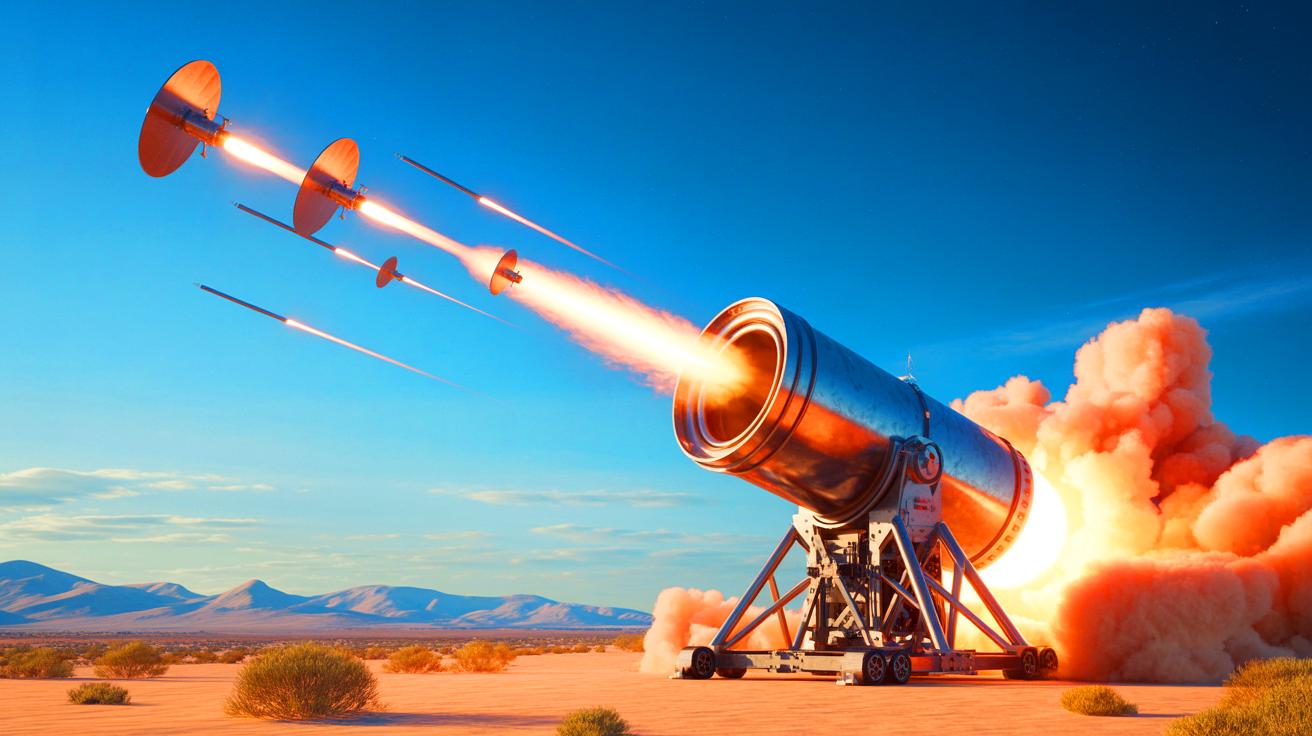
SpinLaunch, a trailblazing startup hailing from California, is poised to transform the world of satellite launches. By employing a giant centrifugal cannon, the company aims to send hundreds of flattened “microsatellites” into low-Earth orbit. This innovative method promises to make satellite deployment more cost-effective and environmentally sustainable, positioning SpinLaunch as a formidable contender against industry giants like SpaceX. With substantial funding backing their efforts, SpinLaunch’s approach could set a new benchmark in satellite launches, both in terms of efficiency and ecological impact. The coming years may well witness a shift in how space missions are executed, thanks to this revolutionary technology.
A New Era of Satellite Launches
SpinLaunch’s approach to satellite deployment leverages a massive centrifugal cannon, a groundbreaking concept that could redefine the satellite launch industry. This technology not only aims to reduce costs significantly but also to minimize the environmental footprint traditionally associated with rocket launches. The company’s Meridian Space constellation is at the forefront of this innovation, with plans to launch its first set of pancake-like satellites in the near future. Each microsatellite, measuring 7.5 feet in width and weighing around 154 pounds, is designed to be lighter and more efficient than current alternatives. This method of stacking satellites like pancakes in a “launch bus” could allow SpinLaunch to surpass existing records for simultaneous launches, challenging SpaceX’s dominance.
Backed by nearly $150 million in funding, SpinLaunch’s vision is supported by both investors and industry partners. The recent investment of $12 million from Kongsberg Defence and Aerospace (KDA) underscores the confidence in SpinLaunch’s technology. KDA’s NanoAvionics is tasked with building the initial batch of 250 satellites, further solidifying the project’s credibility. With a launch planned for 2026, SpinLaunch is well-positioned to make a significant impact on the satellite industry.
The Revolutionary Launch System
Central to SpinLaunch’s innovation is its unique launch system, which utilizes a vacuum-sealed chamber and spinning arms to catapult payloads into space. Known as the Suborbital Accelerator, this technology has already demonstrated its potential by successfully launching 10 rockets into suborbital flight from New Mexico. During these test flights, objects are spun up to speeds of 5,000 mph, enduring forces up to 10,000 Gs before being released into the upper atmosphere. The success of these tests, particularly the most recent one in September 2022, lays a robust foundation for the forthcoming orbital demonstration.
The primary advantage of SpinLaunch’s system is its cost-efficiency. Projected costs for future commercial launches range from $1,250 to $2,500 per kilogram, which is less than half the cost of SpaceX’s Falcon 9 rockets. Additionally, the absence of greenhouse gas emissions and booster rockets during launches contributes to a more sustainable model for space travel. This reduction in environmental impact and space debris could position SpinLaunch as a leader in eco-friendly satellite deployment.
Implications for the Satellite Industry
The introduction of SpinLaunch’s technology could have profound implications for the satellite industry. By providing an affordable and environmentally conscious launch alternative, SpinLaunch is set to challenge established players and alter the competitive landscape. The Meridian Space constellation aims to deliver high-speed communication services at a more accessible price point, potentially democratizing access to space-based services.
SpinLaunch’s ambition extends beyond individual launches, with plans to enhance their capabilities through a larger Orbital Accelerator. This development could enable the company to launch up to five commercial payloads daily, significantly increasing the frequency and accessibility of satellite launches. However, with increased activity in low-Earth orbit comes potential challenges, such as the risk of spacecraft collisions, light pollution, and interference with astronomical observations. Addressing these concerns will be crucial as SpinLaunch moves forward with its plans.
Looking Ahead: Challenges and Opportunities
While SpinLaunch’s innovations present exciting opportunities, they also bring challenges that must be carefully navigated. The increase in satellite activity in low-Earth orbit could exacerbate issues such as space debris and atmospheric pollution from re-entering spacecraft. As SpinLaunch advances its ambitious plans, it is crucial to consider these factors and work towards sustainable solutions that balance growth with responsibility.
The success of SpinLaunch’s upcoming launches could establish a new standard for satellite deployment, offering a glimpse into a more accessible and sustainable future for space exploration. However, the question remains: how will the satellite industry adapt to these changes, and what measures will be taken to mitigate the potential risks associated with increased activity in low-Earth orbit?

Can someone explain how a “centrifugal cannon” actually works? 🤔
This should be obvious if you know what a centrifuge or how centrifugal force works. Google it because that comical AI picture is total nonsense.
Click bait nonsense about China.
Remove the ‘verging on special needs’ AI picture as it’s total nonsense and is giving people the wrong idea of how it works. I guess this also shows that the ‘reporter’ (if you can call them that) has not got a clue; thy just asked AI like all the ‘out of their depth’ people do nowadays.
SpinLaunch vs. SpaceX? This is getting interesting! 🚀
Great article! I had no idea about the environmental impact of satellite launches.
Spinning pancakes in space? Sounds like a breakfast gone wrong! 😂
Isn’t there a risk of these satellites becoming space debris? 😬
Where was anything in the article about China raising alarms? Yet another bs click bait from “sustainability times”. Unsubscribe.
Yes. But more importantly, falling back to earth, is a big big issue.
Wow, $150 million in funding! Where do I sign up for a piece of that action? 😅
How will the increase in satellites affect astronomical observations?
Thank you for this article! It’s fascinating to see new tech emerging in space exploration.
Vacuum-sealed chambers and spinning arms? Sounds like sci-fi! 🛸
I’m skeptical. Can this really compete with SpaceX in the long run?
Are there any plans to recycle or deorbit these satellites after their lifespan?
SpinLaunch might just be the game-changer we’ve been waiting for! 🌟
What’s the timeline for their first commercial launch?
This tech could revolutionize space travel. I’m all for it! 🌍
Is the “pancake” design really more efficient than traditional satellites?
Sounds like a great idea, but what about the safety of such high-speed launches?
Could this technology be used for something other than satellites?
Finally, a more sustainable way to explore space! Thanks for sharing.
What are the potential drawbacks of this centrifugal launch method?
SpinLaunch is ambitious, but I’m worried about the environmental impact of so many launches.
Why is China so worried about this? Aren’t they launching satellites too?
How does SpinLaunch plan to handle the potential for space collisions?
Are these pancakes gluten-free? 😂
I’m concerned about the light pollution from all these new satellites.
Great insights on the future of space exploration. Keep it up! 👍
How exactly does this method reduce greenhouse gas emissions?
Will this tech be available for international satellite launches?
SpinLaunch is challenging SpaceX? Let’s see how this unfolds! 🤞
What measures are being taken to prevent these satellites from becoming space junk?
Curious to see how other countries will react to this new tech.
This is the start of a new era in space exploration! Can’t wait to see more. 🚀
Skeptical about the “cost-effective” claim. How do they calculate these savings?
Awesome read! Looking forward to more articles like this. 📚
Interesting read, but what about the potential for accidents during launch?
Does anyone know how long these satellites are supposed to last in orbit?
You guys should do at least the smallest amount of research/review of your AI generated photos and other content… That is 100% not what spin launch looks like or how spin launch works….