


| IN A NUTSHELL |
|
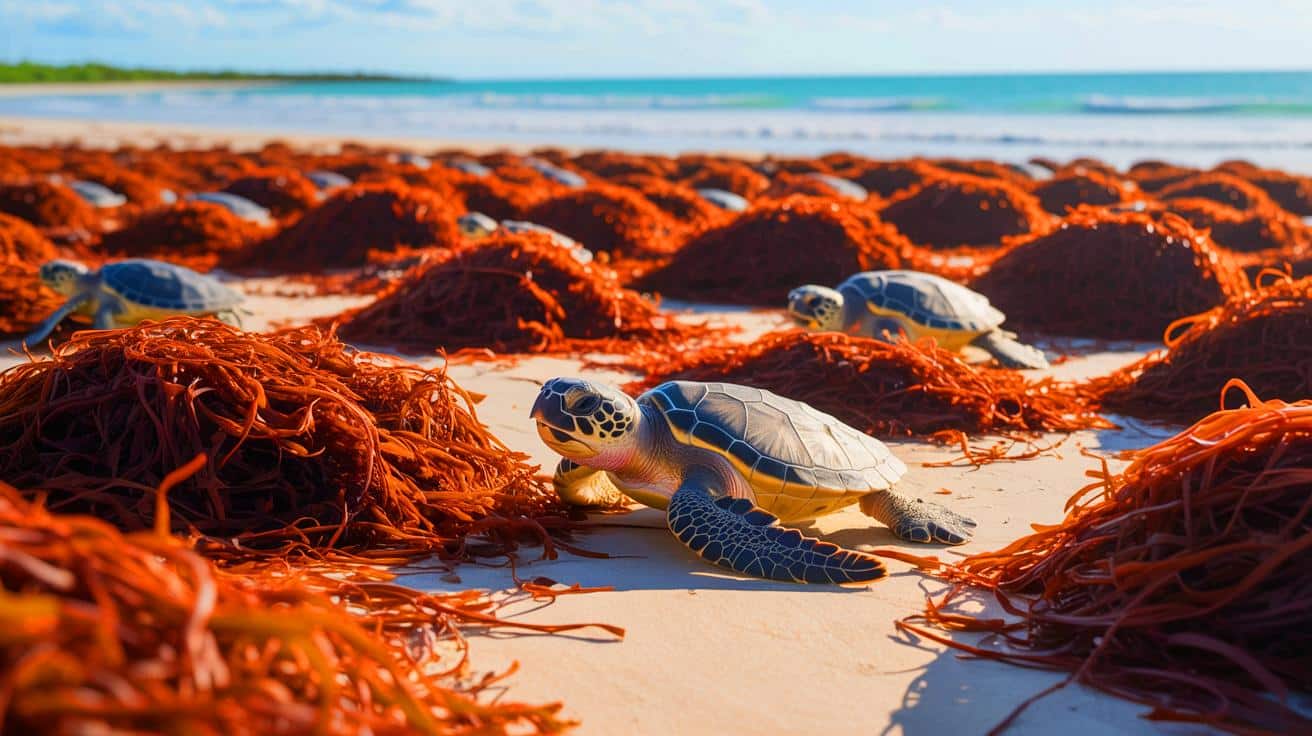
Every year, sea turtle hatchlings face myriad challenges as they embark on their journey from Florida’s beaches to the ocean. Among the obstacles are artificial lights, predators, and now, massive sargassum deposits. These seaweed piles create significant barriers, complicating the already perilous path to the sea. Although sargassum is a familiar sight along the coast, its impact on sea turtle hatchlings has only recently come under scientific scrutiny. A new study sheds light on how these growing seaweed accumulations may threaten the survival of these vulnerable creatures, prompting concerns about their long-term conservation.
Understanding the Impact of Sargassum on Hatchlings
Researchers from Florida Atlantic University’s Charles E. Schmidt College of Science conducted an insightful study to assess how sargassum affects sea turtle hatchlings. The research focused on three common species found on Florida beaches: leatherbacks, loggerheads, and green turtles. Hatchlings were collected from various locations, including Juno Beach, Jupiter, and Boca Raton, to participate in controlled experiments.
In these experiments, researchers created crawlways on the sand to simulate a hatchling’s natural path to the ocean. At the end of these paths, loose piles of sargassum were positioned, ranging in height up to 7.5 inches. This setup allowed researchers to observe how much extra effort hatchlings needed to exert to cross the seaweed. By guiding the hatchlings with a dim light, mimicking the natural glow of the ocean, researchers ensured that their behavior remained undisturbed.
The study revealed that sargassum significantly slowed down the hatchlings, affecting their chances of reaching the ocean safely. The added physical challenge of crossing sargassum not only delayed their journey but also increased their exposure to predators and environmental stresses.
Measuring the Effects on Energy and Physical Condition
To better understand the physical toll on the hatchlings, researchers measured blood glucose levels after each crawl. This metric served as an estimate of the energy expended during their journey. Additionally, they tested the hatchlings’ ability to right themselves when flipped upside down in water, which provided an indicator of their physical condition. Sand temperature was recorded at various points to account for environmental conditions during the trials.
The findings, published in the Journal of Coastal Research, highlighted that hatchlings took significantly longer to complete their paths when sargassum was present. The additional time required to climb over the seaweed increased the risks of predation and heat exposure. Despite these challenges, the study found no significant differences in blood glucose levels between hatchlings that crossed sargassum and those that did not. This suggests that while sargassum slows hatchlings, it does not deplete their immediate energy reserves.
The physiological impacts of crawling itself appeared more significant, with leatherbacks in the no-crawl control group showing higher glucose levels. This underscores the physical demands of the journey, whether impeded by sargassum or not.
Sargassum as a Growing Obstacle
The study’s results reveal that sargassum poses a significant barrier for all three species of sea turtles. Leatherbacks, loggerheads, and green turtles experienced substantial slowdowns when traversing both light and heavy sargassum. The longer hatchlings spend on the beach, the greater their vulnerability to predators such as birds and crabs.
Sarah Milton, Ph.D., senior author of the study, emphasized the risks associated with prolonged exposure on the beach. “The longer a hatchling stays on the beach, the more at risk it becomes — not just from predators like birds and crabs, but also from overheating and dehydration, especially after sunrise,” she said.
This is particularly concerning as sargassum piles can grow over a meter high and stretch for hundreds of meters along South Florida beaches. Such conditions increase the likelihood of hatchlings failing to reach the ocean, particularly when faced with multiple bands of seaweed.
Implications for Conservation Efforts
The findings underscore the urgent need for adaptive beach management strategies. As sargassum accumulations become taller and more widespread, they threaten to impede hatchlings entirely. This could undermine both their immediate survival and long-term conservation efforts. Beyond impeding movement, dense sargassum mats may also reduce available nesting space and alter incubation conditions.
Abbey M. Appelt, a co-author of the study and a sea turtle nesting specialist, highlighted the importance of addressing these challenges. Without thoughtful intervention, the expanding threat posed by sargassum could gradually erode the progress made in sea turtle conservation.
The research calls attention to the complex interplay between natural obstacles and conservation efforts, raising critical questions about how best to protect these ancient mariners.
As Florida’s beaches continue to see increasing amounts of sargassum, the challenges for sea turtle hatchlings grow more acute. Researchers, conservationists, and policymakers must consider how to adapt strategies to mitigate these barriers. What innovative solutions can be implemented to ensure that these vulnerable creatures can continue their journey to the ocean unimpeded by human or natural obstacles?

Wow, I had no idea seaweed could be such a problem for turtles! 🐢
Wow, this sargassum issue is really a big deal for the turtles. What’s the best solution? 🐢🌿
Is there any way to remove sargassum naturally without harming other marine life?
What a leghty article! Maybe a bit too much detail for a casual reader?
Those poor hatchlings! Imagine climbing over seaweed piles while trying to avoid predators!
Another classic example of climate change messing with nature’s balance. 😢
Thank you for highlighting this problem. It’s alarming but necessary to know! 🙏
Great article, very informative! Thanks for shedding light on this issue. 👍
Is sargassum an issue only in Florida, or are other regions seeing similar problems?
Why isn’t there more funding and support for sea turtle conservation? This is serious!
So, what’s next? Are there any beach cleanups planned to help the turtles?
Can’t we just remove the sargassum from the beaches? Seems simple enough.
Love this piece! It’s amazing how even small obstacles can have such a big impact on wildlife.
Amazing research! But why haven’t we heard about this issue before? 🤔
Are there any other animals affected by sargassum, or is it just turtles?