



| IN A NUTSHELL |
|
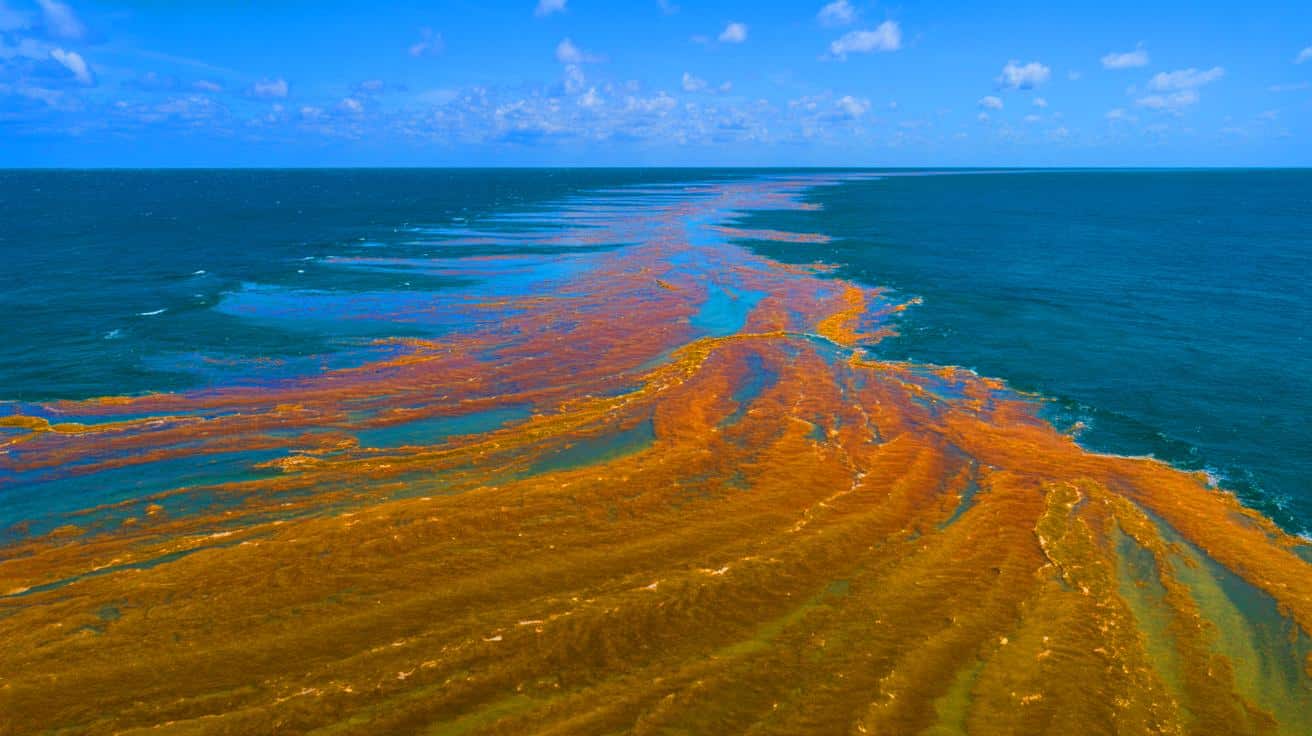
Recent satellite imagery has unveiled an immense 37.5 million-ton mass of brown algae floating across the Atlantic Ocean. This formation, known as the Great Atlantic Sargassum Belt (GASB), stretches from West Africa to the Gulf of Mexico. Emerging less than 15 years ago, the GASB has become a growing phenomenon, raising concerns about its environmental and economic impacts. As it continues to expand, stakeholders are grappling with the implications of this development for marine ecosystems, coastal communities, and climate change dynamics.
The Unprecedented Expansion
Historically confined to the Sargasso Sea, sargassum algae were once a mere ecological curiosity in nutrient-poor waters. However, scientific research now confirms their presence far beyond this region, transforming marine ecosystems along their path. A recent study published in Harmful Algae attributes this dramatic expansion to a complex interplay of environmental and anthropogenic factors. According to Brian Lapointe of the Harbor Branch Oceanographic Institute, these algae thrive in nutrient-rich zones, often fueled by agricultural runoff, wastewater, and atmospheric pollution.
The first major episode of this algae belt was observed in 2011. Since then, it has reappeared almost annually, reaching a record size in 2025: a continuous mat over 5,500 miles long, more than twice the length of the American continent. This emergence may be linked to climatic anomalies, such as the negative phase of the North Atlantic Oscillation in 2009-2010, which pushed algae into tropical waters. Genetic analyses reveal that some varieties, like Sargassum natans var. wingei, already existed in these areas before 2011. Regardless of the cause, this biomass explosion is unprecedented, increasing algae quantities fivefold compared to historical levels.
Costly and Harmful Consequences
While sargassum algae play an ecological role by providing habitat for over 100 marine species, their excessive proliferation has adverse impacts. When they wash ashore in the Caribbean, Gulf of Mexico, or West Africa, they decompose quickly, releasing toxic hydrogen sulfide. This decomposition causes nuisances for local populations, economic losses for tourism, and high cleanup costs. The degradation of algae also creates dead zones, disrupts coral reefs, and can even lead to malfunctions in critical infrastructure. For instance, in 1991, a nuclear power plant in Florida was forced to shut down due to sargassum-related issues.
The Role of Nutrients
The proliferation of sargassum is directly linked to nutrient enrichment in the water, particularly nitrogen and phosphorus. Historically limited by nutrient scarcity in the open sea, these algae now benefit from massive inputs from human activities. Between the 1980s and 2020, the nitrogen content in sargassum tissues increased by 55%, while their nitrogen-to-phosphorus ratio rose by 50%, indicating a growing dependence on terrestrial nutrients.
The Amazon River plays a crucial part in this phenomenon. During flood seasons, it releases significant amounts of nutrients into the Atlantic, fueling these blooms. Conversely, during dry years, algae growth slows, reinforcing the idea that terrestrial inputs are a critical driver of this phenomenon. Ocean currents, like the Gulf Stream, carry sargassum long distances, from the Gulf of Mexico to the central Atlantic. In nutrient-rich areas, such as those influenced by the Mississippi and Atchafalaya Rivers, large algae masses have been observed since the 2000s, leading to massive beachings. Microbial decomposition and animal excretions within algae mats allow their survival even in nutrient-poor waters, contributing to the persistence and expansion of the belt.
Potential Solutions
While sargassum is essential for some marine ecosystems, its excessive proliferation poses a threat. As they decompose, they release greenhouse gases like methane, raising questions about their role in climate change. Scientists are striving to understand these impacts better to assess their repercussions on the carbon cycle. Researchers advocate for coordinated international action to monitor the phenomenon more effectively, model its evolution, and limit nutrient inputs from human sources.
This massive proliferation underscores how eutrophication, once considered a coastal issue, is now redefining open ocean dynamics. As climate change and human activities continue to alter marine ecosystems, similar phenomena may emerge elsewhere, such as in the Pacific and Indian Oceans. The boundary between local pollution and the global health of oceans is becoming increasingly blurred, foreshadowing significant transformations on a planetary scale. In light of these challenges, how will global communities respond to preserve marine ecosystems and mitigate economic impacts?

This is insane! 😱 How can something like this even be stopped?
This is terrifying! How do we stop this from getting worse? 😟
37.5 million tons? Is that even real? 🤔
Can the algae be harvested for biofuel? Seems like there’s plenty to use!
Thanks for bringing attention to this issue. It’s crucial we act now. 🌍
Interesting read, but I wonder if it’s really as bad as they say 🤔
Oh great, another thing to worry about! What’s next, flying sharks? 😂
Thanks for highlighting this issue. We need more awareness! 🌍
Why aren’t governments doing more to tackle this problem? 🤨
Could climate change be the main culprit here?
Great article! Would love to see more on potential solutions. 👍
Is it possible to predict where the algae will go next?
If it’s been happening since 2011, why are we only addressing it now?
Great article, but what about the economic impact on local fisheries?
I’m skeptical. Is this really as bad as it sounds?
Doesn’t this algae have any benefits at all?
Wow, I had no idea! Thanks for sharing this important information. 🙌
What are the economic impacts mentioned? Are there any estimates?
Just when you think you’ve heard it all, nature throws another curveball.
Are there any natural predators that can help control the algae growth?
Algae blooms are a sign of the times. Climate change is real, folks! 🌡️
How does this affect the local marine life? 🐠
Is there anything individuals can do to help reduce this problem?
I guess it’s time to stop using fertilizers, huh? 🤷♂️
How does this compare to other environmental issues we’re facing?
This article is an eye-opener. We need more discussions like this. 💡
Why isn’t this a bigger topic in the news? Seems pretty serious.
Is there any tech being developed to help with this? 🚀
Can this algae mass be harvested for any useful purpose?
So, the ocean is basically a giant soup of algae now? Lovely. 🍵
How does this contribute to global warming? 🌍
Are there any international collaborations working on this issue?
Does tourism play a role in the nutrient pollution?
I hope we can solve this before it gets even more out of hand. 🤞
How does this algae mass affect shipping routes?
This is why we need more investment in environmental science. 💡