




| IN A NUTSHELL |
|
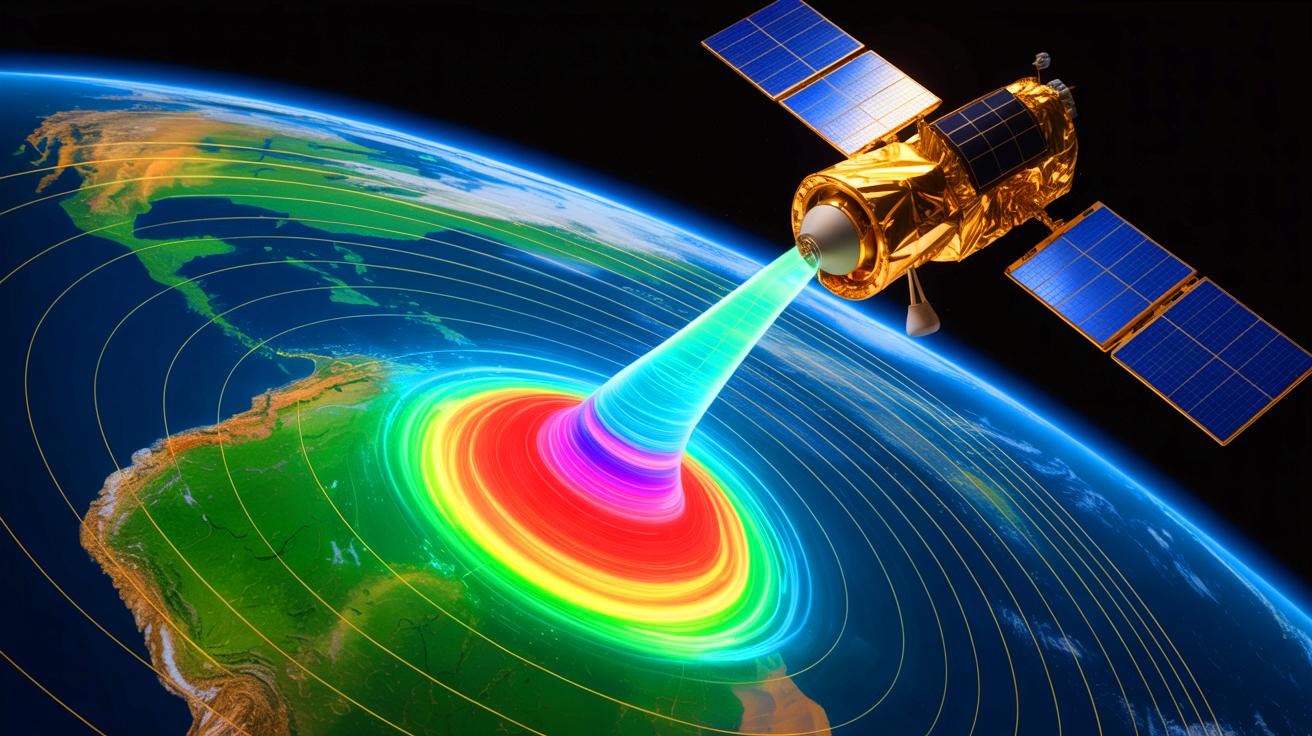
The South Atlantic Anomaly (SAA) is increasingly capturing the attention of scientists and space agencies around the globe due to its unique characteristics and potential impact on space technology. Situated over South America, this region is marked by a significantly weakened magnetic field. As a result, it presents substantial challenges for satellites and other space missions passing through the area. Understanding the SAA’s origins and its continuous evolution is crucial not only for safeguarding satellites but also for advancing our knowledge of Earth’s magnetic field dynamics. This article explores the complexity of the SAA, its implications for space technology, its dynamic changes, and the efforts to predict its future developments.
Deep Origins and Complex Mechanisms
The South Atlantic Anomaly (SAA) is a compelling geomagnetic phenomenon distinguished by a notable reduction in magnetic intensity. This region serves as a breach in Earth’s magnetic shield, which typically protects against high-energy solar particles. The anomaly allows these particles to approach perilously close to the Earth’s surface. The SAA’s origins are deeply rooted in the dynamics of Earth’s outer core, where the movement of molten iron and nickel generates the planet’s magnetic field through a process called the geodynamo.
Two primary factors influence the formation of the SAA: the tilt of Earth’s magnetic axis and the presence of the African Large Low Shear Velocity Province, a dense structure located about 1,800 miles beneath Africa. These factors disrupt the magnetic field’s generation, leading to a local polarity reversal and a further weakening of magnetic intensity in the SAA region. This intricate interplay of forces is a focal point for scientists seeking to understand the profound processes shaping Earth’s magnetic environment.
Scientists Claim “Cocoa DNA Sparks Conflict” as the US Chocolatiers Battle Over Lab-Created Flavors
A Threat to Space Technology
The SAA poses a significant challenge to space technology, particularly for satellites traversing the region. These satellites encounter high levels of energetic protons, which can cause single event upsets (SEUs). Such upsets may lead to temporary malfunctions, data corruption, and in extreme cases, permanent damage to spacecraft systems. To mitigate these risks, satellite operators often take precautionary measures, such as shutting down non-essential systems while passing through the anomaly.
The International Space Station (ISS) also passes through the SAA on each orbit. Although the ISS is equipped with shielding that offers protection for its astronauts, its external instruments remain susceptible to the anomaly’s effects. Bryan Blair, deputy principal investigator for the GEDI instrument on the ISS, reports occasional “glitches” and resets that result in data loss. Missions like the Ionospheric Connection Explorer (ICON) continuously monitor the SAA, adjusting their operations to minimize disruptions. These measures highlight the ongoing impact of the anomaly on space exploration efforts.
Dynamic Evolution and Challenges
The South Atlantic Anomaly is not a static entity; it is dynamically evolving. Observations from the ESA’s Swarm constellation and historical data from NASA’s SAMPEX mission indicate concerning trends. The anomaly is drifting northwest and expanding in size. Notably, since 2020, it has been splitting into two distinct lobes, creating dual centers of minimum magnetic intensity.
This bifurcation increases the number of hazardous zones for spacecraft, complicating the task of developing predictive models for geomagnetic conditions. Understanding the SAA’s changing morphology is essential for ensuring the safety of current and future satellites. Terry Sabaka from NASA emphasizes that these developments necessitate continuous monitoring and adaptation in satellite operations to mitigate potential disruptions. This underscores the ongoing challenges posed by the evolving anomaly.
Anticipating the Invisible
To enhance understanding and prediction capabilities, NASA integrates satellite data with simulations of Earth’s core dynamics. These inputs support global models like the International Geomagnetic Reference Field (IGRF), which track the evolution of Earth’s magnetic field. These models are crucial for planning space missions and gaining insights into our planet’s internal structure. This approach is akin to weather forecasting but operates on longer timescales, allowing scientists to estimate the secular variation—the gradual changes in the magnetic field over years and decades.
Though the current evolution of the SAA is unprecedented in the space era, geological records suggest that similar anomalies are not uncommon over long timescales. Importantly, scientists assert that the current SAA is not an early indicator of a magnetic pole reversal, a rare event occurring over hundreds of thousands of years. Thus, studying the SAA remains a vital research area, crucial for protecting our orbiting technologies and deepening our understanding of the forces driving our planet.
As the South Atlantic Anomaly continues its evolution, the scientific community remains vigilant in its efforts to understand and mitigate its impact. With its potential to disrupt satellite operations and influence our understanding of Earth’s magnetic field, the SAA poses intriguing questions about the future of our planet’s magnetic dynamics. How will these changes shape our technological and scientific pursuits in the years to come?




Wow, this sounds like something out of a sci-fi movie! Are we sure aliens aren’t involved? 👽
Wow, should we be worried about this affecting GPS or our phones? 🤔
Can this anomaly affect GPS signals? I don’t want to get lost on my next road trip! 🗺️
Is this the first time something like this has happened with Earth’s magnetic field?
Are there any historical records of similar anomalies, and how did they impact technology?
Does this mean we’ll start seeing more meteors over South America? 🌠
Impressive article! How do these findings influence our understanding of Earth’s core?
Wow, never knew the magnetic field could split like that. Science is wild!
What measures can be taken to protect satellites from these high-energy particles?
Sounds like a potential disaster for space missions. Hope NASA is on it! 🚀
Can this magnetic field hole affect animal migration patterns?
Thank you for the article! How often do scientists update the models predicting these changes?
Thanks for the detailed article! It’s fascinating to learn how dynamic our planet’s magnetic field is. 😊
So, do we need to worry about our smartphones getting fried? 📱💥
Is there any evidence that this anomaly has affected humans living in the area?
Great read! But I’m curious, how does this compare to other magnetic anomalies around the world?
How long have scientists been aware of the South Atlantic Anomaly?
Is there any chance this could lead to a magnetic pole reversal sooner than expected?
Why does it seem like everything is falling apart these days? 🤦♂️
How accurate are the current models in predicting the anomaly’s future behavior?
Thanks for the update! How does this impact aviation, if at all?
Why isn’t this on the front page of every news site? Seems pretty important!
Is it true that the anomaly is expanding? What does that mean for future space exploration?
Wait, does this mean we could lose satellite TV? No more binge-watching? 😱
This article raises more questions than answers. Need a follow-up with more details!
How confident are scientists that this won’t lead to a catastrophic event?
Thanks for sharing! How does this anomaly compare to the Bermuda Triangle mysteries?
Is it possible that this anomaly could lead to increased auroras in the region?
Is there any relation between the South Atlantic Anomaly and the ozone layer depletion? 🤔
Can this anomaly affect human health in any way?
Why haven’t we heard more about this in the news? It sounds pretty serious.
Great article, but I wish it had more diagrams to help visualize the anomaly.
Could this be an early sign of a pole reversal, or is that just sci-fi stuff?
Interesting read! So, is there any chance this could affect Earth’s weather patterns?
Great article, but it makes me nervous about the future of space travel. Thanks for sharing!
Could this be related to climate change, or is it purely a geomagnetic phenomenon?
How long has this anomaly been developing, and what’s causing it to split now?
This sounds like a plot twist in “The Core” movie. 😅