




| IN A NUTSHELL |
|
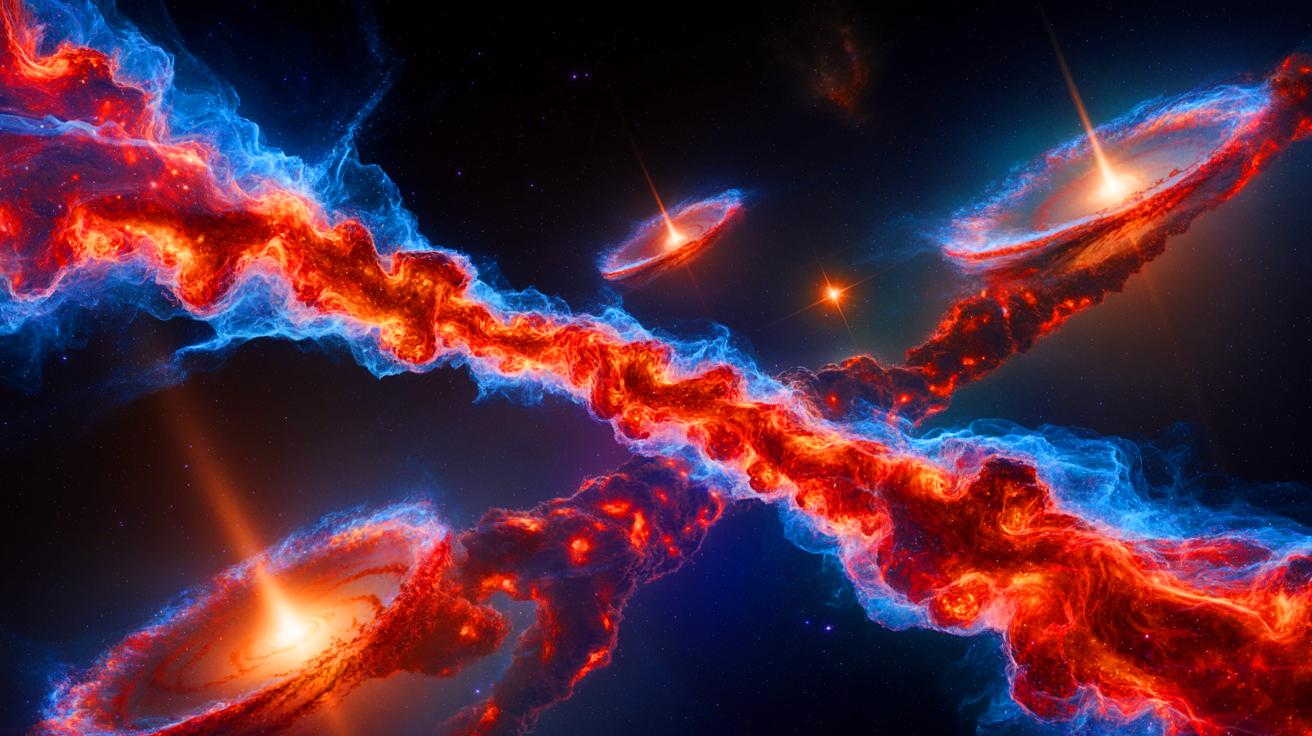
In a groundbreaking discovery, astronomers have identified a massive filament of hot gas connecting four galaxy clusters. This filament, which is ten times the mass of our Milky Way, could potentially account for some of the Universe’s ‘missing’ matter. The identification of this filament through advanced X-ray space telescopes marks a significant milestone in addressing a long-standing cosmic mystery. The discovery not only provides insights into the elusive components of our Universe but also strengthens our understanding of the cosmic web that intricately links various celestial bodies.
Unveiling the Missing Matter
For decades, astronomers have been puzzled by the whereabouts of over one-third of the ‘normal’ matter in the local Universe. Despite its absence from observations, this matter is essential for the validity of our cosmological models. Theories have long suggested that this missing matter might exist in long, diffuse filaments of gas, stretching across the cosmos and connecting the densest regions of space. However, the faintness of these filaments has made them incredibly challenging to detect and study. The recent research, however, has managed to overcome this hurdle, successfully finding and characterizing a single filament of hot gas that stretches between four galaxy clusters. This triumph not only confirms the existence of such filaments but also aligns closely with our leading cosmic models.
The Role of X-ray Telescopes
The discovery was made possible by the collaborative efforts of two powerful X-ray space telescopes, the European Space Agency’s XMM-Newton and JAXA’s Suzaku. The filament, with a temperature exceeding 10 million degrees, extends for 23 million light-years, connecting four galaxy clusters within the Shapley Supercluster. This monumental structure represents one of the most massive formations in our nearby Universe. By combining data from XMM-Newton and Suzaku, researchers were able to isolate the light from the filament, removing cosmic contaminants such as supermassive black holes. This meticulous approach provided a clear view of the gas in the filament, confirming its properties and adding credibility to our cosmological simulations.
Insights into the Cosmic Web
This remarkable finding sheds light on the intricate structure of the cosmic web, a vast, invisible network of filaments that forms the backbone of the Universe. The discovery highlights how galaxy clusters, some of the most extreme structures in the cosmos, are interconnected across colossal distances. It also exemplifies the successful collaboration between telescopes, setting a new benchmark for identifying the faint filaments of the cosmic web. As Norbert Schartel, ESA XMM-Newton Project Scientist, notes, this research not only reinforces our standard cosmological model but also validates decades of simulations, suggesting that the ‘missing’ matter is indeed woven into these elusive threads.
Future Explorations with ESA’s Euclid Mission
The discovery of this colossal filament is just the beginning of a new era of cosmic exploration. The European Space Agency’s Euclid mission, launched in 2023, is dedicated to mapping the cosmic web’s structure and history. Euclid’s mission extends beyond visible matter, delving into the nature of dark matter and dark energy, which together constitute an astonishing 95% of the Universe. These components remain unobserved, posing some of the most profound mysteries in cosmology. By working in tandem with other dark Universe missions, Euclid aims to unravel these mysteries, offering a deeper understanding of our Universe’s fundamental nature.
As astronomers continue to explore the vast expanse of space, the discovery of this massive gas filament serves as a reminder of the complexities and wonders of the cosmos. This finding not only fills in missing pieces of our cosmic puzzle but also opens up new avenues for research and exploration. What other secrets does the Universe hold, waiting to be unveiled by the next generation of telescopes and missions?




Wow, this is mind-blowing! 🌌 I love how the Universe keeps surprising us.
So, are these gas threads common? Or is this a rare find?
Can someone explain how they measure the mass of something so huge? 🤔
It’s amazing what technology can do these days! Kudos to the astronomers!
I’m a bit skeptical about this… How do we know it’s really there?
Does this discovery change our understanding of the Universe’s expansion?
Thank you for this fascinating article. Science is truly incredible!
Why is it called a “gas thread”? Sounds like something from a sci-fi movie! 😂
Do these gas filaments affect the galaxies they connect?
Absolutely stunning! Can’t wait to see what else the Euclid mission finds! 🚀
How come we never saw this before? Has it always been there?
Is this “missing matter” the same as dark matter?
Can these filaments be observed with regular telescopes, or do we need special equipment?
This is huge news! Makes me feel so small in the grand scheme of things.
Is this related to dark matter in any way?
How do they know the temperature of the gas? 10 million degrees sounds intense! 🔥
Is this discovery related to the cosmic microwave background radiation?
I’m curious about how the X-ray telescopes work. Anyone got a simple explanation?
Unbelievable! The Universe is full of surprises. Thanks for sharing this!
Can these gas threads be the reason for anomalies in gravity we observe?
10 times the mass of the Milky Way?! That’s just unfathomable! 😲
I wonder if there are more of these gas threads out there waiting to be discovered.
What’s next for the Euclid mission? More discoveries like this, I hope!
Science never ceases to amaze me. Hats off to the researchers! 🎩
Are these filaments visible to the naked eye or only through telescopes?
Do these gas structures have any impact on the formation of new stars?
Why haven’t we detected these filaments earlier if they’re so massive?
How do we differentiate between these gas threads and other cosmic structures?
This is a huge leap for cosmology! Can’t wait for more updates.
Hope they publish more images of this discovery. It’s fascinating! 📸
Could this discovery help us understand the fate of the Universe?
What challenges did the researchers face in identifying this gas thread?
Does this mean there could be more “missing” matter out there?
How confident are scientists about the existence of this filament?
I’m not sure I understand the cosmic web concept. Can someone explain? 🤷♂️
This is just the beginning. Excited to see what else we uncover! 🌠