



| IN A NUTSHELL |
|
In a groundbreaking study, scientists have discovered a new form of ice that can freeze at room temperature when subjected to extreme pressure. This research has unveiled a form of ice known as ice XXI, showcasing water’s surprising complexity. The investigation, conducted by an international team using advanced technology, reveals that water can transition through multiple pathways to form different types of ice under high pressure. This finding not only challenges previous assumptions about water’s behavior but also opens new avenues for understanding planetary sciences and materials science.
A Laboratory for Extreme Pressure
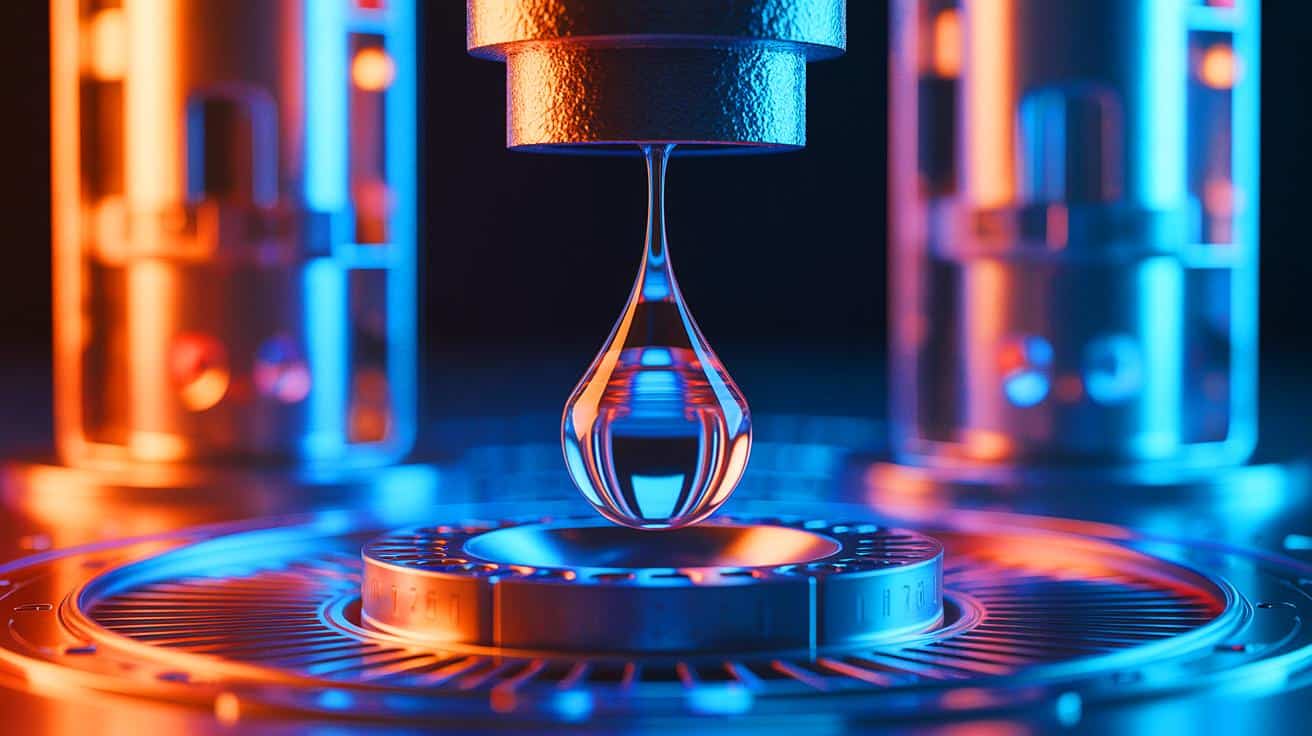
The Korea Research Institute of Standards and Science, in collaboration with European XFEL in Germany, embarked on an ambitious project to study water under extreme pressure. Utilizing a dynamic diamond anvil cell, researchers managed to compress water droplets with precision previously unattainable. This device, equipped with diamond tips, allowed scientists to exert pressures ranging from 0.001 to 120 gigapascals per second. This is millions of times the pressure experienced at sea level.
During the experiments, the pressure was repeatedly varied between approximately 0.6 to 2.0 gigapascals while maintaining a constant temperature of around 77 degrees Fahrenheit. The team monitored the freezing and thawing processes, capturing intricate details of each phase transition. The European XFEL’s rapid X-ray flashes, synchronized with the onset of crystallization, enabled researchers to create brief “movies” of ice formation under conditions similar to those found on distant planets and moons.
Five Different Roads to Ice
The study revealed that water does not follow a single, straightforward path to becoming ice. Instead, it can freeze through five distinct pathways, sometimes forming less common types such as ice VI or passing through transient states. In some scenarios, water transformed into ice VI and then evaporated, while in others, it followed a complex route involving multiple solid phases before liquefying again.
These findings suggest a hidden network of crystallization pathways rather than a solitary route from liquid to solid. The rapid transitions, occurring in just 20 to 40 microseconds, highlight the dynamic nature of water’s behavior under pressure. The researchers’ ability to compress samples along predetermined pressure paths and observe real-time changes has unveiled a previously unknown complexity in water’s phase transitions.
The Birth of Ice XXI
Among the newly discovered pathways, the emergence of ice XXI stands out. This form of ice is structurally distinct from previously known phases, featuring a unique body-centered tetragonal crystal lattice. With 152 water molecules per unit cell, ice XXI is denser than ordinary ice, causing it to sink rather than float.
At approximately 1.6 gigapascals, the density of ice XXI is 1.413 grams per cubic centimeter. Unlike other phases, ice XXI does not revert to its previous state; instead, it transitions toward more stable structures like ice VII and VI. This characteristic classifies ice XXI as a metastable form, persisting temporarily despite more stable alternatives. The research demonstrates how rapid compression can prevent immediate crystallization, allowing unusual structures to form.
Watching Atoms Remodel Themselves
To understand what occurs at the atomic level, scientists combined their experiments with molecular-dynamics simulations. As pressure increased to 2 gigapascals, the internal structure of water shifted gradually from one typical of ice VI to one typical of ice VII. This smooth transition explains why multiple solid structures can develop along the way.
The pressurized water does not abruptly change states; instead, it meanders through intermediate stages where molecules partially align before forming a full crystal. These findings suggest that freezing is more about timing than simply temperature or pressure. The intricate interplay between crystal formation speed and energy movement within the fluid plays a crucial role in determining the outcome.
High-Speed Snapshots of a Hidden World
Capturing events that occur in microseconds required cutting-edge technology. The European XFEL’s ultra-short X-ray pulses enabled researchers to observe atomic reorganization during phase transitions. Additional experiments at DESY’s PETRA III laboratory confirmed the structure of ice XXI and its large repeating units.
Through over a thousand cycles of compression and decompression, researchers consistently observed the same patterns, indicating reproducible physical processes. The success of this study underscores the complexity of water’s behavior and its capacity to surprise even seasoned scientists. As one researcher noted, water’s molecular structure allows for an astonishing variety of patterns, showcasing its inherent richness and flexibility.
This research not only enhances our understanding of water but also has implications for planetary science and materials science. As we continue to explore the universe and manipulate materials, what other secrets might everyday substances like water hold?



Wow, ice that sinks? That’s literally turning my world upside down! 😂
Wait, does this mean we could have ice cubes that don’t float in drinks? 🤔
This is mind-blowing! How can ice exist at room temperature? 😮
Could this discovery have practical applications, or is it just for scientific knowledge?
So, does this mean we could have icebergs that sink? 🤔
I’m curious how this will change our understanding of water on other planets.
So many pathways for ice formation! What’s next, a new form of steam? 😂
How can ice form at room temperature? Isn’t that a contradiction? 🤔
Thanks for the article! It’s fascinating to see water’s complexity unraveled.
Is this why my ice cubes sometimes sink in my whiskey? 😆🍷
Thanks for the article! It’s fascinating to learn about water’s complexity. 🌊
This could revolutionize how we study climates on icy moons. Great discovery!
How did they manage to keep the temperature constant while applying such pressure?
This is amazing! Could this research affect how we understand climate change?
Ice XXI sounds like a superhero name for water! 🦸♂️
Are there any risks in creating such high pressure experiments?