



| IN A NUTSHELL |
|
In a landmark development in agricultural technology, Chinese scientists have introduced the world’s first AI-powered robot capable of performing hybrid pollination autonomously. Named GEAIR, this robot promises to revolutionize breeding practices by reducing costs, accelerating breeding cycles, and enhancing efficiency. Developed by a team led by Xu Cao at the Institute of Genetics and Development Biology, CAS, this innovation combines artificial intelligence with biotechnology to perform precision tasks that were once labor-intensive and prone to error. As the agricultural sector faces increasing challenges, such technologies could be crucial in meeting global food demands.
The Science Behind GEAIR
At the heart of GEAIR’s capabilities is its ability to perform cross-pollination, a fundamental process in creating hybrid plant varieties. Cross-pollination involves transferring pollen from one flower to another, traditionally a time-consuming and error-prone task when done manually. The aim is to produce hybrid offspring that offer superior quality and yield. GEAIR, with its AI-driven precision, reduces the time required for this process and minimizes human error.
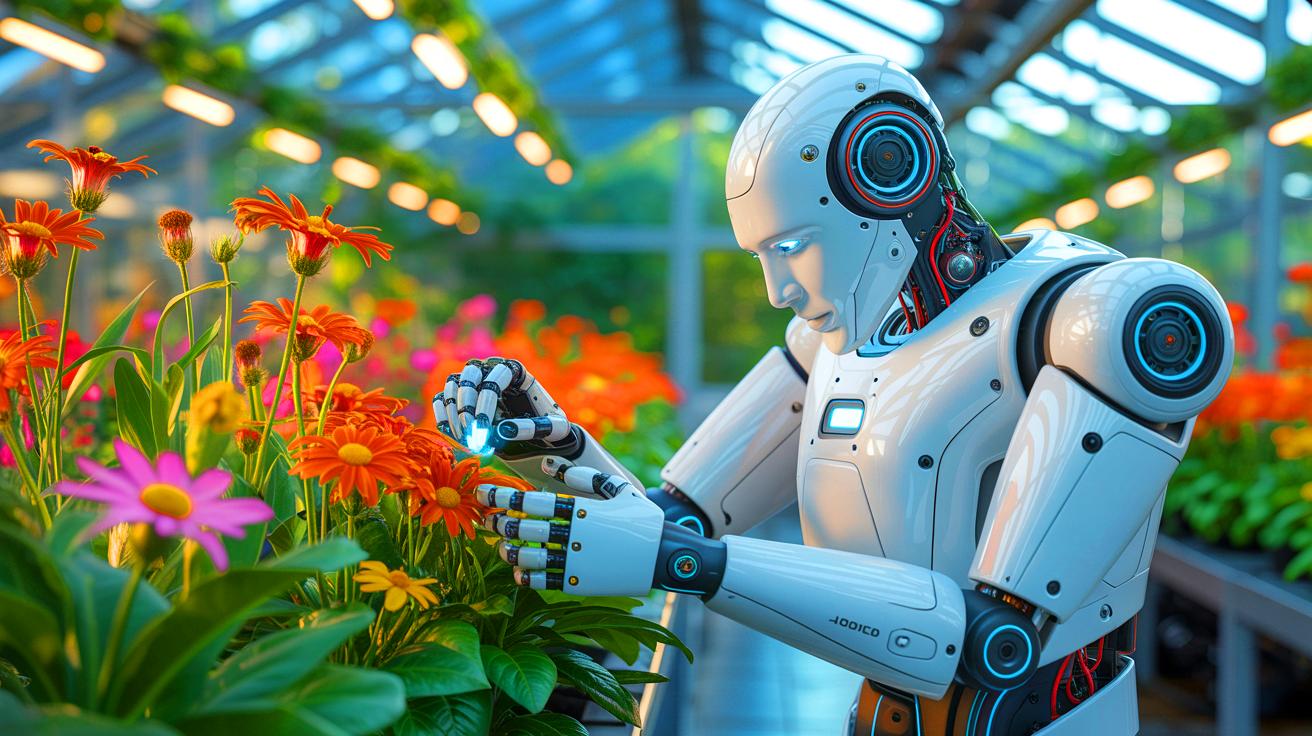
In practical tests, GEAIR has demonstrated remarkable accuracy. The robot navigates autonomously within a greenhouse, identifies a target flower, and extends its mechanical arm to perform the pollination with precision. Xu Cao emphasizes the potential of AI and robotics to transform hybrid breeding, enhancing crop yields and promoting sustainable practices. This innovation could lead to significant cost reductions and efficiency improvements in agricultural production.
Innovative Breeding Techniques
The development of GEAIR involves advanced genetic and farming techniques. Researchers employed gene editing to produce male-sterile flowers, simplifying the creation of hybrid seeds. This genetic modification allows the robot to perform its tasks more effectively. Additionally, the team integrated GEAIR with cutting-edge farming methods such as “de novo domestication” and “speed breeding,” resulting in the establishment of an “intelligent robotic breeding factory.”
One significant application of this technology is the development of a male-sterile soybean system. This advancement could greatly enhance China’s efforts in soybean hybrid breeding, potentially leading to substantial increases in crop yields. The combination of gene editing and robotic precision marks a new chapter in agricultural innovation, potentially setting new standards for future breeding practices.
Potential Impacts and Future Prospects
GEAIR represents a major leap forward in incorporating AI and biotechnology into agriculture. Xu Cao described the project as an intelligent breeding model integrating biotechnology, AI, and robotics into a cohesive system. This model positions China at the forefront of developing fully autonomous and intelligent breeding systems.
Published in the journal Cell, this study highlights the potential applications of AI in biological breeding. By leveraging biotechnology as the foundation, AI as an empowering tool, and robotics as the operator, the study underscores China’s pioneering role in creating a closed-loop technology system. The implications for global agriculture are profound, offering a glimpse into a future where intelligent robots could play a pivotal role in food production.
Challenges and Considerations
While the potential benefits of GEAIR are significant, there are challenges and considerations that must be addressed. The deployment of such advanced technologies requires substantial investment and infrastructure, which may not be feasible for all regions. Additionally, ethical considerations around genetic modification and the impact on biodiversity must be carefully evaluated.
Furthermore, the integration of AI and robotics into traditional farming practices may face resistance from stakeholders accustomed to conventional methods. It is crucial to ensure that these innovations are accessible and beneficial to all, including small-scale farmers who may face barriers to adoption. The role of policy and regulatory frameworks will be critical in facilitating the responsible use of such technologies.
As GEAIR and similar technologies become more prevalent, they could redefine the landscape of agriculture. The promise of increased efficiency and reduced costs is tantalizing, but it also raises questions about the future of labor in agriculture and the potential displacement of workers. How can societies balance technological advancement with equitable access and ethical considerations in agriculture?



Wow, this is amazing! Can’t wait to see how GEAIR changes agriculture. 🌸
Is it really safe to let robots handle such a delicate process? 🤔
Finally, technology is catching up with nature! But what about the bees? 🐝
How soon can we expect to see GEAIR in action globally?
What are the environmental impacts of using AI for pollination?
This sounds like a sci-fi movie plot! 😄
Will GEAIR be affordable for small farmers?
Could this technology help combat food shortages?
Impressive but what are the ethical implications of gene editing?
How does GEAIR compare to traditional pollination methods in terms of efficiency?
Are there any risks of relying too much on AI in agriculture?
Sounds revolutionary, but I can’t help feeling skeptical…
Thank you for sharing this fascinating development! 😊
What happens if GEAIR malfunctions during pollination?
Is there any data on the long-term effects of using GEAIR?
Hope this doesn’t mean the end for human farmers! 🌾
I wonder how GEAIR will perform in different climates.
How does GEAIR ensure diversity in hybrid crops?
This is what happens when technology meets nature. Amazing! 🤖
Can GEAIR be used for other types of plants beyond soybeans?
What’s next? Robots herding cattle? 😂
How does this align with sustainable agriculture practices?
Excited to see how this tech will evolve! 🚀
Is there a backup plan if the AI system fails?
How do we ensure that GEAIR’s use is ethically regulated?
I’m all for innovation, but this seems a bit too much!
Will this tech make farming more accessible worldwide?
Can GEAIR help with other agricultural challenges like pest control?