



| IN A NUTSHELL |
|
In a remarkable advancement for paleontology, scientists have successfully employed a new dating technique to determine the age of a dinosaur egg, dating it back an astonishing 85 million years. This breakthrough, achieved through uranium-lead (U-Pb) dating, offers unprecedented insight into Earth’s ancient climate and the evolutionary challenges faced by species during the Late Cretaceous period. The study, published in Frontiers in Earth Science, not only sheds light on the past but also opens new avenues for understanding prehistoric ecosystems. By precisely dating these eggs, researchers can now explore ancient environmental conditions with extraordinary accuracy, potentially revolutionizing our understanding of dinosaur evolution and extinction.
The Revolutionary U-Pb Dating Method
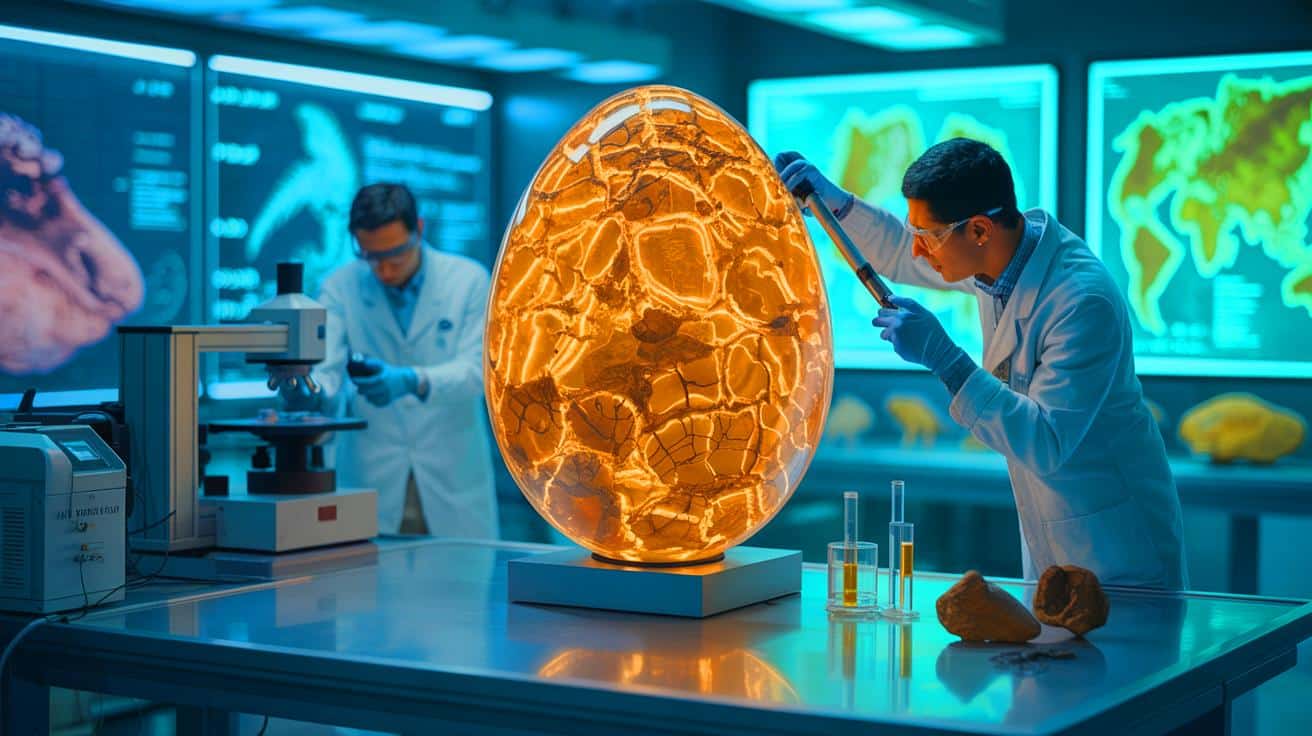
For the first time, researchers have directly dated dinosaur eggs using the uranium-lead (U-Pb) dating method, marking a significant leap forward in paleontological research. This sophisticated technique involves analyzing the decay of uranium into lead, which occurs over millions of years. By using a micro-laser to vaporize minerals in the eggshells, scientists can precisely measure the uranium and lead content, providing an accurate timeline without relying on potentially altered surrounding geological layers.
The dinosaur eggs in question were unearthed from the Qinglongshan site in central China’s Yunyang Basin. These eggs have been accurately dated to 85 million years ago, a time corresponding to the Maastrichtian epoch of the Late Cretaceous period. The study’s lead author, Dr. Bi Zhao, highlights the importance of this method in resolving long-standing uncertainties about the age of dinosaur fossils, stating, “We provide the first robust chronological constraints for these fossils, resolving long-standing uncertainties about their age.”
This innovative approach could revolutionize the establishment of a global chronology for dinosaur eggs, offering new insights into prehistoric life and the environmental factors that influenced dinosaur evolution.
Unveiling Evolutionary Adaptations
The Qinglongshan site, which has yielded over 3,000 eggs across three distinct locations, has become a focal point for studying dinosaur evolutionary adaptations. These eggs, attributed to the species Placoolithus tumiaolingensis from the Dendroolithidae family, are notable for their uniquely porous eggshells. Researchers believe these features were adaptations to a cooling climate that began several million years before the eggs were deposited.
The Late Cretaceous period, particularly the Turonian epoch, experienced a decline in global temperatures, forcing dinosaurs to adapt or face extinction. The specialized pore structures observed in the Dendroolithids may represent evolutionary responses to this climatic shift. However, the inability of P. tumiaolingensis to successfully adapt to these changing conditions suggests an "evolutionary dead end," as Dr. Zhao explained, indicating a decline in their population.
This discovery provides a crucial piece of the puzzle in understanding how ancient species responded to environmental changes, offering a glimpse into the evolutionary pressures shaping life during this era.
Climate Change and Dinosaur Extinctions
The Qinglongshan site, now China's first national reserve dedicated to dinosaur egg fossils, offers profound insights into the role of climate change in shaping extinction patterns during the Late Cretaceous. The fossilized eggs of Placoolithus tumiaolingensis serve as a window into the past, illustrating the impact of a cooling climate on these ancient creatures.
This study not only highlights the significance of environmental shifts in dinosaur evolution and extinction but also underscores the broader implications for understanding prehistoric life. By establishing precise timelines for these fossils, scientists can better trace the effects of global climate changes on ancient ecosystems.
The findings from this research contribute to a deeper understanding of Earth's history, offering valuable lessons for modern-day climate challenges and the potential consequences for current ecosystems.
“They’ve Been Hiding This Monster”: Student Discovers 23 Foot Killer Dinosaur In Museum Storage
Implications for Future Research
The successful application of the U-Pb dating method to dinosaur eggs marks a pivotal moment in paleontological research. This technique not only enhances our understanding of the Late Cretaceous period but also sets the stage for future studies exploring prehistoric life and climate interactions. By providing a more accurate timeline, researchers can delve deeper into the evolutionary history of dinosaurs and the factors that influenced their survival and extinction.
As scientists continue to uncover new fossils and refine dating methods, the potential for discovering additional insights into Earth's ancient past grows. This research opens doors for interdisciplinary collaborations, bridging paleontology, geology, and climate science to create a comprehensive understanding of how ancient ecosystems functioned and evolved.
What new revelations about Earth's history might future studies uncover, and how will these findings shape our understanding of present-day climate challenges?



Wow, 85 million years! That’s like, mind-blowing! 🦖
Wow, 85 million years! That’s older than my morning coffee! ☕️
Isn’t it amazing how technology keeps revealing the secrets of the past? 🔍
How sure are we that this dating method is accurate? 🤔
How do they know the egg’s really 85 million years old? 🤔
Is this the oldest dinosaur egg ever found, or are there older ones?
Thanks for the article! I never knew dinosaurs had such a hard time with climate change too.
Thank you for sharing such fascinating discoveries! This is amazing! 🌟
This is incredible! What does it mean for our understanding of dino evolution?
Does this mean dinosaurs were already struggling before the asteroid hit?
Great piece! But why did it take so long to discover this method for dating eggs?
This is so cool! I love learning about dinosaurs! 🦕
Next thing you know, they’ll find a fossilized omelette! 🍳😂
Can anyone explain how uranium-lead dating works in simple terms?
Is it possible that the climate changes were more drastic than we thought?
Grate article! So informative and exciting! 🦖🌍
What other secrets does the Qinglongshan site hold?
How might this discovery change our understanding of the Late Cretaceous?
Is there any risk of contamination affecting the dating process?
Why do we keep finding such amazing discoveries in China?
Is this technique applicable to other types of fossils?
Thank you for keeping us updated on these incredible finds!
Did these dinosaurs actually go extinct because of climate change?
How many more dinosaur eggs are still waiting to be discovered? 🥚
Could this new dating method be wrong? I’m skeptical! 🤨
What does this mean for our understanding of dinosaur behavior?
Are there plans to use this method on other fossil sites worldwide?
This is like a real-life Jurassic Park! So fascinating! 🎥🦖
How do they ensure precision when using a micro-laser on the eggshells?
Is the Qinglongshan site open for public visits? I’d love to see it! 😍
Why haven’t we heard about this dating method before now?
How will this discovery influence future paleontological research?
Who decides the names for these dinosaur species, anyway?
What other types of fossils can we date using this new method?
Thanks for the article! Can’t wait to see what they find next! 🌟
Are there any controversies surrounding this new dating method?
How does this discovery affect our understanding of dinosaur extinction? 🌍
What’s next for the team studying these prehistoric treasures?
This makes me wonder if we’ll ever find a perfectly preserved dinosaur! 🦖
Is it safe to say dinosaurs were doomed before the asteroid hit?
Can this method be used to date other ancient eggs, like bird eggs?
Such an exciting time to be interested in dinosaurs! 🚀
What about the other 3,000 eggs? Any more dating planned?