




| IN A NUTSHELL |
|
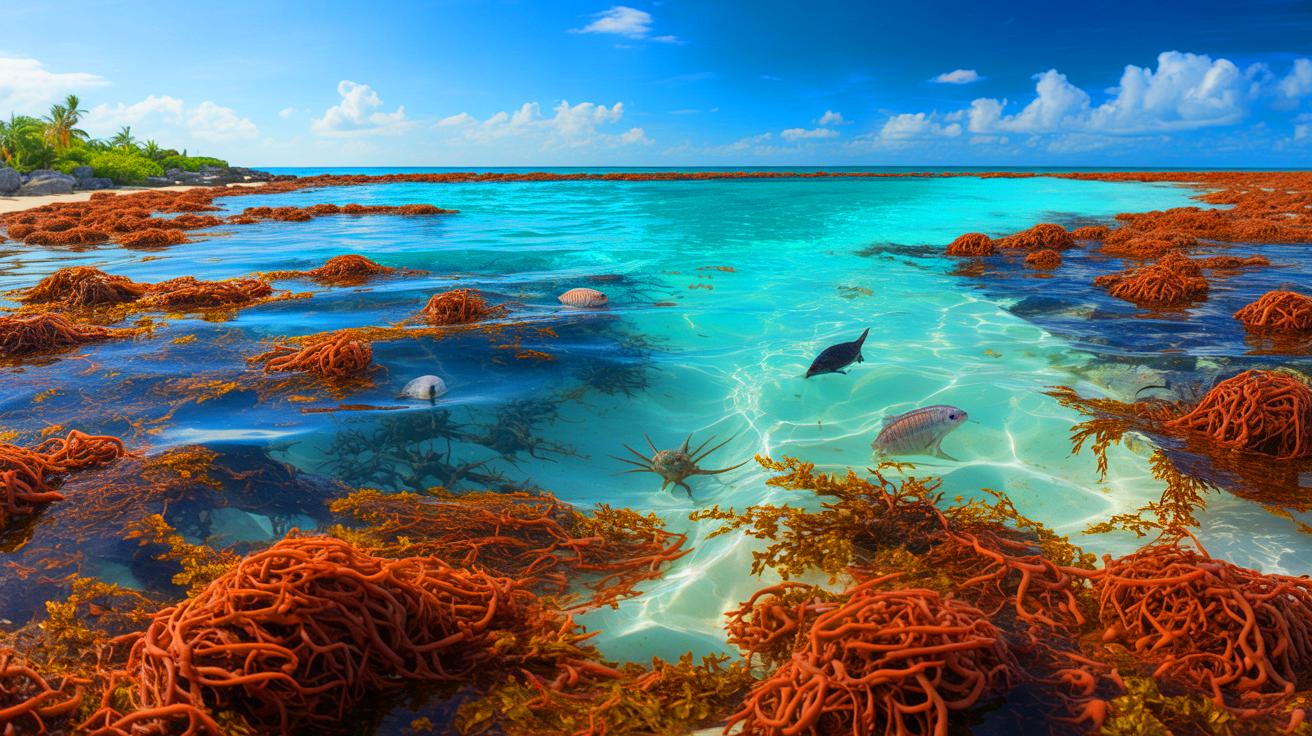
In recent years, massive blooms of Sargassum seaweed have become a troubling phenomenon along the coastlines of the Caribbean, the Gulf of Mexico, and northern South America. These proliferations, which set a new record of 38 million tons in June alone, are a source of concern for both local ecosystems and economies. As Sargassum accumulates on beaches, it decays, releasing a foul odor that deters tourists and affects marine life. While the algae serve as a habitat for marine creatures when afloat, their excessive growth poses significant challenges. Recent scientific breakthroughs have begun to unravel the mystery behind these blooms, offering hope for better predictive models and management strategies.
Decoding the Sargassum Surge
The primary driver of the Sargassum blooms has remained elusive until a team of international researchers, led by the Max Planck Institute for Chemistry, made a groundbreaking discovery. Their research, published in Nature Geoscience, identifies strong wind-driven upwelling near the equator as a key factor. This upwelling brings phosphorus-rich deep water to the surface, which is then carried into the Caribbean. This nutrient influx supports cyanobacteria that live on the algae’s surface.
Cyanobacteria perform nitrogen fixation, a process that converts atmospheric nitrogen gas into a form usable by Sargassum. This symbiotic relationship gives Sargassum a competitive edge over other algae, explaining its recent abundance. By understanding this mechanism, scientists are paving the way for predictive systems that could forecast future Sargassum events and potentially mitigate their impact.
Insights From Coral Cores
The research team utilized coral cores to link Sargassum growth with nitrogen fixation and nutrient-rich water upwelling. Corals, which incorporate chemical traces from their environment as they grow, serve as historical records of ocean chemistry. By analyzing these growth layers, researchers reconstructed oceanic changes over the past century.
Specifically, they measured nitrogen isotopes to determine past nitrogen fixation rates. Corals with low 15N to 14N ratios indicate heightened nitrogen fixation, correlating with periods of Sargassum proliferation. These findings were validated using seawater samples, affirming that corals accurately record nitrogen fixation. This method provides a valuable tool for understanding long-term changes in ocean chemistry and their relationship with Sargassum blooms.
Establishing a Consistent Pattern
Jonathan Jung, a PhD student at the Max Planck Institute, highlights that the study’s findings reveal a consistent pattern between Sargassum biomass and nitrogen fixation since 2011. The research showed significant increases in nitrogen fixation during 2015 and 2018, years marked by record Sargassum blooms, suggesting a strong correlation.
This pattern aligns with the first significant transport of brown algae from the Sargasso Sea into the tropical Atlantic in 2010. The consistent linkage of nitrogen fixation with Sargassum biomass underscores the importance of this nutrient relationship. Understanding this connection can guide future research and management strategies to address the impacts of these blooms.
Refining Predictive Models
The study rules out other potential nutrient sources, such as Saharan dust or river inputs from the Amazon and Orinoco, as major contributors to Sargassum events. Instead, the researchers emphasize the role of phosphorus from upwelling waters and nitrogen from bacteria as the primary drivers. This mechanism offers a more accurate model for predicting Sargassum growth.
Future predictions will rely on monitoring sea surface temperatures, wind conditions, and upwelling patterns in the equatorial Atlantic. According to Alfredo Martínez-García, the study’s senior author, the impact of global warming on these processes will be crucial. The team plans to extend their research using coral records from various Caribbean locations to better understand and manage the ecological and economic challenges posed by Sargassum blooms.
As the scientific community continues to unravel the complexities of these algae blooms, the findings raise important questions about future ecosystem management and economic implications. How will climate change further influence the factors driving Sargassum growth, and what strategies can coastal communities implement to mitigate these impacts? The answers may hold the key to preserving both the natural environment and the livelihoods of those who depend on it.



Wow, 38 million tons of Sargassum! That’s a lot of seaweed 🌿
Wow, 38 million tons of Sargassum! That’s a lot of seaweed. 🌿 How do they even measure that amount?
Great article! Thanks for shedding light on such an important issue. 👍
Isn’t it amazing how coral cores can tell us about ocean history? Nature’s time capsules! ⏳
So, does this mean we’re going to have more stinky beaches? 😷
Does this research offer any solutions for affected coastal communities?
Great article! But I’m curious, how exactly do they determine the contribution of phosphorous from upwelling vs. other sources?
Interesting read! How can local governments use this information?
Why haven’t we found a way to utilize Sargassum for something beneficial yet?
Does this mean we should start investing in Sargassum as a biofuel? 🤔
I’m curious, what role does climate change play in these blooms?
Is there a way to predict when and where these blooms will happen?
I had no idea Sargassum was this big of a problem! Thanks for the insights.
Thank you for this informative piece! It’s eye-opening.
Why was the role of phosphorus-rich upwelling not discovered earlier?
Seems like climate change is the usual suspect again. But what can we do about it?
Maybe we should just start eating Sargassum. Problem solved! 😂