




| IN A NUTSHELL |
|
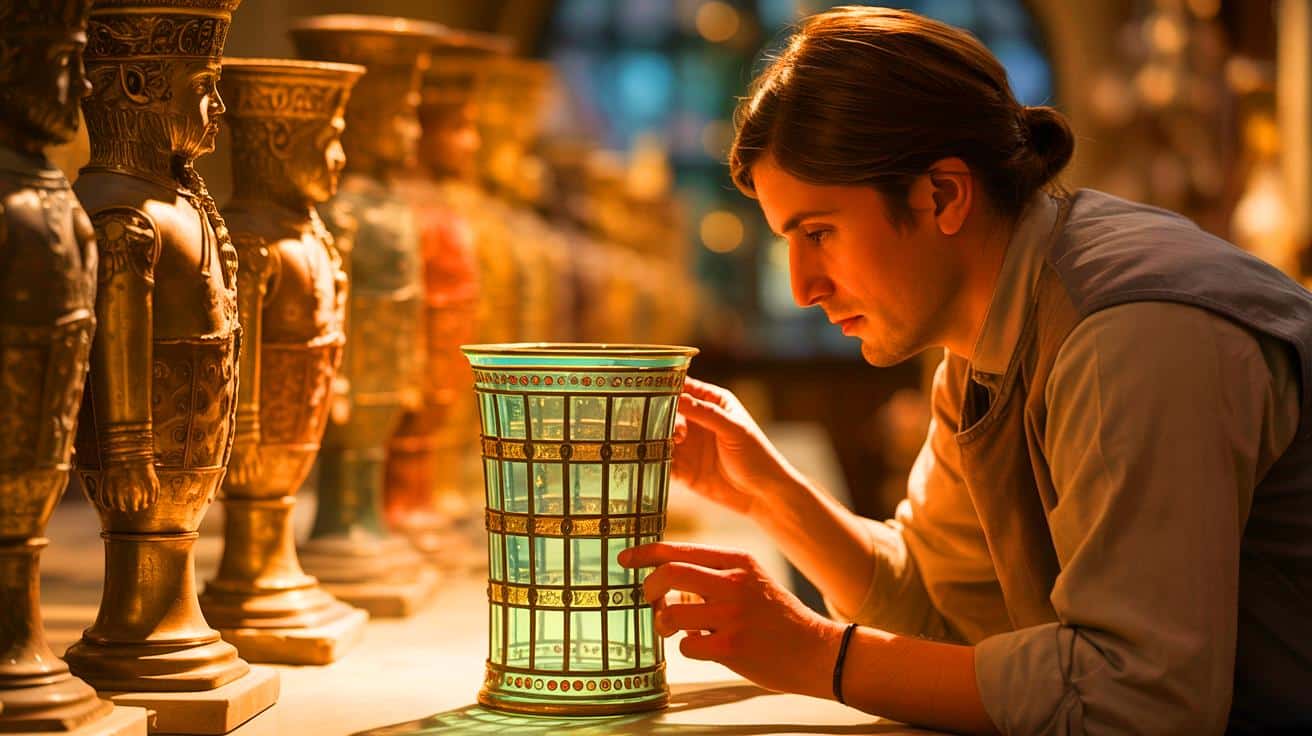
In a quiet museum gallery, Hallie Meredith, an art history professor and practicing glassblower, observed something that had long eluded experts. During a visit to the Metropolitan Museum of Art in New York City in February 2023, Meredith examined a collection of Roman glass cage cups, dating from 300 to 500 CE. These vessels, renowned for their intricate craftsmanship, revealed an overlooked detail when Meredith performed a simple action: she turned one of the cups around. Her discovery shed new light on symbols believed to be mere ornamentation, suggesting they were likely makers’ marks. This insight challenges long-held assumptions about Roman glass production, focusing attention on the artisans behind these exquisite creations.
Overlooked Symbols and Ancient Makers’ Marks
Meredith’s discovery began with a closer examination of abstract shapes and inscriptions on a Roman vessel. Traditionally viewed as decorative, these elements included diamonds, leaves, and crosses. Meredith’s research suggests these symbols served as makers’ marks, identifying the workshops and artisans responsible for crafting these complex glass objects. As a trained glassblower, Meredith’s inclination to physically engage with the artifacts led to this revelation. Her unique perspective enabled her to see patterns that had been overlooked by others, revealing a hidden layer of information about the creators of these ancient works.
“Because I am trained as a maker, I kept wanting to flip things over,” Meredith said. “When that happens, patterns appear that everyone else has literally photographed out of the frame.”
This insight emphasizes the importance of considering the maker’s perspective in understanding ancient artifacts. These marks, previously dismissed as mere decoration, now offer a glimpse into the identity and organization of Roman glass workshops.
Tracing a Network of Roman Glassworkers
Meredith’s observation led to a broader investigation into the organization of Roman glassmakers. Her findings, published in the Journal of Glass Studies and World Archaeology, document the recurrence of these symbols across multiple objects. This repetition points to a shared visual system used by Roman glassworkers from the fourth to sixth centuries CE. By examining tool marks, inscriptions, and unfinished pieces, Meredith uncovered evidence of collaborative workshops where engravers, polishers, and apprentices worked together. This discovery reveals a community of artisans whose contributions had been obscured over time.
The implications of this research extend beyond the identification of specific makers. It highlights the collaborative nature of Roman glass production, challenging the notion of solitary artisans. Meredith’s work underscores the value of interdisciplinary approaches that combine art history with practical experience.
Rethinking How Roman Glass Was Made
For centuries, scholars have debated the techniques used to produce Roman openwork glass vessels. Meredith’s research shifts the focus from methods to the people involved. Each diatretum began as a thick-walled glass form, intricately carved into two layers connected by thin bridges. The final product, a delicate lattice, required immense skill and endurance. Meredith argues that these vessels were the result of collective effort, with multiple specialists collaborating on a single piece over time.
“They weren’t personal autographs,” she said. “They were the ancient equivalent of a brand.”
This perspective reframes the understanding of Roman glass production, positioning it as a community-driven endeavor. Meredith’s findings encourage a reevaluation of assumptions about ancient craftsmanship and highlight the importance of recognizing the contributions of diverse artisans.
A Broader History of Ancient Craft Labor
Meredith’s forthcoming book, The Roman Craftworkers of Late Antiquity: A Social History of Glass Production and Related Industries, promises to expand on these ideas. Drawing on her experience as a glassblower, she explores the physical demands of ancient craftwork. At Washington State University, she teaches a course called Experiencing Ancient Making, where students recreate artifacts using modern technology and traditional techniques. This hands-on approach fosters empathy and a deeper understanding of ancient artisans.
Meredith’s broader goal is to restore visibility to the laborers behind ancient material culture. By focusing on the evidence of craftworkers’ lives, she challenges static narratives that emphasize elite figures. Her next project combines art history with data science, creating a database that tracks unconventional writing across artifacts. This initiative aims to illuminate the multilingual and diverse backgrounds of ancient artisans, offering a new lens through which to view historical objects.
Meredith’s work invites scholars and the public to reevaluate ancient artifacts, urging them to see beyond technical brilliance to the human stories behind the objects. Her research emphasizes the importance of collaboration, creativity, and skill in shaping these works. As light catches the lattice of a diatretum, it reflects not just artistry but also the lives of those who crafted it centuries ago. How might future discoveries continue to reshape our understanding of ancient craftsmanship?




Wow, this is incredible! Who knew a simple turn could reveal so much history? 🤯
Wow, who knew that flipping a cup could reveal so much history? Fascinating stuff! 🍷
Hallie Meredith deserves a medal for this discovery! 🏆
This is a great article. Thanks for shedding light on the artisans behind these masterpieces!
Wait, so you’re telling me we’ve been missing these symbols for 1,500 years? 🤔
Does anyone else think Meredith should start a detective agency for ancient artifacts? 🕵️♀️
Are there any images of the makers’ marks? Would love to see them!
Thank you for shedding light on such an amazing topic. This was a fascinating read!
Can these findings change how we date Roman artifacts in the future?
Hallie Meredith sounds like a real-life Indiana Jones! 🔍
Great article! It’s always exciting to learn more about ancient cultures.
Why did it take so long for someone to notice these marks? Are we too focused on the wrong details?
Isn’t it amazing how much we can still learn from ancient artifacts? Great read!
How can we be sure that these markings are truly makers’ marks and not just decoration? 🤔
I love that this discovery highlights the importance of the artisans! 🎨
So, did the Romans have their own version of “Made in Rome” tags? 😆
What other ancient items might have similar hidden messages?