




| IN A NUTSHELL |
|
In a stunning revelation of medieval intrigue, forensic analysis of a 750-year-old skeletal remains has unearthed the brutal murder of Béla, Duke of Macsó. This 13th-century Hungarian noble was viciously stabbed more than two dozen times by at least three assailants, employing weapons such as a saber and a long sword. This discovery, published in the February 2026 issue of Forensic Science International: Genetics, not only enriches our understanding of medieval power struggles but also underscores the violent lengths to which individuals would go to eliminate perceived threats to their power.
Unraveling Historical Mysteries
The journey to uncover Béla’s remains began in 1915, when archaeologists discovered a young man’s skeleton at a Dominican monastery on Margaret Island in Budapest. Initially, the bones were believed to belong to Béla, based on historical accounts of his assassination in 1272. However, the bones went missing during World War II, halting further investigations. In 2018, the skeleton was rediscovered in a wooden box at the Hungarian Natural History Museum, prompting researchers to revisit the case.
Despite the discovery, questions remained about the skeleton’s true identity. Historical records suggested Béla was murdered and his remains were collected and buried by his sister Margit and niece Erzsébet. Researchers faced a challenge when initial radiocarbon dating seemed to place the remains before Béla’s birth. However, further analysis revealed that a diet rich in seafood, common among royals, could skew these results. This revelation, coupled with DNA comparisons to Béla’s known relatives, confirmed the skeleton belonged to the Duke of Macsó.
The Forensic Investigation
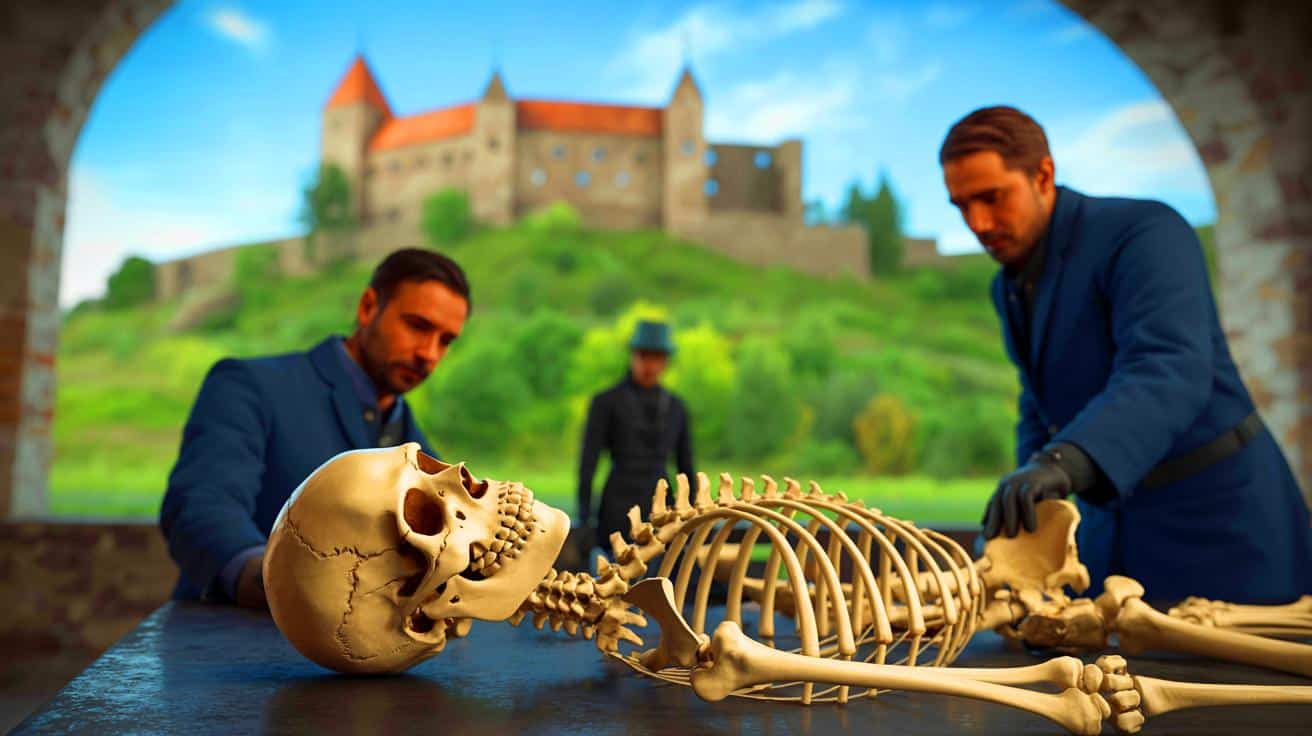
The forensic analysis of Béla’s skeleton revealed significant information about the circumstances of his death. The team, led by osteoarchaeologist Martin Trautmann, identified 26 injuries, including nine to the skull. These findings indicated a premeditated and coordinated attack. The study meticulously reconstructed the sequence of blows by examining how the injuries overlapped and the likely reactions of Béla’s body during the assault.
Defensive wounds on Béla’s arms and hands suggest he was unarmed and without armor during the attack. The analysis determined that at least two different weapons were used, indicating multiple assailants. The attack began with frontal strikes from one attacker wielding a saber, while another assailant struck from the side with a long sword. This coordinated effort suggests a deliberate assassination rather than a random act of violence.
Piecing Together the Motive
Understanding the motive behind Béla’s murder requires delving into the complex political landscape of 13th-century Hungary. Historical accounts suggest that Béla was killed by Henrik Kőszegi, a former friend and mentor, due to escalating political tensions. Rival noble factions were vying for power, and Béla, with his legitimate claim to the throne, posed a significant threat.
The ferocity of the attack, characterized by overkill, suggests a deeply personal motive. The excessive number of wounds, far beyond what was necessary to kill, points to an assassination fueled by intense hostility. This brutal act underscores the volatile nature of medieval power struggles, where alliances could swiftly turn into deadly enmities.
Scientific Validation and Expert Opinions
The scientific community has largely supported the findings of this study. Notably, Eleanor Graham, a forensic scientist at Northumbria University, praised the research for its rigorous scientific evidence. Despite initial discrepancies in radiocarbon dating, the study’s forensic traumatological assessment aligns with historical accounts of Béla’s violent demise.
These findings not only validate historical narratives but also highlight the potential of modern forensic techniques in resolving age-old mysteries. By combining osteoarchaeology with DNA analysis and historical research, the study offers a comprehensive understanding of Béla’s death and its broader implications in medieval Hungary’s political landscape.
As we reflect on the violent end of Béla, Duke of Macsó, we are reminded of the enduring intrigue surrounding historical figures and the power dynamics they navigated. This case exemplifies how modern science can illuminate the past, offering new insights into the lives and deaths of those who shaped history. What other hidden stories from the annals of history await discovery through the lens of forensic science?




Wow, imagine being able to solve a 750-year-old mystery! Forensic science is amazing! 🔍
Wow, this could be a movie plot! 🗡️🕵️♂️
How accurate is DNA analysis on such old remains? 🤔
It’s amazing how modern science can solve mysteries from so long ago. Thanks for sharing this fascinating story!
This is like a medieval CSI episode. Who needs TV when history is this dramatic? 📺
Did the article mention any suspects still alive today? 😜
How did they manage to preserve the skeleton for so many centuries?
Grate work uncovering such a detailed story – really brings history to life!
Is there any evidence of who orchestrated this attack? Seems like a real medieval whodunit!
This sounds like Game of Thrones but in real life!
Why did it take so long to confirm the identity of the skeleton? 🤷♂️
The political landscape in 13th-century Hungary sounds intense. Game of Thrones vibes, anyone? 🐉
Can we be sure the DNA analysis was accurate? Sounds too good to be true.
Can similar forensic techniques be applied to other historical figures?