




| IN A NUTSHELL |
|
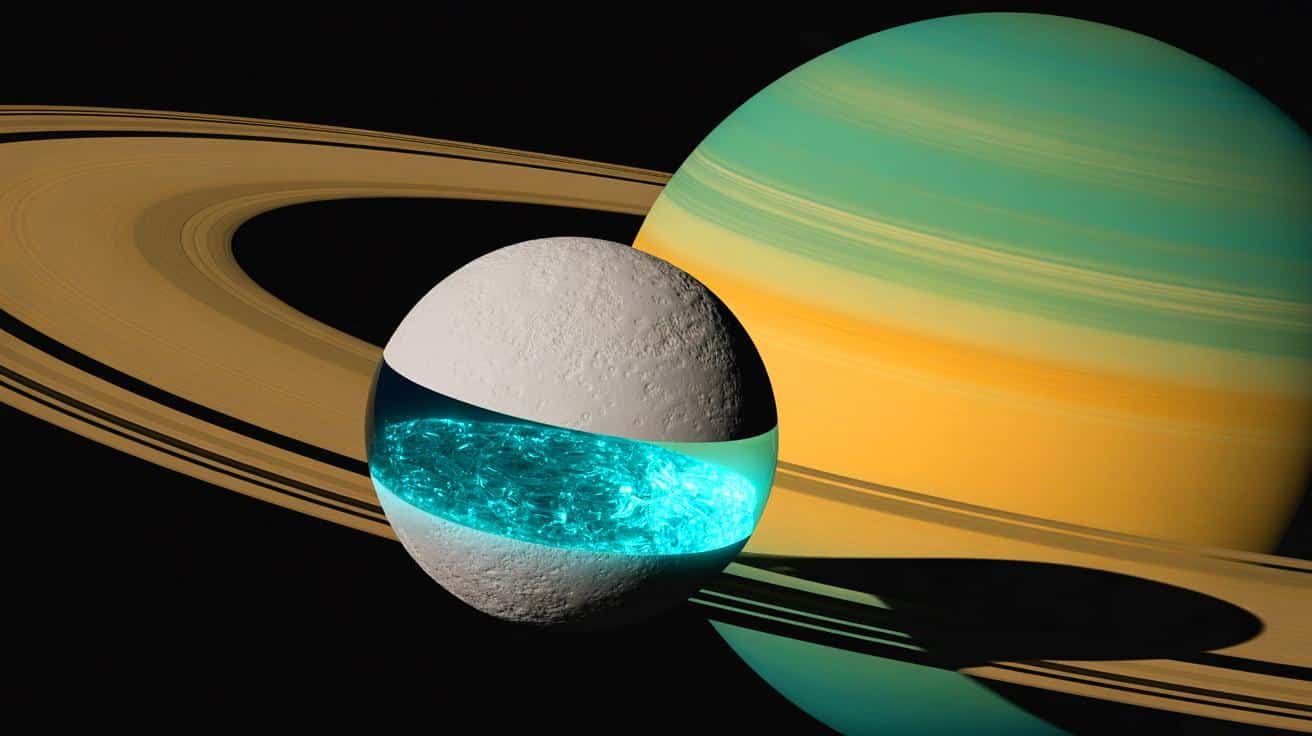
NASA’s Cassini mission has unveiled groundbreaking insights into Enceladus, one of Saturn’s moons and a prime candidate for extraterrestrial life. A recent study reveals that heat is being emitted from both poles of Enceladus, surprising scientists and suggesting a long-term thermal balance that could potentially support life. Published in Science Advances on November 7, these findings could reshape our understanding of the icy moon’s capacity to harbor life. A team of scientists from Oxford University, the Southwest Research Institute, and the Planetary Science Institute conducted the study, which reveals that Enceladus is much more thermally active than previously thought.
The Hidden Ocean Beneath the Ice
Enceladus is home to a vast, salty ocean concealed beneath its icy surface. This ocean, rich in essential chemical ingredients like phosphorus and complex hydrocarbons, is considered a promising environment for life beyond Earth. Scientists believe that the ocean is the central source of the moon’s internal heat. For life to thrive, this ocean must maintain a stable equilibrium over long periods, balancing the energy it gains and loses. Saturn’s gravity causes tidal heating, stretching and compressing Enceladus as it orbits, which helps sustain this balance.
If too little heat is produced, the ocean might freeze, extinguishing any chance for life. Conversely, too much heat could lead to excessive geological activity, disrupting the environment required for life. The study’s lead author, Dr. Georgina Miles, emphasized the importance of understanding Enceladus’ long-term energy availability to assess its potential to support life. The discovery of heat at both poles significantly impacts our understanding of Enceladus as a candidate for life beyond Earth.
Measuring Enceladus’ Unexpected Warmth
Previously, scientists only measured heat loss at Enceladus’ south pole, where geysers release water vapor and ice. The north pole was believed to be geologically inactive. However, recent data from NASA’s Cassini spacecraft challenged this assumption. The team studied the north polar region during two periods: the deep winter of 2005 and the summer of 2015. By analyzing these observations, scientists estimated how much energy Enceladus loses as heat moves from its subsurface ocean to its icy surface, which remains extremely cold.
The study revealed that the north pole’s surface was approximately 7 Kelvin warmer than expected, indicating heat leakage from the hidden ocean.
The researchers measured a heat flow of 46 ± 4 milliwatts per square meter, equating to about two-thirds of the average heat escaping through Earth’s continental crust. This translates to roughly 35 gigawatts of energy across Enceladus, equivalent to the power produced by millions of solar panels or thousands of wind turbines.
A Stable Ocean Environment
When combined with heat detected at the active south pole, Enceladus’ total heat loss reaches approximately 54 gigawatts. This finding aligns with predictions of how much heat tidal forces should generate. The balance between heat creation and loss suggests Enceladus’ ocean could remain liquid for extended periods, providing a stable environment that might allow life to develop. Dr. Carly Howett, a corresponding author of the study, emphasized the significance of understanding the moon’s global heat loss in assessing its potential to support life.
This new result supports Enceladus’ long-term sustainability, a vital component for life to develop. The discovery of a balanced thermal environment increases the likelihood that Enceladus could remain a focal point in the search for life beyond Earth. The question remains: how long has this ocean existed, and could it have provided stable conditions for life to emerge over billions of years?
Mapping Enceladus for Future Exploration
Understanding Enceladus’ thermal dynamics has implications for future missions. Thermal readings can help estimate the thickness of the moon’s ice shell, crucial for planning missions that may explore its ocean with robotic probes or landers. The analysis suggests that the ice is 12 to 14 miles thick at the north pole and about 15 to 17 miles thick on average, slightly deeper than earlier estimates.
“Eking out the subtle surface temperature variations caused by Enceladus’ conductive heat flow was a challenge,” noted Dr. Miles. “Our study highlights the need for long-term missions to ocean worlds that may harbor life.”
The discoveries from Cassini’s data underscore the importance of extended missions for uncovering the secrets of celestial bodies. As scientists continue to analyze Enceladus, questions about its history and potential for life remain at the forefront of planetary exploration.
The recent revelations about Enceladus’ thermal activity have reignited interest in the moon’s potential to host life. With heat emanating from both poles, the evidence points to a stable environment beneath the ice. As researchers delve deeper into understanding Enceladus’ ocean and its history, new opportunities for exploration arise. Could the secrets of Enceladus one day reveal the presence of extraterrestrial life within our solar system?



Wow, Enceladus sounds like a real-life cold Jacuzzi! 🛁
Wow, Enceladus sounds like a mini Earth! Could it really support life? 🤔
Is NASA planning any missions soon to explore Enceladus further? 🚀
I hope future missions to Enceladus include a live stream! 📡
Can someone explain how the ocean stays warm under all that ice? 🤔
Is the ocean warm enough for life or just warmer than expected?
This is exciting news! Maybe we’ll find some alien fish swimming around. 😂
How does Enceladus’ heat compare to Earth’s geothermal activity?
How do they measure the heat from so far away? Sounds like magic!
Enceladus is now my favorite moon. Sorry, Europa! 🌓
This is fascinating! Thanks for the detailed article. 🙌
Why have we only discovered the heat at both poles now?
It’s amazing to think there could be life out there! Thank you for the article. 🌌
When they say “potential for life,” do they mean little green aliens or microbes? 😂
Are there any theories on what kind of life could exist in Enceladus’ ocean?
Why do we keep looking at icy moons? Shouldn’t we focus on Mars instead?
I’m skeptical. How reliable are these heat measurements?