




| IN A NUTSHELL |
|
The world of military aviation is witnessing a groundbreaking transformation, as Lockheed Martin’s subsidiary Sikorsky unveils the S-70UAS U-Hawk, a cockpit-free Black Hawk helicopter. This innovative model aims to redefine logistics and air assault operations by removing traditional pilot controls in favor of autonomous systems. By equipping the U-Hawk with advanced Matrix autonomy technology, Sikorsky has created a helicopter that can fly without human intervention, offering enhanced cargo capacity and new mission capabilities. This development represents a significant shift in military aviation, promising to change how the military approaches aerial logistics and combat support.
Autonomous Flight: A New Era in Military Aviation
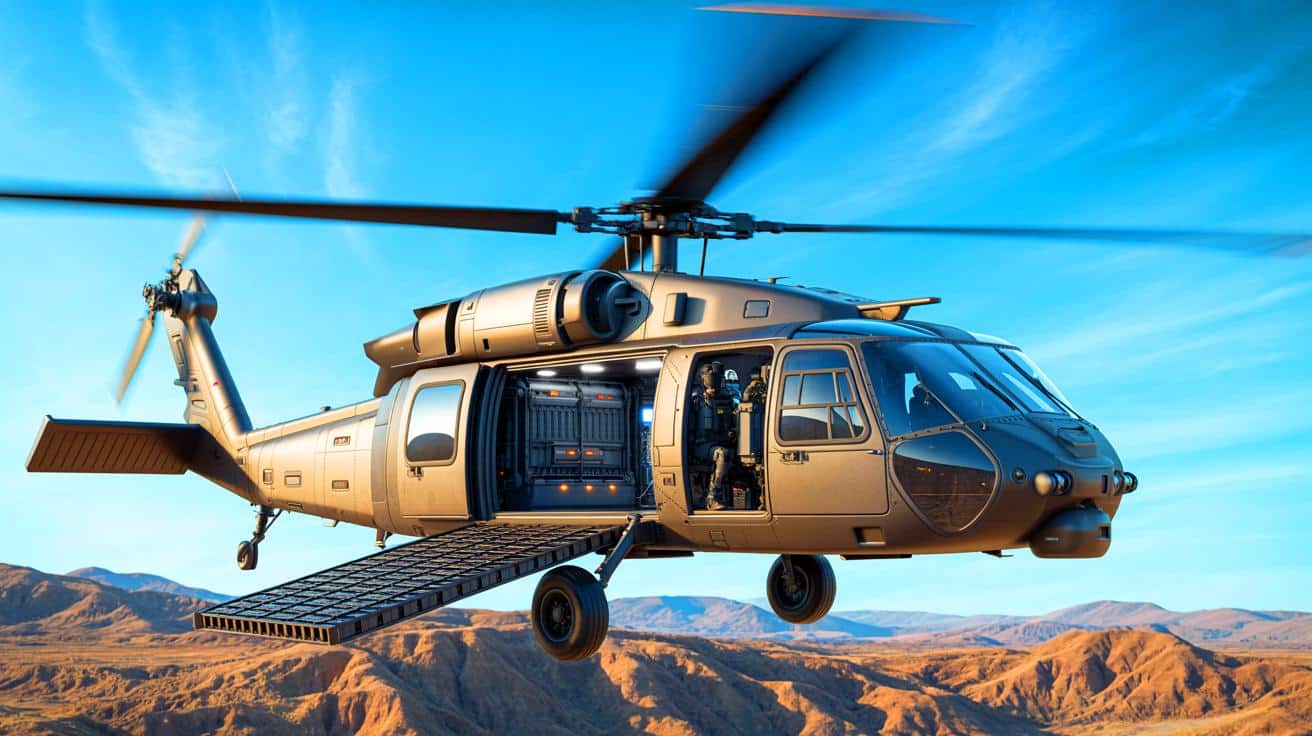
The concept of an autonomous Black Hawk helicopter has been years in the making, with DARPA and Sikorsky previously converting existing models for pilot-optional capabilities. However, the S-70UAS U-Hawk pushes this concept to the next level by eliminating the cockpit altogether. This bold move is showcased at the Association of the United States Army (AUSA) exposition, where the U-Hawk’s unique design was revealed. The absence of a cockpit, windows, or seats marks a significant departure from traditional helicopter design, emphasizing its role as an uncrewed aerial system.
The heart of this transformation lies in Sikorsky’s Matrix autonomy technology, which, coupled with a third-generation fly-by-wire system, enables the U-Hawk to execute complex missions autonomously. The system acts as a digital co-pilot, capable of generating flight plans, navigating, and avoiding obstacles without human input. This technological leap not only enhances operational efficiency but also opens up new possibilities for military logistics and air assaults. The U-Hawk can undertake missions from takeoff to shutdown, guided by a ground operator using a ruggedized tablet to set mission parameters.
“They’ve Been Hiding This Monster”: Student Discovers 23 Foot Killer Dinosaur In Museum Storage
Revolutionary Cargo Capabilities
One of the most striking features of the U-Hawk is the replacement of the traditional cockpit with clamshell doors and a loading ramp. This redesign increases the helicopter’s cargo space by 25%, allowing it to carry oversized loads such as HIMARS pods and Naval Strike Missiles. Additionally, the U-Hawk’s roll-on, roll-off capability facilitates the transport of uncrewed ground vehicles, expanding its utility in various military scenarios.
The U-Hawk also boasts improved T700-GE-701C engines and an upgraded gearbox, resulting in a significant increase in external lift capacity from 8,000 pounds to 9,000 pounds. This enhancement further solidifies the U-Hawk’s role as a versatile utility platform. The enhanced cargo capabilities and autonomous functions position the U-Hawk as a formidable asset in modern military operations, capable of supporting diverse missions such as logistics, reconnaissance, and combat support.
Implications for Military Operations
The introduction of the S-70UAS U-Hawk represents a paradigm shift in military aviation, with far-reaching implications for operational strategies and resource allocation. By removing the need for a human pilot, the U-Hawk reduces personnel risk and allows for more flexible deployment in hostile environments. Its autonomous capabilities enable it to perform missions that would be challenging or impossible for traditional helicopters, such as operating in GPS-denied areas or conducting long-duration flights without pilot fatigue.
The U-Hawk’s ability to carry drone swarms and internal fuel tanks for extended range further enhances its strategic value. This capability allows for coordinated drone operations and long-range missions, providing military planners with new tactical options. As the U-Hawk continues to evolve, its potential applications in both military and civilian sectors are likely to expand, paving the way for future innovations in autonomous aviation.
Future Prospects and Challenges
As Sikorsky prepares for the U-Hawk’s first flight in 2026, several challenges and opportunities lie ahead. The integration of autonomous systems into military operations requires careful consideration of regulatory, ethical, and operational factors. Ensuring the reliability and security of autonomous systems is paramount, as is addressing concerns related to autonomy in combat scenarios.
Despite these challenges, the U-Hawk’s development underscores the rapid pace of technological advancement in military aviation. By converting existing Black Hawks into fully autonomous platforms, Sikorsky is setting a precedent for future innovations. The U-Hawk’s success could inspire similar transformations in other military and civilian aircraft, driving further exploration of autonomous technologies. As the military continues to embrace automation, the U-Hawk serves as a testament to the potential of technology to reshape the future of aerial operations.
The S-70UAS U-Hawk represents a bold step forward in military aviation, redefining the capabilities and potential of unmanned aerial systems. As the first flight approaches, questions remain about how this technology will shape future military strategies and the broader landscape of aviation. How will the integration of autonomous helicopters like the U-Hawk influence the future of warfare and global defense initiatives?




Wow, this is both exciting and terrifying! How soon will we see these in active deployment? 🚁
Wow, a helicopter without a cockpit! What’s next? A car without wheels? 🤔
How will this impact the job market for pilots? 🤔
Can’t wait to see the U-Hawk in action. This could change military logistics forever!
Can it fly in all weather conditions? What if there’s a storm?
Does this mean we’ll have fewer helicopter pilots in the future? 🤷♂️
Seems like a risky move to remove the cockpit entirely. What if tech fails?
So, no cockpit means more cargo space. That’s pretty smart!
Thank you for this informative article. The future of military aviation seems both exciting and a bit terrifying.
Is there a backup plan if the Matrix system malfunctions?
Is it just me, or does this sound like the beginning of a sci-fi movie? 🤖
Great article, thanks for breaking down the tech details!