



| IN A NUTSHELL |
|
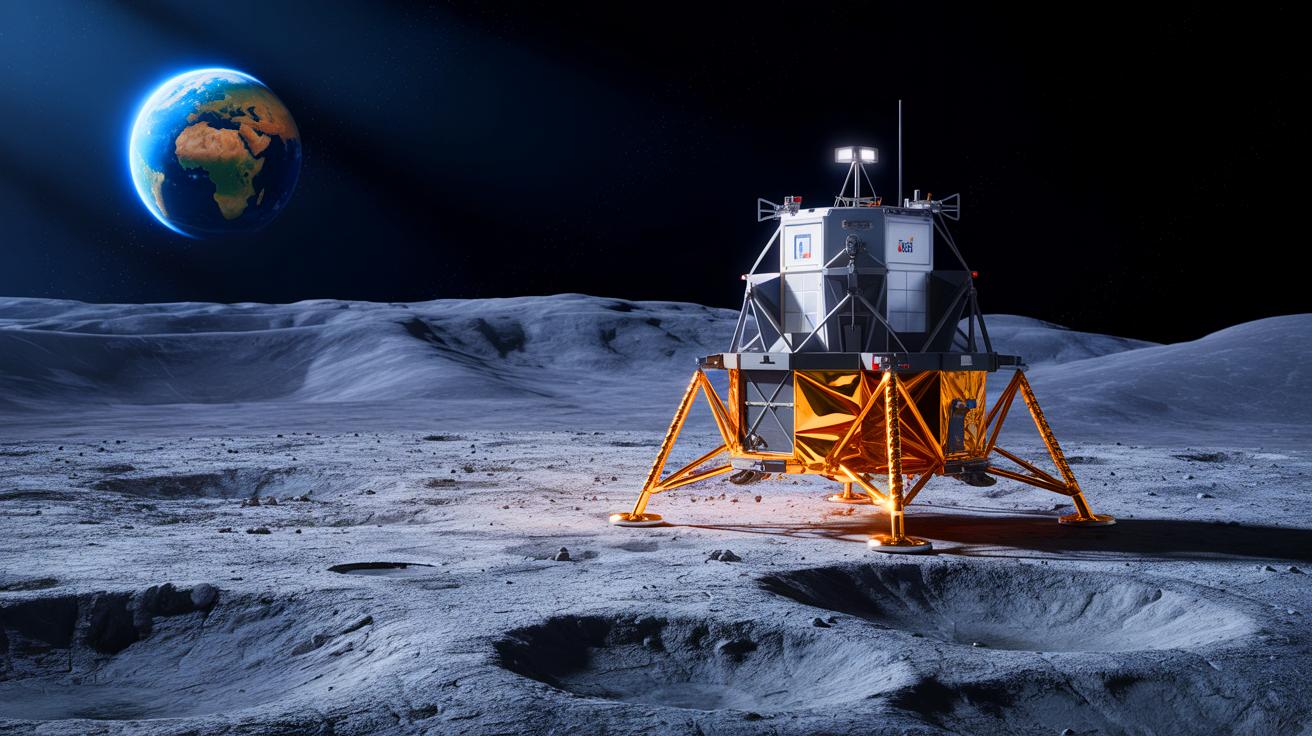
In a significant leap forward for its lunar ambitions, China has completed a critical test of its new crewed lunar lander, known as Lanyue, or “embrace the moon.” Conducted in Hebei Province, this milestone marks the first time China has fully tested a spacecraft’s ability to land on and launch from a celestial body. The success of the test is a pivotal moment in China’s space exploration efforts, underscoring its commitment to sending humans to the moon by the end of the decade. The test’s completion on August 6 has generated considerable global interest, especially as other nations intensify their lunar exploration plans.
The Complexity of Lander’s System Testing
The recent comprehensive trial of China’s Lanyue lunar lander was designed to evaluate its integrated performance under conditions that mimic the lunar environment. To achieve this, engineers employed giant tether towers to replicate the moon’s gravity and constructed a cratered field to simulate the rugged lunar terrain. This innovative approach allowed for a realistic assessment of how the lander’s various systems would function in tandem.
Key components of the test included evaluating the lander’s ascent and landing design, the control system’s efficiency, the precision of engine shutdown, and the coordination of guidance, navigation, and propulsion systems. CCTV footage revealed the lander’s engines and thrusters igniting, with a yellowish exhaust plume indicative of nitrogen dioxide from the propellant.
This test was not merely a technological demonstration but a strategic step in China’s broader lunar aspirations. By successfully evaluating these critical systems, China has demonstrated its growing capabilities in space exploration, positioning itself as a formidable player in the new space race.
A Multi-Purpose Lander for Lunar Exploration
The Lanyue lander is not just a vehicle for transporting astronauts to the lunar surface; it is designed as a versatile platform that will serve multiple roles. Once on the moon, the lander will act as a habitat, power source, and data hub for the taikonauts. Furthermore, it will be equipped to carry a lunar rover and various scientific payloads, enhancing its utility for exploration and research.
China’s strategy for landing astronauts on the moon involves two crucial launches using its Long March rockets. The first mission will send the Lanyue lander into lunar orbit, while the second will launch the Mengzhou crew spacecraft. Once in orbit, the two vehicles will dock, allowing astronauts to transfer to the lander for their descent to the lunar surface.
The multi-purpose design of the Lanyue lander reflects China’s ambition to establish a sustainable human presence on the moon. By integrating multiple functions into a single platform, China aims to maximize the scientific and exploratory potential of its lunar missions.
China’s Ambitious Lunar Timeline
China’s progress in lunar exploration is part of a broader global competition that is intensifying as multiple countries pursue their own lunar missions. China aims to conduct its first crewed lunar landing before 2030, a timeline that aligns with NASA’s plans for its Artemis program. NASA’s Artemis II mission, a crewed fly-by around the moon, is slated for no later than April of next year, with the subsequent Artemis III mission aiming for a lunar landing in mid-2027.
However, the timeline for Artemis III is subject to change due to delays in the development of SpaceX’s Starship Human Landing System. This uncertainty adds a layer of complexity to the global space race, with China steadily advancing its own timeline and capabilities.
In addition to its lunar ambitions, NASA has announced plans to launch a nuclear reactor to the moon by 2030, a move aimed at establishing a sustainable power source for future lunar habitats and research facilities. This development underscores the strategic importance of the moon as a platform for further space exploration.
The Broader Implications of China’s Lunar Efforts
China’s successful test of the Lanyue lander is not just a national achievement but a significant event with global implications. As China advances its space capabilities, other nations are compelled to reassess their own strategies in the face of mounting competition. The drive to establish a human presence on the moon is not only a matter of national prestige but also a strategic endeavor that could shape the future of space exploration.
The successful test also highlights the technological prowess and strategic foresight of China’s space program. By focusing on both the technical and logistical aspects of lunar exploration, China is positioning itself as a leader in the next phase of human space exploration. This raises important questions about the future of international collaboration and competition in space.
As the global space race intensifies, the question remains: How will international cooperation and competition shape the next decade of lunar exploration and beyond?




Wow, China is really stepping up their space game! 🌕🚀
Does anyone know how this compares to NASA’s Artemis program?
Can’t wait to see a space race in my lifetime! Go Lanyue! 🌌
Honestly, this is just another way for countries to flex their muscles. 😒
Is this a strategic play against NASA or just technological advancement?
Hope they have backup plans for any potential mishaps on the moon. 🤞
I wonder how the taikonauts feel about riding this new lander.
Great article, but why aren’t we hearing more about this in mainstream media?
China’s space program is really impressive. Keep it up! 🌟
The difference is I believe the Chinese will land on the moon in 2030.
With the Felon in charge cutting funding to critical national projects I doubt an Artemis crew will ever land on the moon.
The only felon is Biden pardoning his family.
2030 feels like it’s just around the corner! Time flies. 🕰️
Are they planning to collaborate with any other countries or is this a solo mission?
Isn’t it risky to send humans to the moon without a few more unmanned tests?
Nice to see some competition in space exploration. It benefits us all! 🌍
Why are we so focused on the moon when Mars is the real prize? 🤔
Reading this makes me want to become an astronaut! 🚀
Hope this mission won’t be delayed like so many others. Fingers crossed!
China’s on a roll! First the space station, now this? Incredible. 🚀
Do they have plans for using sustainable energy on the moon?
Every new update on space exploration is so exciting. Keep them coming!
Is there any international oversight on these lunar missions?
What if something goes wrong? Is there an evacuation plan?
For once, can we just have a friendly competition without the politics? 😅
Interesting read, but I’m more curious about their Mars plans!
China vs. NASA. Who will get there first? Place your bets! 🏆
I still can’t believe we’re talking about living on the moon. Sci-fi becomes reality!
Why does everyone want to go back to the moon so badly?
Good luck to all involved. This is a huge undertaking! 🙌
Hope the mission includes some amazing moon selfies! 📸
Is China planning to build a permanent base on the moon?
What are the environmental impacts of these missions?
Space exploration is the future! Kudos to China for making strides. 🌌
How does the Lanyue compare to the Apollo landers?
Can’t wait for the day we watch a live lunar landing again. 🌑
Is this another “space race” or something more collaborative?