




| IN A NUTSHELL |
|
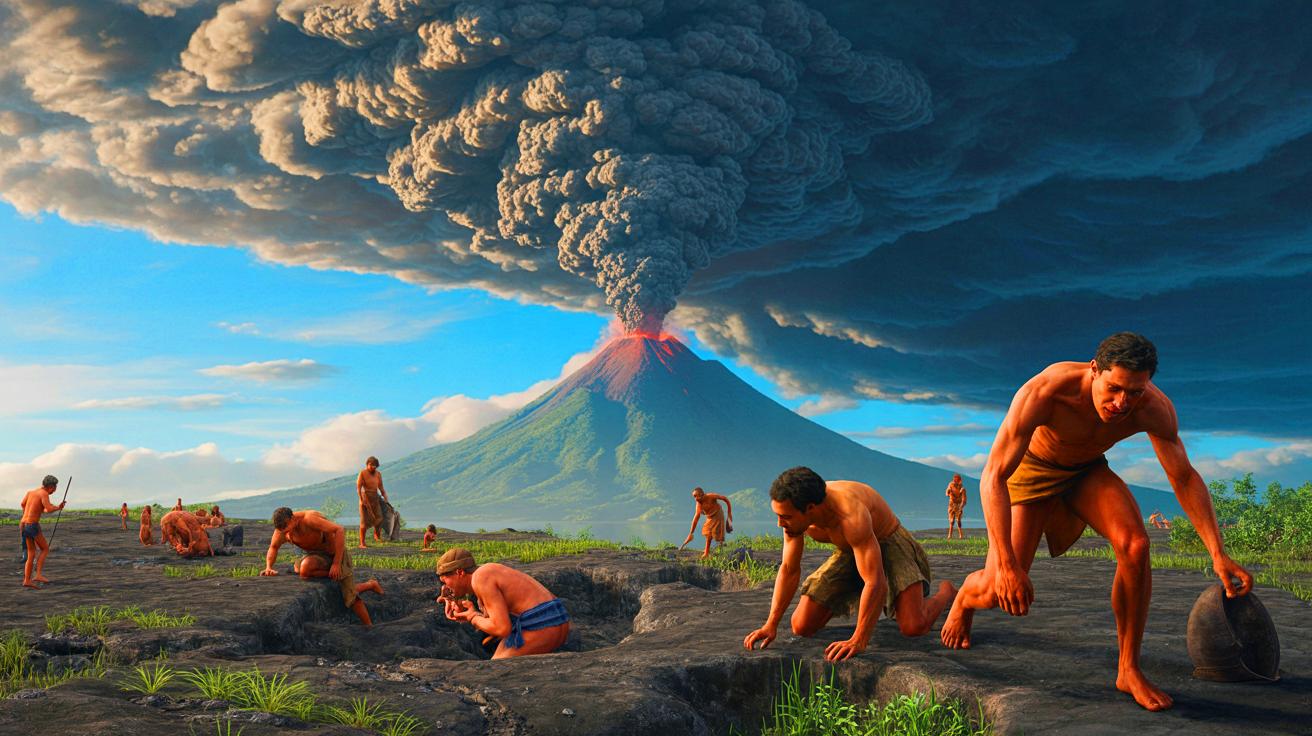
Some 74,000 years ago, a cataclysmic event dramatically altered the Earth’s environment and reshaped the course of human history. Known as the Toba supereruption, this massive volcanic explosion released an unprecedented amount of ash into the atmosphere, leading to significant climatic changes. While the immediate aftermath was devastating, recent studies have revealed intriguing insights into how early humans survived and adapted to these extreme conditions. This article delves into the Toba supereruption’s scale, its impact on human populations, and the resilience and adaptability that characterized early human response to this global catastrophe.
The Scale of the Toba Supereruption
The Toba supereruption stands as one of the largest volcanic events recorded in Earth’s history. Occurring approximately 74,000 years ago on the island of Sumatra in modern-day Indonesia, the eruption ejected an estimated 672 cubic miles of ash into the stratosphere. This event was over 10,000 times more powerful than the 1980 eruption of Mount St. Helens. The sheer magnitude of the eruption led to a significant global cooling event, potentially lasting up to six years. This prolonged period of reduced sunlight and lower temperatures wreaked havoc on ecosystems and disrupted food chains worldwide.
In areas near the eruption, the impact was catastrophic. Acid rain, massive ash fallout, and environmental devastation threatened all forms of life. Despite these harsh conditions, humans living far from the eruption’s epicenter managed to survive. The question remains: how did these populations endure such a dramatic global event? The answer lies in their adaptability and the strategies they employed to cope with the adverse conditions.
How Volcanic Glass Reveals Ancient Human Survival
Archaeologists studying the impact of the Toba eruption on ancient human populations have turned to volcanic glass, known as cryptotephra, to gather evidence. This fine dust, produced by volcanic eruptions, can travel vast distances and remain preserved in archaeological sites for tens of thousands of years. By analyzing cryptotephra, researchers can trace the reach and impact of the eruption, providing valuable insights into how early human populations were affected.
Scientists such as Jayde N. Hirniak have meticulously studied these microscopic glass shards found in archaeological layers. The cryptotephra is extracted from soil samples at excavation sites and chemically analyzed to trace its origins. The presence of these volcanic remnants at sites like Pinnacle Point in South Africa and Shinfa-Metema in Ethiopia confirms that humans inhabited these areas before, during, and after the eruption. This evidence underscores the resilience of early human populations in the face of environmental adversity.
Human Adaptability and Technological Innovation in the Wake of the Eruption
Despite the catastrophic consequences of the Toba eruption, archaeological evidence suggests that early humans displayed remarkable adaptability. At Pinnacle Point, for example, human activity seems to have increased after the eruption, indicating that people not only survived but thrived under the new conditions. Researchers have identified new technological innovations, particularly in stone tool technologies, that demonstrate human adaptability.
In Ethiopia, evidence shows human groups adapted to harsh, arid conditions by altering their behavior. They began fishing in shallow waterholes and following seasonal rivers to find food. The adoption of new technologies, such as the bow and arrow, also played a crucial role in human survival. These advancements allowed early humans to hunt more effectively and protect themselves in a changed world. Rather than succumbing to the catastrophic conditions, human societies made significant behavioral changes that enabled them to continue thriving.
The Role of Genetics in Understanding Human Bottlenecks
The Toba catastrophe hypothesis suggests that the supereruption caused a severe genetic bottleneck, drastically reducing human population numbers to fewer than 10,000 individuals. This theory is supported by genetic evidence from modern human populations, which indicates a reduction in genetic diversity around the time of the eruption. The bottleneck hypothesis posits that this loss of genetic diversity resulted from the extreme climatic and environmental effects of the eruption.
However, recent archaeological evidence complicates this narrative. Studies of the Toba event, particularly those involving volcanic glass and site activity in South Africa and Ethiopia, suggest that human populations were more resilient and widespread than previously thought. These findings challenge the idea of a drastic population collapse and indicate that the eruption alone may not have been solely responsible for the genetic bottleneck. Instead, it suggests that human populations were able to survive and adapt, raising questions about the complexity of human resilience.
In examining the Toba supereruption and its aftermath, it becomes clear that early humans demonstrated extraordinary resilience and adaptability. This catastrophic event, while devastating, also served as a catalyst for technological and behavioral innovations that aided human survival. As we reflect on this historical event, it prompts us to consider how modern human societies might respond to similar global challenges. How can we draw lessons from the past to ensure a resilient and adaptable future?




Wow, it’s amazing how our ancestors managed to survive such a massive catastrophe! 🌋
Wow, I can’t believe humans survived that! What a story of resilience. 🌋
Is there any evidence of similar volcanic events after Toba that affected human populations?
How exactly did scientists determine the human population dropped to 10,000? 🤔
Incredible article! I didn’t know about cryptotephra until now. Thanks for the knowledge! 🙏
Isn’t it incredible that something so cataclysmic could lead to technological innovation?
So, is the Toba eruption the reason I’m bad at math? 🤔
How did researchers determine there were only 10,000 survivors? Seems like a tough number to pin down.
This makes me wonder about other ancient events that might have shaped human evolution. Any recommendations for further reading?
This is fascinating. Makes me wonder how many other events in history reshaped humanity like this.
Thank you for such an insightful article! It really puts modern challenges into perspective.
Great read! The adaptability of early humans is truly inspiring. 💪
Should we be worried about another supervolcano erupting in our lifetime?
So, did the Toba eruption affect dinosaurs too? 😂
Interesting article, but I’m skeptical about the 10,000 survivor claim. Any new evidence on that?