



| IN A NUTSHELL |
|
Physicists at the University of Colorado Boulder have unveiled a groundbreaking creation: a time crystal visible to the human eye. This development follows the theoretical proposal of time crystals by Nobel laureate Frank Wilczek in 2012. Time crystals, unlike conventional crystals such as diamonds, exhibit a repeating structure not in space, but in the dimension of time. This characteristic allows their components to remain in perpetual motion, bringing forth a potential revolution in various technological fields. This article delves into the science behind time crystals, their potential applications, and the fascinating journey of their discovery.
The Science Behind Time Crystals
Time crystals are a peculiar state of matter that challenge traditional understanding, as they seem to violate a fundamental law of thermodynamics. The concept was first realized in 2016 when scientists observed time crystals in a laboratory setting. In 2021, Google’s quantum computer provided another demonstration by creating a network of atoms that repeated their movements upon laser activation. The recent breakthrough at CU Boulder marks the first instance where a time crystal is visible to the human eye.
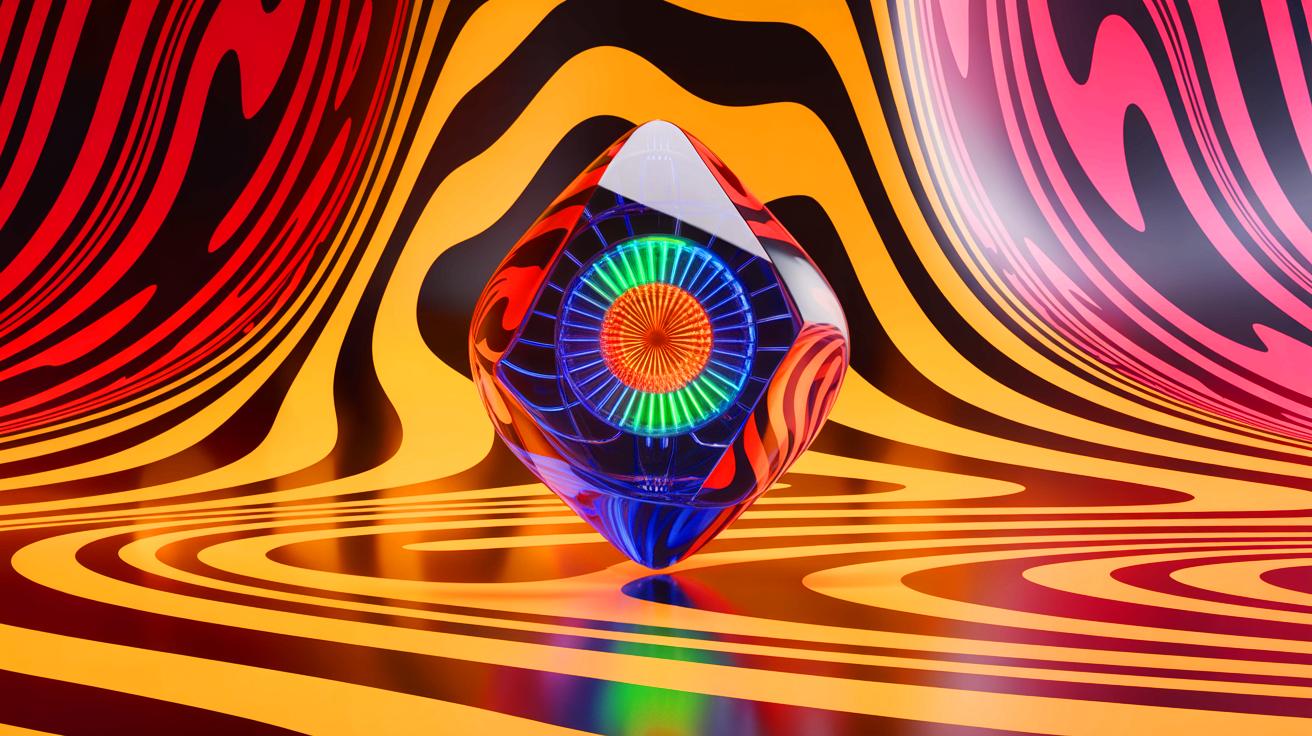
The creation involves liquid crystals, similar to those used in smartphone displays. By placing these crystals in glass cells and exposing them to specific light, physicists observed that the crystals moved in repeating, dynamic patterns. Under a microscope, these patterns appeared as swirling “psychedelic tiger stripes” that continuously danced in a cycle. The process is initiated by compressing the molecules, forming “kinks” that mimic atomic behavior and interact like particles.
Potential Applications in Anti-Counterfeiting
The implications of time crystals extend beyond their scientific intrigue; they hold promise for revolutionary applications. One such application is in the field of anti-counterfeiting. Researchers suggest that embedding time crystals in currency could create “time watermarks,” a unique, moving pattern revealed by simple light exposure. This would provide an innovative solution to counterfeiting, as replicating such a dynamic pattern would be exceedingly difficult.
This technology could also impact data storage. By stacking time crystals, it may become possible to create complex patterns for storing large amounts of digital information. The stability of these patterns, observed even under varying temperatures, underscores their potential for practical use. As physicist Ivan Smalyukh notes, the beauty of time crystals lies in their simplicity: once conditions are set, the phenomenon naturally unfolds.
Time Crystal Under the Microscope
The journey to creating a visible time crystal involved leveraging the properties of liquid crystals. These materials, which exhibit characteristics of both solids and liquids, were strategically manipulated by Zhao and Smalyukh. By filling glass cells with liquid crystals and applying light, they achieved the desired repeating patterns. The experiment’s success hinged on understanding how these molecules interact under specific conditions.
The researchers’ work has demonstrated that time crystals can be directly observed, challenging prior assumptions about their invisibility. This visibility opens new avenues for exploring the intricate behaviors of time crystals and their interactions with light. Smalyukh’s description of the process—where a simple beam of light births a world of time crystals—captures the essence of this scientific achievement.
Future Prospects and Challenges
As research into time crystals advances, the potential for new applications grows. The unique properties of time crystals could pave the way for innovations in optical devices, 2D barcodes, and beyond. However, challenges remain in scaling up the technology for widespread use. The complexity of manipulating time crystals and ensuring their stability in various environments are hurdles that researchers must overcome.
The findings, published in the journal Nature Materials, represent a significant step forward. While the current applications are exciting, the full scope of what time crystals can achieve remains an open question. Continued research and experimentation will be crucial in unlocking their full potential and integrating them into practical technologies.
The creation of a visible time crystal marks a pivotal moment in the field of physics, blending theoretical concepts with tangible results. It invites further exploration into the mysterious world of time-related phenomena. As scientists continue to probe the capabilities of time crystals, one must wonder: what other secrets does this enigmatic state of matter hold, and how might it reshape our understanding of the universe?


Wow, this is mind-blowing! How do I get my hands on one of these time crystals? 🔮
Wow, “psychedelic tiger stripes” in perpetual motion? Sounds like a sci-fi movie scene! 🌌
Can someone explain how time crystals don’t violate the laws of thermodynamics? 🤔
Can someone explain how a time crystal doesn’t violate the second law of thermodynamics? 🤔
Incredible breakthrough! Thank you, CU Boulder physicists, for expanding our horizons. 🙏
The idea of anti-counterfeiting with time crystals is brilliant. Thank you, CU Boulder team! 🙌
So, are time crystals going to replace regular crystals in jewelry? 😂
I’m skeptical. How can something be in perpetual motion without external energy input? 🤨
Can we expect to see time crystals in commercial products anytime soon?
Psychedelic tiger stripes” sounds like a great name for a rock band! 🎸
This is fascinating, but how reliable are these patterns under different conditions?
I’m skeptical. How can something be in perpetual motion without energy input?
How are these time crystals different from those used in quantum computing? 🤷♂️
The potential applications are mind-blowing! Can’t wait to see where this leads. 🚀
Could this technology be used in holographic displays? That would be so cool! 😍
Just when I thought I understood crystals, along comes this time-bending concept!
Is this time crystal visible without any special equipment?
What are the chances of these being used in anti-counterfeiting measures? Sounds promising.
Time crystals: the new frontier of science or just a passing fad? 🤨
Thank you for making complex science accessible! This is truly groundbreaking work.
Does this have any implications for quantum computing?
Time crystals sound like something from Doctor Who! 🕒
Are these visible time crystals stable over long periods?
How does the process of creating these crystals work? More details, please!
As if regular crystals weren’t dazzling enough, now we have ones that dance in time! 💎
Does this discovery mean we need to rewrite physics textbooks? 😅
I can already imagine time crystals being used in futuristic art installations!
Could time crystals have applications in renewable energy technology?
So, can we expect “time crystal” to be the next buzzword in tech? 📈
How do liquid crystals differ from these time crystals?
This research gives a whole new meaning to “time is money” if it fights counterfeiting! 💰
Is there any chance we might see these crystals in consumer electronics?
Time crystals are a thing now? What’s next, time travel? 😜
Thank you for sharing this discovery. Keep up the amazing work at CU Boulder! 🌟
Is there any video footage available of these “psychedelic tiger stripes” in action?
This is all very interesting, but what practical challenges do time crystals face?
Are there any environmental impacts from producing time crystals?