



| IN A NUTSHELL |
|
The recent discovery of an intact impact crater in southern China has provided scientists with new insights into Earth’s geological history and the frequency of extraterrestrial impacts. Situated in Zhaoqing, Guangdong Province, the Jinlin crater is now recognized as one of only about 200 confirmed impact sites on the planet. Its significance is heightened by its age, as it is considered one of the youngest known craters. This discovery not only challenges our understanding of the Earth’s recent past but also adds a crucial piece to the puzzle of how celestial bodies have shaped our world over time.
A Rare and Young Crater in Southern China
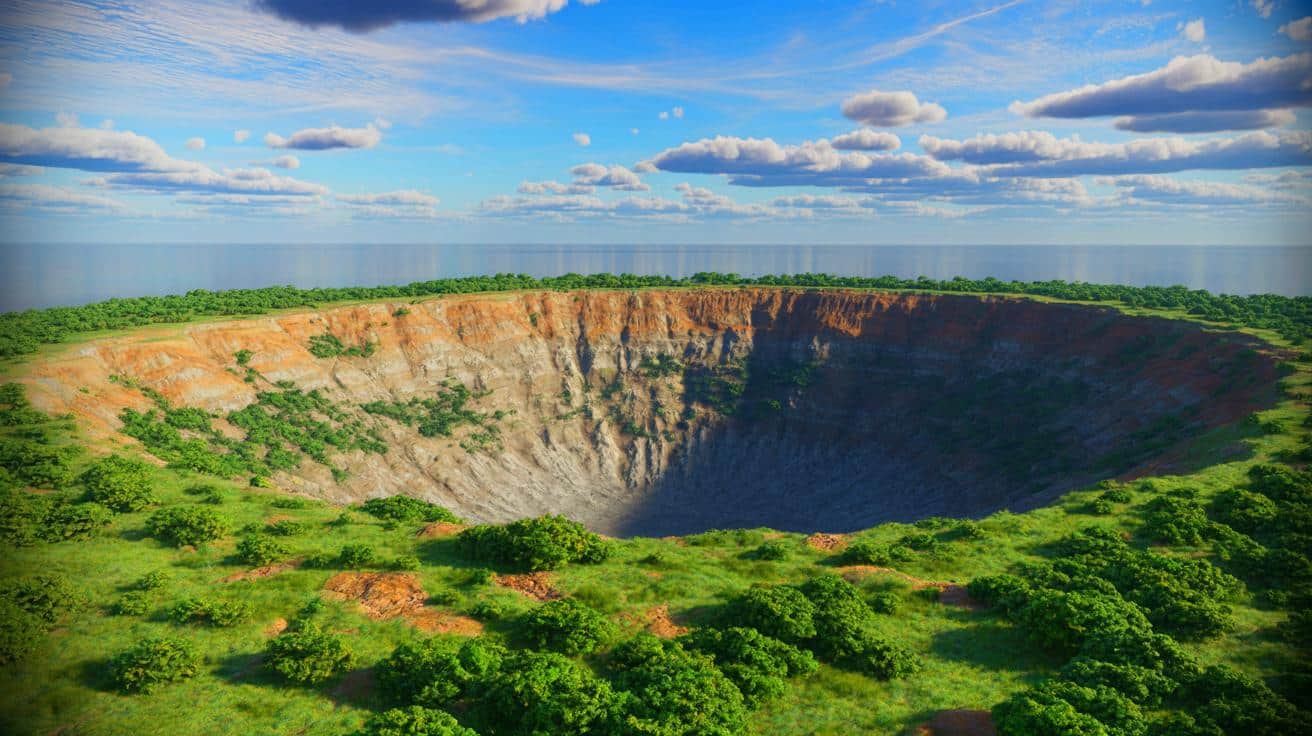
The Jinlin crater, located in Guangdong Province, is a bowl-shaped geological feature that has captured the attention of scientists worldwide. This newly identified site stands out due to its age, placing it among the youngest craters on Earth. It is believed to have formed during the early-to-mid Holocene epoch, which began approximately 11,700 years ago, at the end of the last ice age. The crater’s diameter of 2,950 feet makes it the largest verified impact site from this period, surpassing Russia’s Macha crater, which measures about 985 feet.
The identification of the Jinlin crater is significant because it reveals that the frequency of impacts from small extraterrestrial objects during the Holocene may have been greater than previously recorded. This site provides a unique opportunity to study the aftermath of such impacts, offering clues about how these events have influenced Earth’s geology and environment.
“This discovery shows that the scale of impacts of small extraterrestrial objects on the Earth in the Holocene is far greater than previously recorded,” said author Ming Chen.
Clues About the Object That Struck Earth
Researchers have determined that the object responsible for the Jinlin crater was most likely a meteorite. This conclusion is drawn from the crater’s size, which would have been significantly larger if it were caused by a comet. A cometary impact would have resulted in a crater at least 6.2 miles across, far exceeding the dimensions of Jinlin.
What remains uncertain is the composition of the meteorite. Scientists are currently investigating whether the celestial body was made of stone or iron, as this distinction can provide further insights into the nature of the impact. Understanding the material composition is crucial for reconstructing the event and assessing the potential risks of future impacts.
Remarkable Preservation and Shock Features in Quartz
One of the most striking aspects of the Jinlin crater is its remarkable state of preservation. Despite being located in a region prone to heavy rainfall, strong monsoons, and high humidity, the crater has remained well-defined. This preservation has allowed researchers to examine the site in detail, uncovering critical evidence of its formation.
Within the granite layers of the crater, scientists discovered grains of quartz featuring planar deformation features. These microscopic structures are recognized as definitive indicators of an impact event, as they form only under the intense shockwaves generated by celestial collisions. The presence of these features provides strong evidence supporting the impact hypothesis.
“On the Earth, the formation of planar deformation features in quartz is only from the intense shockwaves generated by celestial body impacts, and its formation pressure ranges from 10 to 35 gigapascals, which is a shock effect that cannot be produced by any geological process of the Earth itself,” noted Chen.
Significance for Understanding Earth’s Impact History
The discovery of the Jinlin crater holds significant implications for our understanding of Earth’s impact history. While it is believed that potential impact sites exist globally, many have been lost to erosion, weathering, and geological transformations. The Jinlin crater’s survival offers an exceptionally clear glimpse into the Earth’s recent geological past and the role of extraterrestrial impacts in shaping it.
The insights gleaned from this site contribute to a broader understanding of the distribution and effects of small celestial bodies impacting our planet. By studying the Jinlin crater, scientists can refine models of impact frequency and consequences, offering a more objective basis for predicting future events. This research not only enriches our knowledge of Earth’s history but also informs our preparation for potential future impacts.
“The impact crater is a true record of Earth’s impact history,” said Chen. “The discovery of the Earth impact crater can provide us with a more objective basis for understanding the distribution, geological evolution, and impact history and regulation of small extraterrestrial bodies.”
The Jinlin crater’s discovery serves as a reminder of the dynamic forces that continue to shape our planet. As researchers delve deeper into its mysteries, they unlock valuable knowledge about the Earth’s past and its ongoing evolution. What other hidden features beneath our feet might offer similar revelations about our planet’s history and future challenges?




Wow, this is mind-blowing! I never knew there were so many impact craters on Earth. 🌍
Wow, this is mind-blowing! Can’t believe there’s still so much to discover about Earth. 🌍
How did they determine the age of the Jinlin crater?
Is this the largest crater discovered in Asia or just China?
This is fascinating, but how sure can we be that it was a meteorite and not something else? 🤔
Great article! Thanks for sharing such fascinating information. 😊
Thanks for the interesting read! I never knew there were so few confirmed impact sites. 😊
Can someone explain why the preservation of this crater is such a big deal?
How do scientists determine the age of a crater like Jinlin?
Another reason to visit China! Who’s coming with me? 😄
The fact that it’s so well-preserved is incredible. Nature never ceases to amaze me!
Is it possible that other craters have been misidentified or overlooked in the past?