



| IN A NUTSHELL |
|
In an era where technological advancements are reshaping the way we perceive transportation, the emergence of flying cars is a testament to human ingenuity. However, the journey to integrating these vehicles into daily life is not without its challenges. Recently, a rehearsal for the Changchun Air Show in northeastern China highlighted these challenges when two electric Vertical Take-Off and Landing (eVTOL) vehicles collided mid-air. The incident resulted in a fire and left one pilot with minor injuries. This event underscores the complexities and risks involved in the burgeoning field of aerial mobility, particularly as China advances its ambitious plans for a low-altitude economy.
Collision and Fire
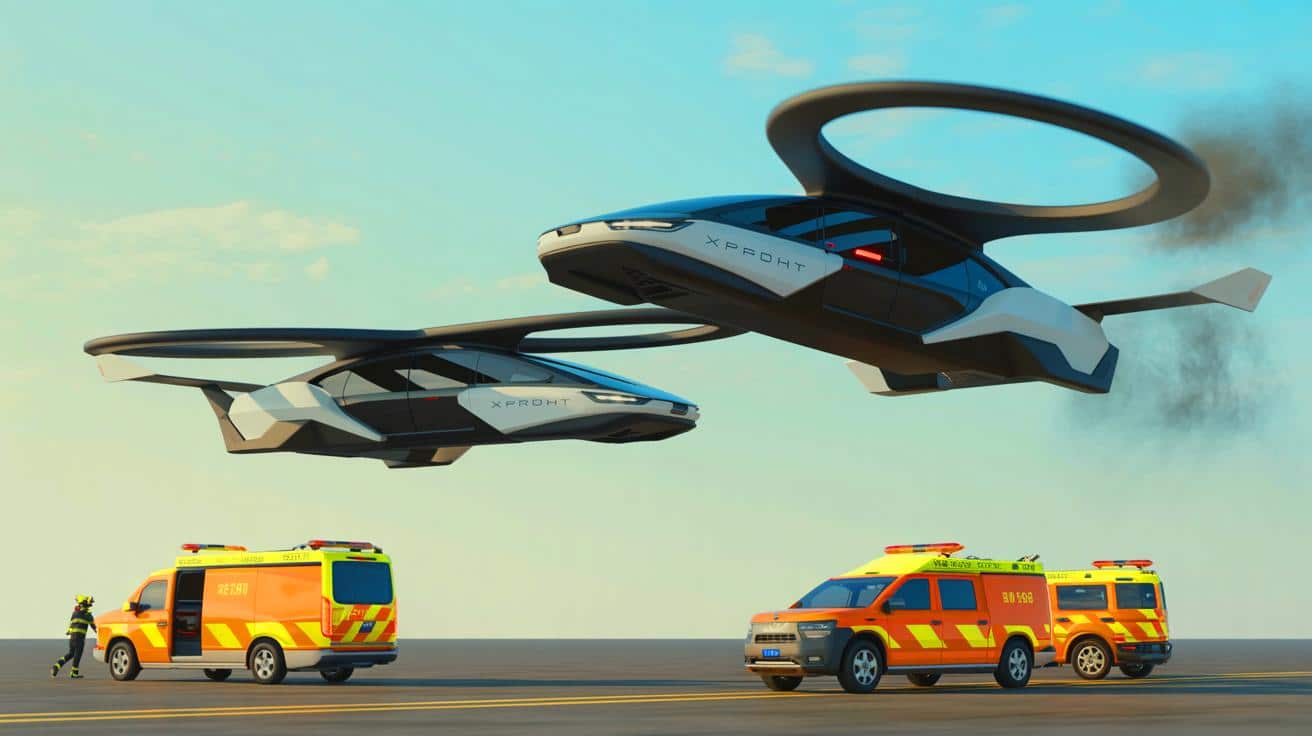
The recent collision during the rehearsal involved two eVTOLs from Xpeng Aeroht, a subsidiary of the Chinese electric vehicle maker Xpeng. The company attributed the mid-air collision to “insufficient flight distance” between the vehicles during a formation exercise. While one vehicle managed to land safely, the other caught fire upon landing due to damage to its body. This incident was captured on videos circulating on Chinese social media, showing smoke rising from one of the aircraft.
Emergency services, including fire trucks and ambulances, were dispatched promptly to the site. Xpeng Aeroht assured that “all on-site personnel were safe,” and local authorities have completed the necessary on-site handling work. The injured pilot was quickly taken to a nearby hospital, and reports confirm that the injuries were minor, with the individual in stable condition. The cause of the accident remains under investigation as the company and authorities work to ensure such incidents are minimized in future operations.
High-Stakes Ambitions
Xpeng Aeroht’s ambitions reflect a high-stakes race to lead in the flying car industry. Founded in 2013, Xpeng Aeroht has positioned itself as Asia’s largest flying car company, focusing on developing modular flying cars and eVTOL models. The vehicles involved in the recent crash are part of this ambitious lineup, capable of completing multiple flights on a single charge and featuring advanced technology such as a 270-degree panoramic cabin.
Despite the recent setback, the company has made significant strides in the field. It has received over 4,000 orders for its units, each costing approximately USD 281,015. As part of its global expansion, Xpeng Aeroht received a special flight permit and began conducting airborne tests in the UAE in September. The company is also in the process of constructing a modular flying car factory in Guangzhou, with plans for mass production and deliveries by 2026. These efforts align with China’s broader push to develop its “low-altitude economy,” which includes drones, flying taxis, and other aerial services operating below 3,000 meters.
China’s Low-Altitude Economy Push
The concept of a low-altitude economy has become a strategic priority for China, as indicated in the Communist Party’s annual government work report. This initiative aims to harness the potential of aerial services, including drones and flying taxis, to drive economic growth. By 2023, China had over 2,000 drone manufacturers and more than 20,000 companies operating unmanned aerial vehicles (UAVs).
Various cities across China are experimenting with drone delivery services for parcels, food, and medical supplies. This push for a low-altitude economy is part of a broader strategy to integrate advanced technologies into everyday life, enhancing efficiency and connectivity. However, the recent collision at the Changchun Air Show serves as a reminder of the technical and regulatory challenges that must be addressed to realize the full potential of these technologies. Ensuring safe and reliable operations will be crucial as China continues to develop this emerging sector.
The Future of Flying Cars
As the world watches China’s progress in the field of flying cars, questions arise about the future of this technology. The recent incident underscores the importance of safety and regulatory frameworks in the development of aerial vehicles. Companies like Xpeng Aeroht are at the forefront of this industry, pushing the boundaries of what is possible. However, the path to widespread adoption is fraught with challenges.
Technological advancements must be matched with robust safety protocols and regulatory oversight to ensure the safe integration of flying cars into urban environments. The potential benefits of this technology are immense, offering new solutions for urban mobility and logistics. Yet, the journey to a future where flying cars are a common sight requires careful planning, innovation, and collaboration among industry stakeholders and regulators. How will these challenges shape the future of aerial mobility, and what role will flying cars play in the cities of tomorrow?
The incident at the Changchun Air Show highlights both the promise and perils of flying car technology. As China continues to push the boundaries of its low-altitude economy, the world will be watching closely. The key to unlocking the potential of flying cars lies in balancing innovation with safety and regulation. As we look to the future, how will the industry address these challenges and transform the way we move through the skies?



Wow, flying cars sound exciting but also terrifying! 🚗✈️
Wow, flying cars are really a thing now? 🚀 But maybe we should focus on making them safer first.
Maybe start with flying bikes before jumping to cars? Just a thought.
How does one even learn to fly these things? Is there a special license?
Thanks for the info, but I’ll stick to my bike for now. 🚴
Great article! But shouldn’t we focus on improving public transport first?
Flying cars? More like falling cars if you ask me.
What happens when there’s a mid-air traffic jam? 😅
Is this the future of Uber? Because I’d rather walk!
Do you think flying cars will ever be as safe as regular cars?
Flying cars: cool concept, but let’s get the bugs out first.
Imagine the insurance costs for one of these things! 💸
Thanks for the article. What are the next steps for safety improvements?
This is why we can’t have nice things. 😢
How soon before we see these flying cars in action in other countries?
Seems like the Jetsons were onto something after all!
Flying cars are a disaster waiting to happen without proper regulations.
Would these flying cars even be affordable for the average person?
How many more accidents need to happen before we realize flying cars might not be the best idea?
Glad the pilot is okay, but the incident is worrying.
Can we really call them “cars” if they fly? 🤔
Thank you for this comprehensive article. It’s eye-opening!
Are flying cars environmentally friendly compared to regular cars?
Thanks for sharing this! What’s next for Xpeng Aeroht?
Why are flying cars being prioritized over improving road safety?
Amazing potential, but I’d like to see more safety tests first.
What does this mean for air traffic control? 🛫
Why are we in such a rush to get flying cars when we can’t even trust self-driving cars yet?
This is just the beginning of the Jetsons era! Exciting times ahead! 🛸
Oh great, another way for people to crash into each other. 🙄
Isn’t it a bit early to call them “death traps”? Every technology has teething problems.
What are the safety standards for these eVTOLs? Seems like they need to be stricter.
China’s low-altitude economy sounds like a sci-fi movie plot.
Flying cars are the future, but safety has to be the priority! 🛡️
Flying cars? Really? We can’t even drive properly on roads! 😂
How long before these things are buzzing over my house at all hours?
Hope the pilot recovers soon. Safety should definitely be a priority before mass production.
I can barely parallel park. Imagine trying to land one of those! 😂
Does anyone else feel like we’re rushing into this without enough oversight?