



| IN A NUTSHELL |
|
As the world continually seeks sustainable energy sources, a quiet revolution is taking place at the junctions where rivers meet the sea. Osmotic energy, the power derived from the natural mixing of fresh and salt water, is emerging as a promising alternative. This innovative energy source operates independently of weather conditions, unlike solar and wind power, making it a reliable, continuous option. Recent advancements in osmotic power technology, particularly in Japan, are setting the stage for its wider adoption and potential integration into global energy systems, marking a significant milestone in the pursuit of renewable energy solutions.
The Science Behind Osmotic Energy
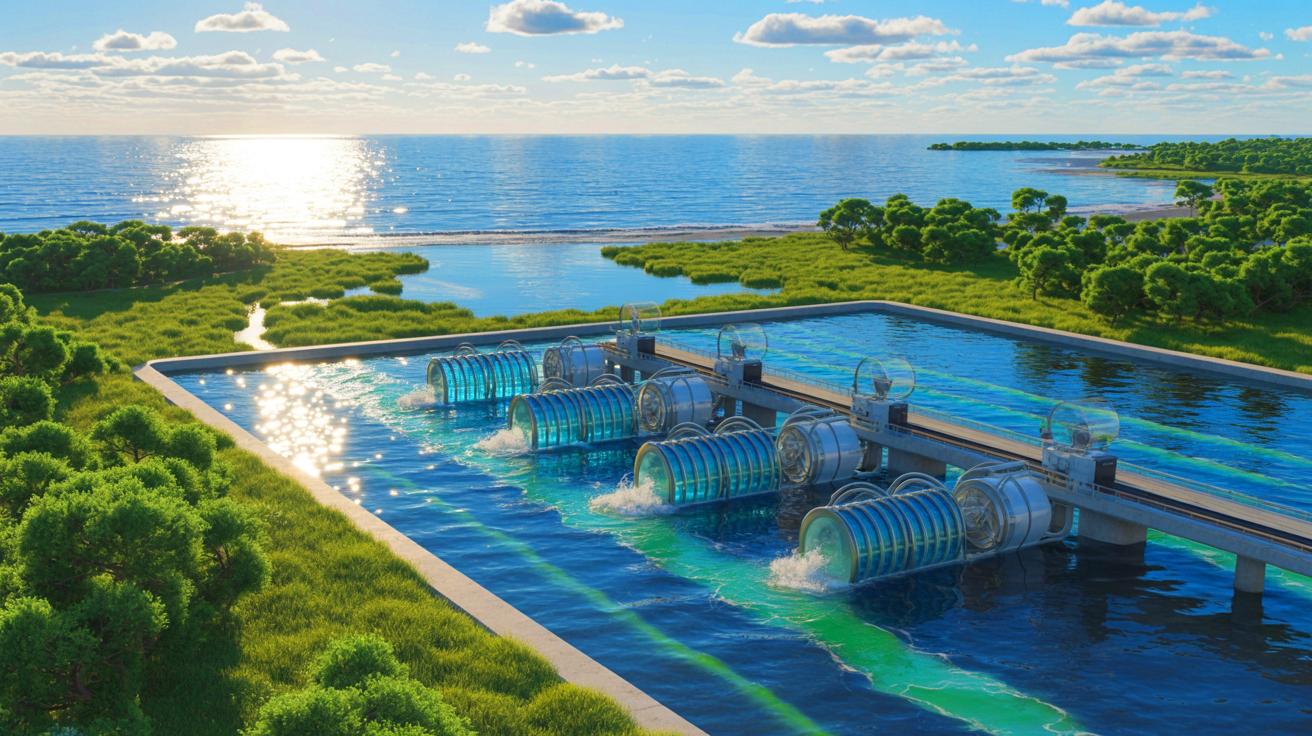
The concept of osmotic energy is based on a simple yet ingenious principle. When fresh and salt water are separated by a semi-permeable membrane, water molecules naturally move across the barrier to equalize the salinity levels. This movement creates a pressure difference, which can be harnessed to spin a turbine and generate electricity. No combustion or emissions are involved, allowing for a clean energy source that operates independently of day-to-day weather conditions.
This innovative approach was first put into practice by the Norwegian company Statkraft in 2009. Their prototype plant demonstrated the feasibility of generating electricity from osmotic potential. Despite its success, high costs and technical challenges kept the technology confined to research labs and small-scale projects for many years. The recent developments in Japan, however, suggest that osmotic energy may soon move beyond the experimental phase and become a viable component of our energy infrastructure.
Japan’s Pioneering Efforts
In Fukuoka, Japan, a new osmotic power facility has been established, marking a significant breakthrough in the field. Developed by a consortium that includes the National Institute for Materials Science, this facility is the second of its kind in the world to be designed for continuous output, following a similar project in Denmark. Although modest in scale, the Fukuoka plant is expected to generate around 880,000 kilowatt-hours per year, sufficient to power approximately 220 households or support the energy needs of a desalination plant.
This facility distinguishes itself by integrating with existing infrastructure, particularly by utilizing the concentrated brine waste from a desalination plant. This approach not only enhances the salinity gradient, thereby increasing efficiency, but also grounds osmotic power generation in practical applications rather than theoretical models. This integration represents a significant engineering achievement, highlighting the potential for osmotic energy to contribute substantially to global energy systems.
Overcoming Challenges
Despite its promise, osmotic energy faces several challenges that must be addressed to realize its full potential. One significant issue is the energy loss associated with pumping water streams into the power plant and the frictional loss across the membranes. As Professor Sandra Kentish from the University of Melbourne explained, these factors can significantly reduce the net energy gain from osmotic power.
Advancements in membrane and pump technology are crucial to overcoming these hurdles. Researchers are exploring new materials and designs to improve efficiency and reduce costs. The Fukuoka facility, for instance, benefits from the use of concentrated brine, which enhances the potential energy yield. These improvements could eventually make osmotic energy a competitive option alongside more established renewable sources like solar and wind.
“While energy is released when salt water is mixed with fresh water, a lot of energy is lost in pumping the two streams into the power plant and from the frictional loss across the membranes,” said Professor Sandra Kentish.
The Future of Osmotic Energy
The potential of osmotic energy extends far beyond the current installations in Japan and Denmark. Researchers believe that this technology could one day rival hydropower in terms of global potential, provided that costs continue to decrease. Osmotic power plants can operate continuously wherever fresh and saltwater meet, such as estuaries, desalination plants, and even inland salt lakes.
As energy grids worldwide become more diversified, the importance of stable, reliable renewable energy sources like osmotic power will grow. While it may never reach the scale of solar or offshore wind, osmotic energy is poised to play a significant role in the transition to sustainable energy. The recent developments in Fukuoka serve as a testament to the technology’s viability and its potential to become an integral part of our energy landscape.
The exploration of osmotic energy is still in its early stages, but its potential is undeniable. As advancements continue and costs decrease, could osmotic power become a cornerstone of renewable energy strategies worldwide?



Wow, if this works as promised, it could be a game-changer for renewable energy! 🌍💡
Is this really going to power Japan forever? Sounds too good to be true. 🤔
Sounds too good to be true. What’s the catch? 🤔
Thank you for the insightful article! This is a much-needed development in the renewable energy sector.
How does this compare in cost to solar and wind energy?
How does the cost of osmotic power compare to traditional energy sources?
Japan is really leading the way in innovative energy solutions. Thank you for sharing this!
Wow, this is fascinating! I had no idea you could generate power from mixing water. 🌊
How does the energy output of this plant compare to traditional power plants?
I wonder how long it’ll take before this technology is available globally.
Can this technology be implemented in other parts of the world, or is it just for Japan?
Are there any environmental downsides to this osmotic power plant?
Finally, renewable energy that isn’t at the mercy of the weather! 🌧️🌞
Isn’t “unlimited power” a bit of an exaggeration? Nothing is truly unlimited.
Salty power sounds like something from a superhero movie! 🦸♂️
Great article, but I’m curious—what happens to the fish in these estuaries?
This could be a game-changer for countries with long coastlines!
What are the main technical challenges still facing osmotic power?
I’m skeptical. If it’s so effective, why aren’t more countries implementing it?
Could osmotic power be combined with other renewable sources to improve efficiency?
Finally, a renewable energy that isn’t weather-dependent! 🌤️
I’m impressed by Japan’s innovation. They always seem to be ahead in technology.
How does osmotic power compare to nuclear energy in terms of output?
This is an amazing breakthrough! Kudos to the Japanese researchers involved.
Sounds promising, but what about maintenance costs?
Can this technology be adapted for smaller, local applications?
Could this be the solution to energy shortages in island nations?
Love the concept, but I’m worried about the initial investment costs. 💸
Interesting read! How scalable is this technology for larger populations?
Are there any plans to integrate osmotic power with existing renewable grids?
This sounds too good to be true. What’s the catch?
Japan always seems to be on the cutting edge of energy tech. Well done! 🇯🇵
Can this technology help reduce the carbon footprint of energy production?
How reliable is this energy source during environmental changes like floods?
I’m curious to see how this will develop over the next few years.
More articles like this, please! I’m learning so much about renewable energy. 🌱
What are the potential geopolitical implications if this technology becomes widespread?
Looks like solar and wind will have some serious competition soon.
Is there any chance of this tech being used in inland water bodies?
What happens during droughts or when freshwater supply is low?
Seems promising, but how do they plan to tackle the issue of energy loss?
Coud this tech be the key to solving energy crises in coastal areas?
I’m excited to see Japan leading in sustainable energy solutions!