



| IN A NUTSHELL |
|
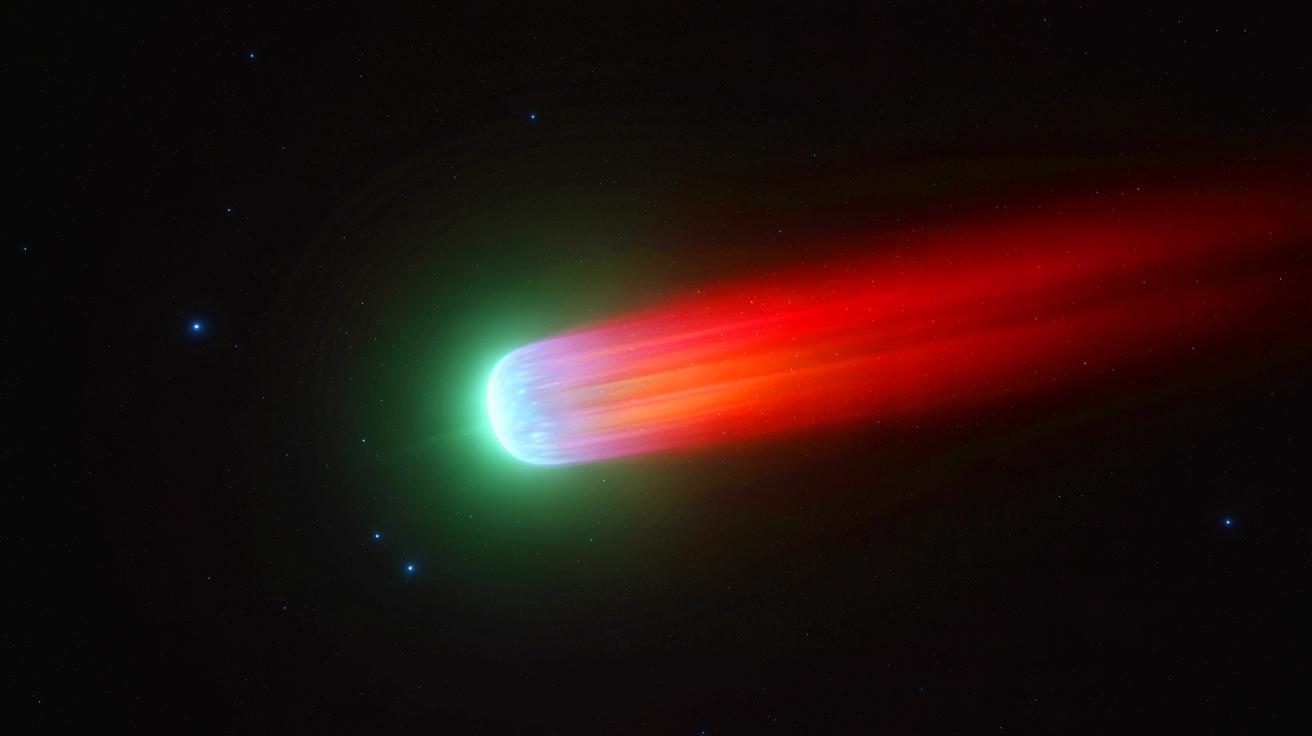
In the summer of 2025, astronomers using the ATLAS telescope in Chile uncovered an extraordinary cosmic visitor: the interstellar comet 3I/ATLAS. This discovery has gripped the scientific community, as the comet defies many of the established norms of celestial behavior. As it journeys closer to the Sun, 3I/ATLAS challenges decades of astronomical understanding with its peculiar chemical makeup, trajectory, and activity. Remarkably, it is only the third confirmed interstellar object to traverse our solar system, following the groundbreaking discoveries of 1I/ʻOumuamua in 2017 and 2I/Borisov in 2019. These intriguing characteristics have prompted scientists to closely study this enigmatic celestial body.
An Unprecedented Comet
The comet 3I/ATLAS has garnered attention for its highly unusual composition. Unlike typical comets, which are dominated by water ice, 3I/ATLAS exhibits a strikingly different profile. Its “coma”—the nebulous envelope surrounding the nucleus—is dominated by carbon dioxide (CO₂) rather than water. This results in an exceptionally high CO₂/H₂O ratio, one of the highest ever recorded in any known comet. Further adding to its mystery, 3I/ATLAS began emitting water and volatile compounds when it was approximately 325 million miles from the Sun. This is a distance where water sublimation is typically minimal.
Additionally, determining the size of the comet’s nucleus has proven to be a challenge. Observations from the Hubble Space Telescope suggest a relatively small nucleus with a diameter of about 3 miles. However, other observations estimate a much larger size, possibly between 6 to 12 miles in diameter. If these latter estimates are accurate, 3I/ATLAS could represent the largest interstellar object ever observed. This uncertainty continues to fuel the curiosity and excitement among astronomers as they attempt to unlock the secrets of this cosmic anomaly.
An Intriguing Trajectory
The trajectory of 3I/ATLAS is as perplexing as its composition. It follows a hyperbolic path, indicating that it is not gravitationally bound to the Sun. This means, like its interstellar predecessors ʻOumuamua and Borisov, 3I/ATLAS is merely passing through our solar system. Its speed is equally remarkable, estimated at a staggering 130,000 mph. Moreover, its orbit is nearly aligned with the plane of the ecliptic but in a retrograde motion. This retrograde motion means that the comet is traveling opposite the direction of the planets in our solar system, yet it remains in the same “flat disk” in which they orbit the Sun. This unexpected pattern is unusual for an interstellar object, which would typically have a more random trajectory.
Some data suggest that 3I/ATLAS might be one of the oldest objects from the Milky Way’s disk of stars, potentially predating our solar system. However, these are only hypotheses for now. Scientists are eager to conduct further observations in the coming weeks. Notably, in a controversial hypothesis, Dr. Avi Loeb and colleagues speculated that the comet could be an extraterrestrial technology with potentially “hostile” intentions. This idea was swiftly dismissed by Oxford University astronomer Chris Lintott, who called it “nonsense” and emphasized the importance of continuing scientific exploration to understand this object.
Upcoming Observations and Opportunities
The month of October promises to be significant for astronomers, as 3I/ATLAS will pass close to Mars, providing an opportunity for more detailed observations. By the end of October, the comet will be near the Sun, temporarily obscuring it from view from Earth due to the Sun’s glare. However, it will reappear in early December, offering a potentially once-in-a-lifetime chance to study it up close. The closest approach to Earth will occur on December 19, presenting perhaps the only opportunity to observe this interstellar traveler before it continues its journey beyond our solar system.
These upcoming observations are anticipated with great excitement, as they could provide invaluable insights into the nature of interstellar objects and their origins. The scientific community eagerly awaits the data that will emerge from these observations, hoping to better understand the formation and behavior of such unique cosmic bodies.
The Broader Implications
The discovery and study of 3I/ATLAS have profound implications for our understanding of the universe. As only the third known interstellar object, it provides a rare opportunity to study materials and processes that occur outside our solar system. The unusual characteristics of 3I/ATLAS may offer clues about the conditions and history of regions far beyond our cosmic neighborhood. The comet’s unexpected composition and trajectory challenge existing models and theories about the formation and behavior of interstellar objects.
As researchers continue to analyze the data collected from 3I/ATLAS, they may uncover new insights into the building blocks of planets and the processes that govern the evolution of star systems. These findings could inform our understanding of the universe’s history and the potential for other life-bearing systems. As we await further revelations from this fascinating comet, we are left to ponder: what other mysteries of the cosmos remain hidden, waiting to be discovered?




Is it possible that 3I/ATLAS is not a comet at all but something entirely different? 🤔
Wow, this comet is traveling backwards? Physics is really going off the rails! 🤯
This article blew my mind! The universe is even more mysterious than I thought!
So if 3I/ATLAS isn’t bound by the sun’s gravity, could it be coming from another galaxy?
Are there any theories on how 3I/ATLAS got its unusual chemical composition?
I love how our understanding of space keeps evolving. Keep up the great work!
Wait, are we sure this isn’t an alien spaceship? 👽
This article is mind-blowing. Thank you for such an enlightening piece!
Thank you for writing such an informative piece. It’s fascinating to learn about interstellar objects.
Does this mean our physics textbooks need updating? 😅
Is it possible that the comet’s speed could affect its trajectory through the solar system?
I’m skeptical. How can a comet travel backward? Sounds like science fiction to me.
The high CO₂ ratio is mind-boggling! What does that mean for our understanding of comets?
I’m skeptical. How do we know this isn’t just a mistake in observation?
Could this comet be a remnant of a solar system that existed before ours?
Great article, but I think calling it an “anomaly” might be a bit of an overstatement.
Is there a chance 3I/ATLAS could collide with Earth? 😨
Are there any theories on how many more interstellar objects might pass through our solar system?
Thank you for breaking down complex science for us non-astronomers. Much appreciated! 🙌
This comet is faster than my morning coffee! ☕️
Why do we always assume these objects are natural? Could it be a probe sent by another civilization?
What’s with the speculation about extraterrestrial technology? Seems a bit out there to me.
Is there any way the general public can observe 3I/ATLAS when it gets closer?
How do astronomers determine the speed of such distant objects?
Could this comet’s trajectory teach us about the gravitational forces in our galaxy?
Thanks for the article, but I’m still confused about how a comet can travel backwards. 😵
Are there any plans to send a spacecraft to study 3I/ATLAS up close?
This is a game-changer for astronomy! Can’t wait to hear more about the findings.
Why does it matter if the comet has a high CO₂ content? Isn’t that common?
Fascinating read! Could this comet help us understand the early universe?
I’m not convinced. How can we trust these observations? Seems too extraordinary to be true.
Could this comet affect the orbits of planets in our solar system?
Thank you for sharing this discovery. Excited to follow the upcoming observations!
Is it true that this comet could be older than our solar system? That’s incredible!
The universe keeps surprising us, doesn’t it? 😊
Why does the retrograde motion of 3I/ATLAS matter to scientists?
How does 3I/ATLAS compare to ʻOumuamua and Borisov in terms of significance?
What do skeptics say about the interpretations of 3I/ATLAS’s trajectory and composition?
I’m intrigued by the idea of studying materials from outside our solar system. So cool!
Could 3I/ATLAS’s trajectory hint at the presence of dark matter? 🤔
Is it possible for interstellar comets to bring new elements into our solar system?
Thank you for this enlightening article. It’s amazing how much we still have to learn!
With all these new discoveries, will we ever run out of cosmic mysteries? 🪐
How do scientists estimate the size of objects so far away? Amazing precision!
So, are we expecting more surprises from 3I/ATLAS in the near future? Can’t wait! 🌟