




| IN A NUTSHELL |
|
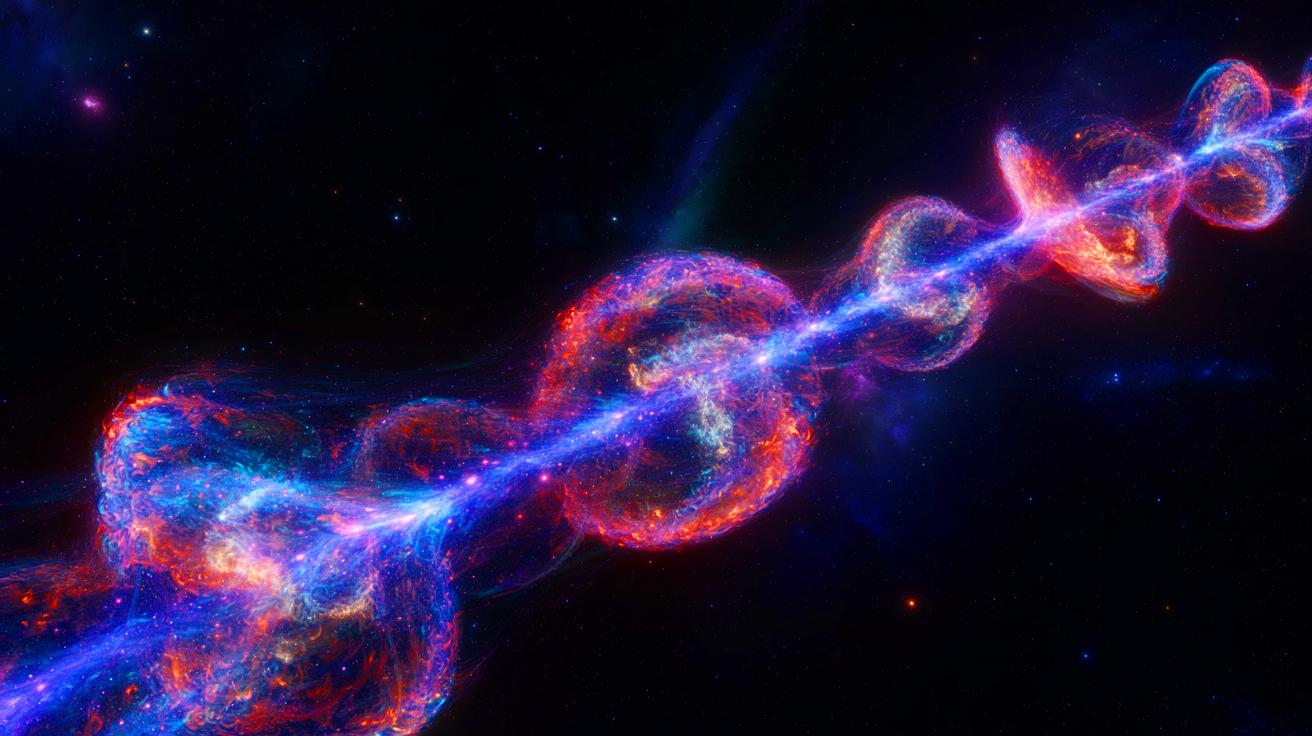
In the grand tapestry of the cosmos, astronomers have made a groundbreaking discovery that could reshape our understanding of the universe. A colossal tendril of hot gas, spanning an astonishing 23 million light-years and connecting four galaxy clusters, has been identified. This structure, with a mass ten times that of the Milky Way, holds much of the universe’s elusive “missing matter.” Unlike dark matter, this missing matter consists of baryons, the ordinary atoms forming stars, planets, and even our bodies. This revelation supports long-held cosmological models and offers profound insights into the Cosmic Web, the vast network that underpins the universe.
Unveiling the Missing Matter
For decades, scientists have been puzzled by the absence of a significant portion of the universe’s baryonic matter. While the existence of dark matter remains an enigma, this missing matter pertains to the ordinary atoms that constitute the visible universe. Models of the universe have suggested that a third of this baryonic matter was unaccounted for. The recent discovery of a massive filament of hot gas linking galaxy clusters suggests that these models were accurate, and the missing matter is indeed hidden within these vast cosmic structures.
The filaments stretch between dense regions of the universe, forming a part of the Cosmic Web. This network is believed to have guided the formation of galaxies and other cosmic structures over billions of years. The detection of this specific filament was enabled by advanced X-ray telescopes, which could identify and analyze the faint emissions from these gaseous threads. This discovery not only affirms our existing cosmological theories but also enhances our understanding of the universe’s intricate architecture.
The Role of Advanced Telescopes
Identifying these elusive filaments required the sophisticated capabilities of telescopes like XMM-Newton and Suzaku. Suzaku, operated by the Japan Aerospace Exploration Agency, effectively mapped X-ray emissions over large cosmic regions, while the European Space Agency’s XMM-Newton provided detailed analyses of specific X-ray points. Together, these telescopes formed a powerful observational duo, enabling astronomers to filter out light from other cosmic sources and focus exclusively on the filament’s emissions.
Through this approach, researchers could accurately determine the filament’s properties, including its staggering temperature of 18 million degrees Fahrenheit. Such precise measurements underscore the importance of international collaboration and technological innovation in astronomy. By combining data from multiple sources, the research team could present a comprehensive picture of this cosmic phenomenon, bolstering the validity of our current cosmological models.
Implications for Cosmic Understanding
This discovery has far-reaching implications for our understanding of the universe. By revealing a significant portion of the universe’s missing baryonic matter, astronomers have not only solved a longstanding mystery but also opened new avenues for research into the Cosmic Web. These filaments, acting as cosmic scaffolds, play a crucial role in the formation and evolution of galaxies and other large-scale structures.
Understanding these filaments could provide deeper insights into the universe’s composition and the forces shaping its evolution. As more such structures are identified and studied, scientists can refine their models and simulations, leading to a more nuanced understanding of cosmic dynamics. This discovery represents a significant milestone in our quest to unravel the mysteries of the cosmos and underscores the potential for future breakthroughs in this field.
Future Directions in Cosmic Exploration
The revelation of this filament highlights the importance of continued exploration and technological advancement in astronomy. As new telescopes and observational techniques are developed, astronomers will be better equipped to probe the universe’s deepest secrets. The ongoing study of cosmic filaments and their role in the Cosmic Web will remain a focal point of astronomical research, with the potential to revolutionize our understanding of the universe.
Future missions may focus on identifying additional filaments and mapping the Cosmic Web in greater detail. By doing so, scientists hope to uncover new insights into the formation and evolution of the universe. This research could pave the way for a deeper understanding of the fundamental forces at play in the cosmos and the intricate structures that arise from them. As we continue to explore the universe, what other hidden wonders might we uncover?



Wow, what a discovery! Does this mean we’ll need to rewrite some parts of our physics textbooks? 🤯
Are there any practical implications of finding this missing matter?
Could this discovery affect our understanding of dark energy too?
Isn’t it fascinating how much of the universe we still don’t know? This is just the beginning! 🌟
The Cosmic Web sounds like something out of a sci-fi movie. Can’t wait to learn more!
How does this discovery align with or challenge existing cosmological models?
23 million light-years? That’s incomprehensible! 😮
Thanks for the detailed breakdown. I’ve always been curious about the Cosmic Web.
So, baryons are basically ordinary atoms? I thought we were still looking for dark matter!
What are the next steps in studying these cosmic filaments?
Amazing article! Thanks for breaking down such a complex topic into digestible information. 🚀
This is a landmark moment in astronomy. Can’t wait to see what they find next!
I wonder how this discovery impacts the search for extraterrestrial life.
23 million light-years of hot gas? That’s hotter than my ex’s temper! 😂
Why has it taken us so long to find this missing matter? Is it really that elusive?
Can’t believe how much we’re still uncovering about the universe. Truly awe-inspiring!
What role did international collaboration play in this discovery?
Do you think this will inspire more funding for space research?
How do these findings affect the concept of the universe’s expansion?
Is there a possibility that other forms of “missing matter” still exist out there?
Who knew the universe could be so sneaky, hiding all that matter in plain sight! 😜
How does this discovery help us understand the formation of galaxies?
Can this new understanding of the Cosmic Web help us trace the universe’s history?
So this is different from dark matter, right? Can someone explain the key differences?
This is mind-boggling! But how certain are we that this is the “missing matter” we’ve been looking for?
Great article, but the real question is: how do they measure something 23 million light-years long?
I’m skeptical—how can we be sure this isn’t just a theoretical construct? 🤔
What an extraordinary find! Kudos to the astronomers involved. 🌌
Can we expect more discoveries like this with the new telescopes being developed?
Reading this article was like taking a crash course in cosmology. Thank you!