




| IN A NUTSHELL |
|
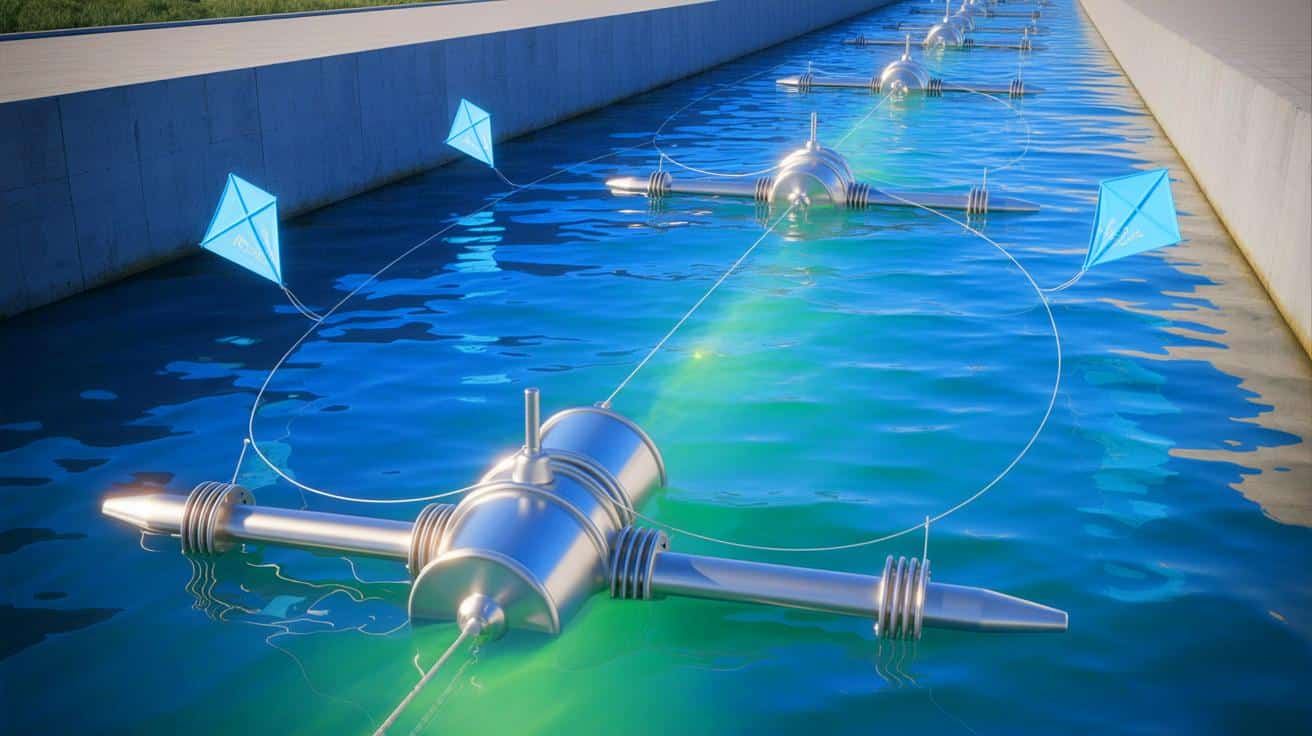
In an innovative leap toward sustainable energy, a German research team has unveiled a groundbreaking tidal power plant prototype, employing technology typically reserved for ski lifts. Developed by Anton and Peter Glasl of enrope GmbH, this new system utilizes small kites tethered to a cable, driven by water currents to generate power. Partnering with the Munich University of Applied Sciences and the Technical University of Munich, the team successfully tested their creation in the Isar Canal. This project, named cableKites, marks a significant step in renewable energy, combining creativity with technical prowess to harness the untapped potential of tidal forces.
The Power of Underwater Ski Lifts
The cableKites system ingeniously repurposes the mechanics of ski lifts for underwater electricity generation. In this setup, pulleys at both ends guide a looped cable, with water-driven foils—akin to ski lift T-bars—attached to it. As water currents push against these kites, their movement propels the cable, which in turn powers generators located at the pulleys. This innovative approach flips the script on traditional ski lifts. Instead of the pulleys driving the cable, the water current powers the cable, which then generates electricity.
The design was developed by the Glasl brothers, who leveraged their expertise in ski lift manufacturing to create a novel energy solution. The kites, designed for stability and efficiency, are cost-effective to produce. Robert Meier-Staude, a fluid mechanics specialist, emphasized the system’s stability and energy conversion efficiency. This unique application of ski lift technology to underwater environments highlights the potential for creative engineering solutions in renewable energy development.
“They’re Stealing Sunlight In The Arctic”: Company Builds Impossible Solar Farm Where Sun Disappears
Testing the Waters
The research team recently conducted real-world tests of the prototype in the Middle Isar Canal, near Landshut, Germany. The device, weighing approximately 220 pounds and measuring 59 feet in length, was carefully lowered into the canal using a crane. The tests demonstrated the kites’ ability to maintain stable alignment in the water current, achieving speeds of up to 4.9 feet per second. This stability is crucial for the system’s effectiveness in generating power.
In describing the kite’s motion, Meier-Staude noted that they “fly” through the water, exploiting the medium’s density. Water’s density allows the underwater kites to be significantly smaller than their airborne counterparts while producing equivalent energy. The successful test marked a major milestone in proving the technical feasibility of this tidal power plant concept, paving the way for larger-scale implementations in the future.
Potential Impact and Future Plans
The cableKites project represents a promising advancement in Europe’s energy transition efforts. The European Green Deal outlines ambitious plans for renewable energy development, including the installation of tidal power plants capable of generating 40 gigawatt-hours annually by 2050. This innovative technology could play a crucial role in achieving these goals, offering a sustainable alternative to traditional energy sources.
While the prototype’s kites measured just 39 inches long and 7.8 inches wide, full-scale implementations would feature kites five times larger. This scalability is essential for the widespread adoption of tidal power plants, which could significantly reduce Europe’s carbon footprint and reliance on fossil fuels. The project’s success underscores the importance of interdisciplinary collaboration in addressing global energy challenges.
Challenges and Opportunities Ahead
Despite the promising results of the cableKites prototype, several challenges remain before large-scale deployment can occur. The team must address issues related to the durability and maintenance of the underwater systems, particularly in harsh marine environments. Additionally, the economic viability of scaling up production and installation needs further exploration to ensure cost-effectiveness.
Nevertheless, the potential benefits of this technology are immense. By harnessing the power of ocean currents, tidal power plants could provide a consistent and reliable source of renewable energy. As the world seeks to reduce greenhouse gas emissions and transition to sustainable energy solutions, the cableKites project offers a glimpse into a future where our oceans play a vital role in powering our communities. How will this innovative technology shape the landscape of renewable energy in the coming decades?


This sounds like a game-changer for renewable energy! How soon can we expect to see these tidal power plants in action? 🌊
Wow, underwater ski lifts? That’s a wild concept! 🏂🌊
How does the system hold up against strong ocean currents?
Wait, underwater ski lifts? Sounds like something out of a sci-fi movie! 😂
I’m curious about the durability of these kites. Can they withstand harsh marine environments?
This is a really creative idea! Thanks for sharing. 😊
Impressive! But how does this system handle the varying speeds and directions of ocean currents?
Are there any environmental concerns with this technology?
Sounds amazing! When can we expect to see this in action on a larger scale?
Brilliant innovation! Thank you to the German researchers for pushing the boundaries of what’s possible. 👏
Will this technology be cost-effective compared to other renewable energy sources?
I’m skeptical. What about the environmental impact on marine life? Have they considered that?
The idea of using ski lift mechanics underwater is mind-blowing. Great innovation! 💡
Can this system be used in all types of water bodies, or are there specific conditions needed?
How does the energy output compare to traditional wind or solar power systems?
How does this compare in efficiency to traditional tidal power plants?