


| IN A NUTSHELL |
|
The recent completion of the central solenoid for the ITER project marks a significant achievement in the field of nuclear fusion. This accomplishment is a testament to international collaboration, aiming to create a sustainable and virtually limitless energy source. As nations invest in this groundbreaking technology, the potential for a future powered by clean energy becomes increasingly tangible. With the central solenoid complete, the project moves closer to its goal of producing energy through nuclear fusion, a process that could revolutionize global energy systems.
Understanding the Role of the Central Solenoid
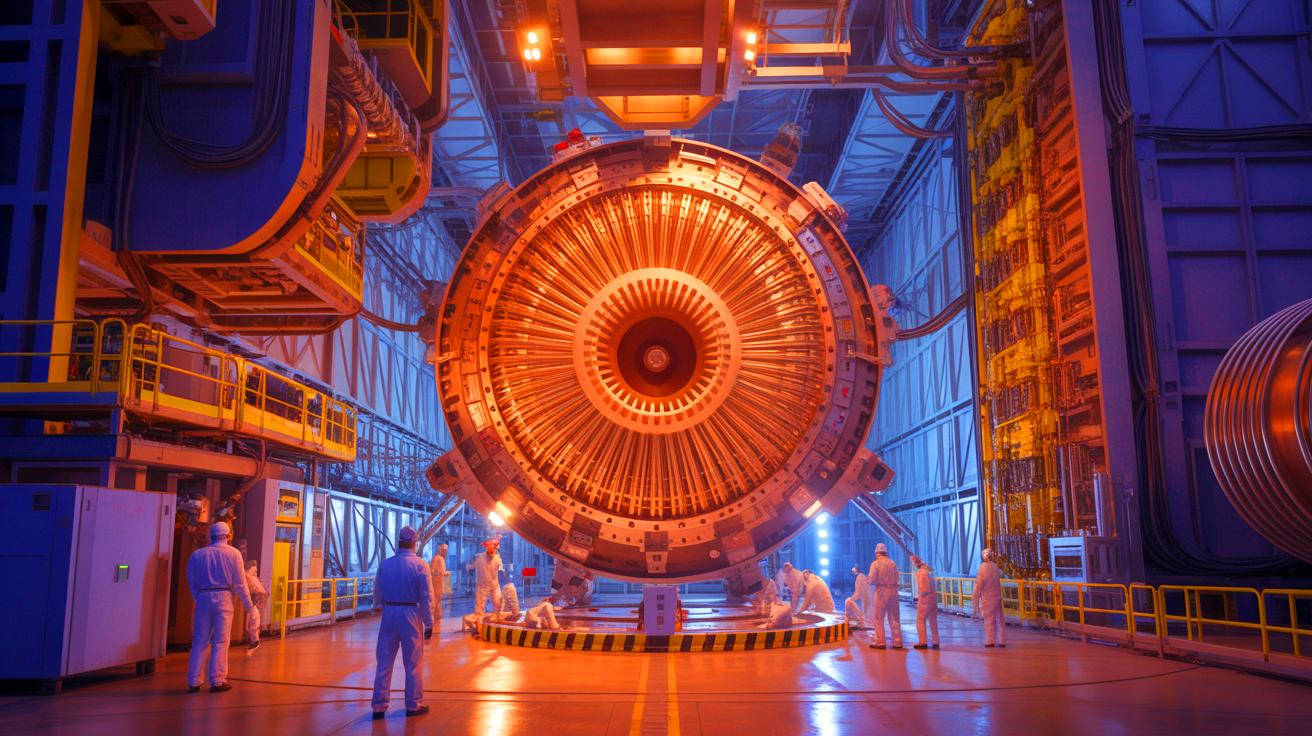
The central solenoid is the core component of the ITER Tokamak reactor, crucial for sustaining the nuclear fusion reaction. This superconducting magnet is designed to generate and maintain a superheated plasma core. The plasma, composed of ionized hydrogen gas, must reach temperatures of around 150 million degrees Celsius, which is significantly hotter than the sun’s core. At these temperatures, atomic nuclei can fuse, releasing vast amounts of energy.
Standing at 42.6 feet tall and weighing nearly 3,000 tons, the solenoid is an engineering marvel. It collaborates with other magnetic systems to form a magnetic cage, necessary for confining and controlling the plasma. The solenoid is engineered to withstand forces equivalent to 13.5 million pounds, highlighting its strength and importance in achieving a successful fusion reaction. This infrastructure is a critical step towards demonstrating the feasibility of nuclear fusion as a practical energy source.
The Significance of a Magnet That Can Levitate an Aircraft Carrier
The central solenoid’s power, equivalent to levitating an aircraft carrier, is essential for the operation of the ITER reactor. The extreme temperatures within the reactor prevent the use of physical containers to hold the plasma. Instead, magnetic fields are employed to suspend the plasma, preventing it from coming into contact with the reactor walls. The solenoid provides the necessary magnetic force to suspend the plasma for several minutes, facilitating the fusion reaction.
This capability is not just a testament to the solenoid’s power but also its necessity in achieving nuclear fusion. With its magnetic energy capacity of 6.4 gigajoules, the solenoid enables ITER to produce 500 megawatts of power from just 50 megawatts of input, illustrating the efficiency and potential of fusion energy. This development is a promising step toward a future where clean and abundant energy is accessible to all.
International Collaboration and Its Impact
The ITER project is a shining example of international collaboration, with Europe covering 45% of the costs and six other countries contributing 9% each. This cooperation highlights the collective effort to address global energy needs and combat climate change. By setting aside political differences, participating nations demonstrate the power of unity in overcoming complex challenges.
Pietro Barabaschi, ITER’s Director-General, underscores the project’s success as reliant on its technical complexity and international partnership. Despite geopolitical tensions, this collaboration remains robust, showcasing humanity’s ability to unite for a common cause. As ITER progresses, it serves as a beacon of hope for what can be achieved through global cooperation.
Challenges Ahead and the Road to Completion
Despite its achievements, ITER faces several challenges before becoming fully operational. Initially started in 2007, the project is now aiming for its first operation by 2035. This timeline reflects the intricacy of the project, requiring meticulous engineering and coordination across international borders.
The ongoing assembly must integrate complex systems while adhering to stringent safety standards. Nonetheless, the progress made thus far instills confidence that the ultimate goal is within reach. Successful operation of the ITER reactor could herald a new era in energy production, with far-reaching impacts on industries and societies worldwide.
The completion of the central solenoid is a pivotal milestone in the quest for harnessing fusion energy. As ITER continues to advance, it exemplifies the potential of human innovation and cooperation. Will this fusion breakthrough lead to a transformative energy future, reshaping how we power our world and explore the universe?

Wow, this sounds like sci-fi! Can it really levitate an aircraft carrier? 🚢
Why isn’t this more widely reported in mainstream media?
What’s the environmental impact of building such a complex system?
Do you think geopolitical tensions might affect this collaboration? 🤔
Is there any chance of this technology being weaponized? 😬
Such an informative read! Thanks for keeping us updated.
Will the energy produced be affordable for everyone?
Thank you for the detailed explanation. Fusion energy is indeed promising!
Can someone explain how this is different from nuclear fission?
I can’t wait for the day when we have clean, limitless energy! 🌟
How do they plan to maintain the reactor once it’s operational?
Isn’t there a risk of accidents like in regular nuclear plants?
This is incredible progress, but I’m concerned about future funding.
When’s the next major milestone expected for the ITER project?
Love the optimism, but what are the odds of meeting the 2035 target?
Is fusion energy going to be sustainable in the long run?
Why does it take so long to get the reactor operational?
Could this technology eventually replace fossil fuels entirely?
Does the article mention anything about the cost of this project? 💸
I’m curious, how long will the central solenoid last before needing replacement?
Let’s just hope this doesn’t end up being another scientific flop.
2035 seems so far away. Are there any plans to accelerate the timeline?
Thanks for the article. It’s exciting to see such international cooperation.
Are there any potential downsides to using fusion energy?
Why is fusion energy considered safer than other forms of nuclear power?
The engineering behind this is just mind-blowing! ⚙️
What role does the U.S. play in the ITER project?
Is it true that fusion energy has no radioactive waste? 🤔
Hope this tech doesn’t fall into the wrong hands. 😟
It’s amazing what international collaboration can achieve. Hope it continues! 🌍
So, when can we expect fusion-powered cars? 😄
With the world facing an energy crisis, this couldn’t come at a better time.
Does anyone else find the idea of a magnet that powerful terrifying? 🤯
Great article, but can you explain how the central solenoid is cooled?
If this works, will it solve all our energy problems?
How does this compare to other fusion projects like SPARC?
As exciting as this sounds, I’ll believe it when I see it working.