



| IN A NUTSHELL |
|
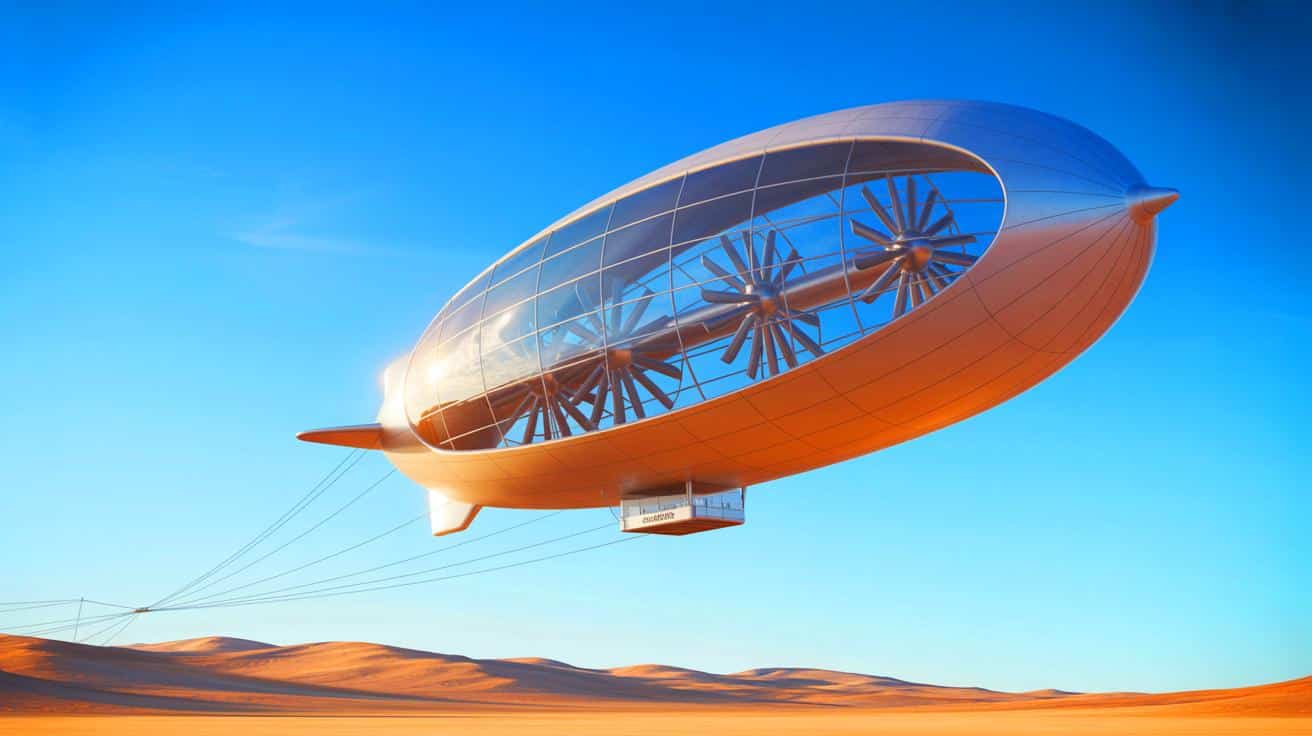
The successful maiden flight of China’s S1500, a revolutionary airborne wind turbine, marks a significant step forward in renewable energy technology. This innovative system, resembling a giant Zeppelin, harnesses the power of high-altitude jet stream winds. Unlike traditional wind turbines, which require extensive infrastructure, the S1500 floats in the sky, reducing material use and costs. Developed by Beijing SAWES Energy Technology Co., Ltd., with support from Tsinghua University and the Aerospace Information Research Institute, this megawatt-scale system promises to transform energy generation. Its ability to be quickly deployed in diverse environments, from deserts to islands, highlights its potential for widespread application.
Harnessing High-Altitude Winds
The S1500’s design capitalizes on the vast, untapped resource of high-altitude winds. These winds, found at altitudes between 1,640 and 3,281 feet, are significantly stronger and more consistent than those at ground level. This makes them an ideal source for generating renewable energy. The physics behind wind power is compelling: as wind speed increases, the energy it carries grows exponentially. For example, a doubling of wind speed results in an eightfold increase in energy. This principle underscores the potential of high-altitude wind turbines to outstrip the power generation capabilities of traditional land-based systems.
Beyond energy generation, the S1500 offers additional benefits. Its quick deployment capability makes it a versatile tool for disaster response. In the aftermath of earthquakes or floods, the airborne turbine can be rapidly deployed to provide essential power to lights, radios, and other emergency equipment. This adaptability highlights the S1500’s potential as a critical resource in both energy generation and emergency management.
Technological Advancements and Milestones
The development of the S1500 builds on a series of technological advancements and milestones. Prior prototypes, such as the S500 and S1000, laid the groundwork for this megawatt-scale system. The S500, a helium-filled blimp, reached an altitude of approximately 1,640 feet, generating over 50 kW of power. Three months later, the S1000 climbed to about 3,281 feet, doubling power output to 100 kW. These incremental achievements validated the concept of high-altitude energy harvesting, culminating in the S1500's successful deployment.
The S1500 features a unique design, comprising a main airfoil and an annular wing that form a giant duct. Within this duct, 12 turbine-generator sets capture and convert high-altitude winds into electricity. The power is then transmitted to the ground via a tether cable. This innovative approach reduces the need for towers or deep foundations, cutting material use by 40 percent and lowering electricity costs by 30 percent.
National Support and Future Prospects
China's commitment to airborne wind power is evident in its national action plan. Issued by the National Development and Reform Commission, this plan outlines research and development priorities for large-scale high-altitude wind-power generators from 2016 to 2030. The S1500 represents a culmination of these efforts, showcasing China's readiness to harness one of the last major untapped sources of renewable energy.
The potential impact of airborne wind turbines extends beyond national borders. With winds in the sky carrying several times the energy of ground-level winds, these systems could play a pivotal role in the global transition to renewable energy. Their ability to access remote or difficult-to-reach areas, coupled with their mobility, positions them as a valuable asset in the pursuit of sustainable energy solutions.
Challenges and Opportunities
While the S1500's innovative design and successful deployment represent a breakthrough, challenges remain. The stability of the airborne platform in extreme weather conditions, as well as the durability of its components, will be critical factors in its long-term viability. Additionally, regulatory frameworks and safety standards must evolve to accommodate this new technology.
Despite these challenges, the opportunities presented by the S1500 are significant. Its capacity to generate renewable energy in a variety of environments, combined with its rapid deployment capabilities, make it a promising solution for both energy production and disaster response. As the global demand for clean energy continues to rise, the S1500 and similar technologies could play a crucial role in meeting this need.
The S1500 exemplifies the potential of innovative technologies to reshape the energy landscape. As airborne wind power systems continue to evolve, their impact on renewable energy generation is poised to grow. What additional advancements could further enhance the capabilities of airborne wind turbines in the future?

This sounds amazing! But how will they ensure the tether doesn’t get tangled or break during bad weather? ⛈️
Wow, this airborne turbine is literally taking renewable energy to new heights! 😄
How do they keep the S1500 stable during storms? 🌪️
Wow, I never thought I’d see flying power plants in my lifetime. The future is here! 🚀
China’s leap into airborne turbines is impressive! What are the environmental impacts though?
Is the S1500 controlled remotely, or does it have an autonomous system for flight? 🤔
Does this mean we’ll see less of those giant wind farms on land? They’re such an eyesore.
Thank you for shining a light on this innovative tech! 🚀
What happens if one of these turbines crashes? Safety concerns, anyone?
Thank you for sharing this groundbreaking info! It’s incredible what technology can achieve.
Can these flying turbines be used in urban areas or only in remote locations?
Great read! But how is the electricity transmitted back to the ground?
Wait, so it’s like a giant flying kite? 😂 Seriously though, how stable is this thing in the sky?
Does this mean we might see flying wind farms in the future?! 🌬️
So cool! But what about the noise? Does it disturb nearby wildlife?
This seems too good to be true. What’s the catch?
China is really leading the way in renewable energy. Kudos! 👏
The 40% reduction in material use is impressive. How does it affect durability?
I hope they have a plan for maintenance up there. 🤨
Could this tech be adapted for use on other planets? 🚀
Interesting read! How does the cost compare to traditional wind turbines?
What is the expected lifespan of these turbines in the air?
Are there any partnerships with international companies for this tech?
Has the S1500 been tested in different climate conditions?
Does this mean fewer wind farms on the ground? 🤔
What a great way to utilize high-altitude winds! 🌎
Can’t wait to see one of these in action. Any videos available?
What happens if it collides with a plane? Safety first!
Thnks for the info! Renewable energy is the future!
Are there any plans to expand this technology to other countries?
How do they keep the tether cable from snapping? Must be pretty strong!
Will this tech help reduce carbon emissions significantly?
Is the S1500’s energy output consistent throughout the year?
Hats off to the engineers who made this possible! 🎓
When are we going to see these in action in the US?
Great article! But what about the regulatory hurdles?